Get Full Government Meeting Transcripts, Videos, & Alerts Forever!
Get email alerts on the Parks Recreation Capital Facilities topic
No spam. Unsubscribe anytime.
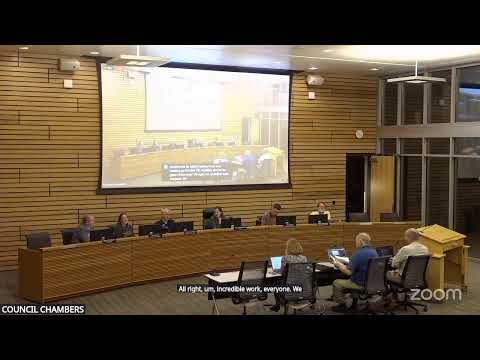
Kenmore Planning Commission advances PROS element, schedules public hearing after debate over project list and trails
Summary
The Kenmore Planning Commission reviewed the Parks, Recreation and Open Space (PROS) element and capital facilities project list, debated project detail, costs and trail impacts, removed several wetland tributary items from the draft CFP, and agreed to hold a public hearing on Oct. 7.
The Kenmore Planning Commission on Sept. 23 reviewed a draft Parks, Recreation and Open Space (PROS) element and its companion Capital Facilities Plan (CFP) project list, debated the scope and cost assumptions for parks and trails, and directed staff to prepare the chapter for a public hearing Oct. 7. Commissioners raised concerns about the level of detail and potential environmental effects of trails through wetlands and asked staff to remove several tributary corridor items pending further study.
The discussion centered on whether the CFP should present an unconstrained “menu” of projects or a prioritized, finance-ready program. Todd Hall, principal planner, told commissioners the project list and cost estimates are in 2025 dollars and intended to support grant applications and future budgeting: “These cost estimates include not only construction of all the improvements … they also include the design, the permitting, the engineering, and the contingencies.”
Commissioners questioned specific line items, cost precision and environmental impacts. Commissioner Vanderlyn called the draft an “unrestrained list” and warned the public and council could interpret items as commitments. Commissioner LaSalle argued the commission had not always discussed park-level details sufficiently and urged either removing items now or deciding priorities after the public survey and the full PROS plan. Vice Chair Thompson pressed for clearer cost realism on large items such as a proposed SR 522 overpass, and Tom Beckwith, consultant, clarified that some CFP entries are feasibility studies, not final construction estimates: “This is just a feasibility assessment.”
On project content, commissioners and staff discussed dozens of proposed projects that appear in the draft: a set of planning studies (example: a Swamp Creek wetland conservation/public access plan, estimated at $75,000), streetscape and urban parklets on 180th Avenue, pocket/mini parks in park-gap neighborhoods, improvements at Lake Pointe (King County allocation noted), potential synthetic turf conversions at athletic fields, upgrades to the City Hall site for an inclusive playground, and larger regional facilities such as a recreation center (18,000 sq ft) and a cultural center (28,000 sq ft). Staff said development-level costs on the draft add to roughly $50 million for parks and about $40 million for acquisitions over a 20-year horizon, with trails estimated around $4.5 million. Staff also said an appendix will present financing options and a voter survey to test community priorities and ability to pay.
Environmental sensitivity and trails drew sustained attention. Commissioners asked that trail locations and surface types be treated as conceptual and refined through feasibility work; staff said the draft includes conceptual route graphics and that final trail alignment would avoid critical habitat. Commissioners asked staff to remove or table three corridor items from the CFP for further study: the Tributary 62 spur, an Arrowhead Creek spur, and a Little Swamp Creek public access entry; the commission also agreed to remove the Public Works yard entry from the parks CFP because it is already in the city facilities list.
The commission did not adopt spending commitments at the meeting. Instead members approved proceeding to a public hearing on the PROS element and CFP at the commission’s Oct. 7 meeting, asking staff to incorporate clarifying language about feasibility, to round or label cost estimates as “planning-level/ROM (rough order of magnitude) in 2025 dollars,” and to preserve consistency between the chapter text, park sheets and the CFP table.
Commissioners asked staff to provide more accessible exhibits ahead of the public hearing (updated trail graphics, a clearer explanation of funding sources such as park impact fees, conservation futures and possible King County contributions, and the methodology used to derive costs) and to include the financial appendix referenced in the draft PROS plan. Todd Hall said the full PROS plan and its appendix will show funding assumptions, revenue projections and how priorities could be phased.
The commission scheduled the Oct. 7 public hearing to allow time for public comment and for commissioners to consider survey results and any edits to the CFP and PROS plan before forwarding a recommendation to the city council. Staff said meeting the city’s timeline for grants and plan-adoption reviews will require that the commission finalize the element this fall.
The commission’s review combined policy-level decisions (goals and level-of-service methodology), programmatic direction (items to be removed or tabled for further study) and scheduling (public hearing date). No final appropriation or construction authorization was made at the Sept. 23 meeting.