Get Full Government Meeting Transcripts, Videos, & Alerts Forever!
Get email alerts on the Engagement Center Relocation topic
No spam. Unsubscribe anytime.
Fargo officials weigh three relocation options for downtown engagement center amid neighbor concerns
Summary
City and partner agencies presented three potential sites for relocating the Downtown Engagement Center, drawing praise for services and questions about safety, transit access and process from neighborhood residents; no commission vote has been taken.
City staff and partner agencies presented three potential relocation sites for Fargo’s Downtown Engagement Center at a neighborhood meeting where residents raised safety, transit and transparency concerns and providers outlined why the center needs a new, single-floor home.
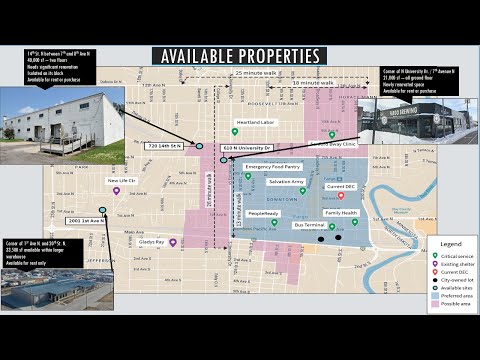
Brenda Derek, assistant administrator for the City of Fargo, opened the meeting by saying the commission has “made a commitment to move the engagement center out of where it presently sits” and identified three candidate properties under review: 610 North University, 720 14th Street North and 2001 First Avenue North.
The center’s partner agencies told the meeting they serve people experiencing homelessness with low-barrier services — showers, lockers, laundry, hygiene items, care coordination and connections to housing, mental-health and substance-use treatment — and that the current downtown building is hard to operate because services are split across three floors. "The engagement center plays a vital role in the lives of people who are unhoused because it provides immediate access, low barrier access, to a number of different resources," said Jan Elias, who described harm-reduction outreach and public-health partnership work with the center.
Why it matters: Providers and users said a single-level, roughly 20,000-square-foot site would let multiple partners work onsite at once and improve client access, safety and continuity of care. Beth Olson of Presentation Partners in Housing said a colocated housing-navigation presence helps people complete applications and accept housing offers: "We need them to still be alive by the time that we can find them a landlord," she said.
What officials presented: City staff said Bloomberg Associates — a philanthropic advisory group that has provided pro bono planning input — helped identify site criteria that prioritized walkability to downtown amenities, quick renovation feasibility, one-level floor plans and transit access. Staff said available buildings that match the footprint they want are scarce and that the three properties were the current viable options. They said the commission "started the process" to consider alternate locations and that no commission vote has occurred.
Community concerns: Dozens of residents questioned selecting sites outside the core downtown area, asked how the move would affect neighborhood safety and property values, and pressed for more public documentation of consultants’ work. Christopher Cohen, a Fargo resident, said on the process and site choice: "I think this is a form of discrimination to kick them out of downtown." A nearby day-care operator asked specifically how the city would "guarantee the safety of, like, children in that area" if a center moved into a residential block.
Providers’ response to safety concerns: Center partners said they cannot "guarantee anybody's safety anywhere," but argued the center’s presence allows staff to respond quickly to problems and to provide outreach that reduces street incidents. Kim Seeb of Family Health Care’s Homeless Health Services noted operational benefits: "When we say to someone, are you ready for treatment today? We can walk them to talk to someone about that." Jan and other partners said the current site’s layout — multiple floors and limited sight lines — makes it harder to supervise outdoor spillover and to provide integrated services.
Access and transit: Transit access was a repeated concern. City staff said 610 North University and 720 14th Street North are near routes on University Avenue, while 2001 First Avenue North has a route just north of it; 720 may require a short walk to the nearest stop. Providers and residents noted higher bus fares and winter walking conditions pose barriers for clients who rely on transit or mobility aids.
Operations, capacity and services: Partners said the current center serves roughly 90 people per weekday and that related clinics and programs connected to the center see about 1,200 different patients annually. The center currently operates Monday through Friday; staff said weekend services are desired but not funded at present. Providers noted specific program needs that motivate relocation: on-site counseling groups, housing navigation offices, expanded lockers and indoor space for partners to meet clients.
Funding and timeline: Staff said the city pursued legislative funding earlier in the year but did not secure the larger appropriation requested. The group reported some state and county support for staffing and said private donors have expressed interest; they also said an operational demonstration in a new facility could support future legislative funding requests. City staff indicated the commission must still vote on relocation and that timing will depend on that political decision and funding; one city official suggested a target of having a new site ready by November if steps proceed quickly, but emphasized the schedule is contingent on commission direction and available financing.
Process and transparency questions: Residents asked for written reports from Bloomberg Associates and details about acquisition costs; one attendee said an open-records request returned no consultant report. City staff replied that Bloomberg’s assistance was pro bono and that staff are continuing due diligence on renovation estimates, acquisition status and potential private donations.
Next steps: Staff will deliver the neighborhood input to the City Commission; no formal vote has been taken. City staff said they will visit the three properties further, refine cost estimates and discuss next steps with the commission. Meeting organizers provided QR codes and a sign-up sheet for further public input.
Ending: The meeting closed with a mix of support for the center’s services and continuing neighborhood concern about siting, transit and safety. City staff and partners said they will continue outreach and return findings to the commission before any formal relocation decision is made.