Get Full Government Meeting Transcripts, Videos, & Alerts Forever!
Get email alerts on the Judicial Howell Appeal topic
No spam. Unsubscribe anytime.
Tennessee appellate panel hears challenge to hearsay, prior-act evidence and sentence in Howell case
Summary
An appellate panel heard arguments in the appeal of David Robert Howell on claims that the trial court erred in admitting witness statements and prior-act evidence and in imposing sentence.
An appellate panel heard arguments in the appeal of David Robert Howell on claims that the trial court erred in admitting witness statements and prior-act evidence and in imposing sentence.
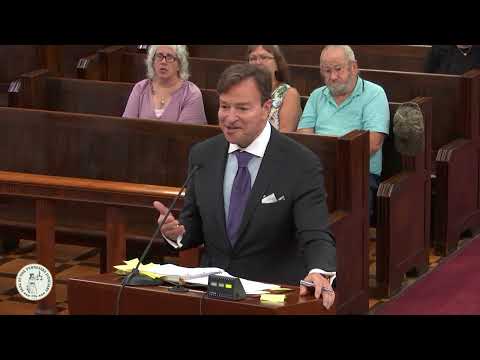
Defense counsel Gregory Isaacs told the court that Howell’s conviction and sentence should be reversed because the trial judge improperly admitted an out-of-court statement under the excited-utterance exception to the hearsay rule, allowed the prosecutor to characterize routine proof as evidence of “grooming” without the required 404(b) process, and imposed an excessive sentence after improperly weighing enhancement factors.
Isaacs summarized the underlying facts as presented at trial: on Aug. 5 a teenage girl identified by initials SC and a friend identified as JR were staying at the home of Howell and Laura Howe; both girls ran from a bedroom after an alleged incident in which SC said Howell touched her. Isaacs stressed that JR’s initial out-of-court remark to others — the statement the state introduced as an excited utterance — was later disavowed at trial, and he argued the record showed only that JR was “shaking” and “mumbling,” which, he said, did not meet the applicable excited-utterance standard.
Isaacs further argued that the prosecution, particularly in closing, assembled harmless-seeming items of proof (texts, occasional shared bed, caregiver role) into a narrative of long-term grooming without first seeking a 404(b) hearing to present prior-bad-act evidence and allow a judicial balancing under the rules of evidence. He urged that the failure to hold a hearing or otherwise preserve the issue warranted appellate relief under plain-error review.
Ronald Coleman, who argued for the State, responded that the trial court properly admitted the out-of-court remark as an excited utterance and that any error would have been harmless because JR later testified at trial and the testimony clarified the earlier remark. Coleman also said the items cited by the defense were not prior bad acts subject to 404(b) and therefore a 404(b) hearing was not required; he argued the defense had waived or failed to preserve several of the evidentiary complaints and that plain-error relief was not warranted.
On sentencing, counsel for Howell challenged the trial court’s application of enhancement factors and the denial of probation. The transcript shows the trial judge (Judge Sword at the trial level) granted a motion for judgment of acquittal on at least one count and granted acquittal on two related counts, but found other counts to merge and imposed a four-year sentence on the merged counts, then denied probation. Isaacs argued the judge should have started at the bottom of the range post-Blakely and that the court improperly relied on assertions about prior conduct and the defendant’s claimed lack of amenability to rehabilitation.
The state defended the sentencing decision as within the trial court’s discretion, noting the court made detailed findings, cited a psychologist’s opinion about rehabilitation, and relied on factors such as deterrence and the presence of multiple victims when imposing consecutive time.
Panel members asked questions about the excited-utterance analysis, what constitutes prior bad-act evidence under Tennessee practice, and how a defense would reasonably preserve an objection when the alleged “grooming” theory first appears in closing argument rather than in a more explicit pretrial notice. Judges identified in the argument as asking questions included a Judge Dyer and a Judge Eric (as reflected in the oral argument exchange).
No forensic evidence was discussed in the record described at argument; the state emphasized the convictions rested primarily on witness testimony. The attorneys told the court they were presenting rival positions on admissibility standards and the appropriate standard of review on appeal (plain-error review vs. preserved error). The panel did not announce a decision during the oral argument.
The appeal raises evidentiary and sentencing questions that could affect how Tennessee courts apply the excited-utterance exception, the scope of 404(b) process when the prosecution’s case theory evolves from admitted facts, and the role of appellate review in unpreserved claims of prosecutorial emphasis in closing argument.