Get Full Government Meeting Transcripts, Videos, & Alerts Forever!
Get email alerts on the Traffic Stops topic
No spam. Unsubscribe anytime.
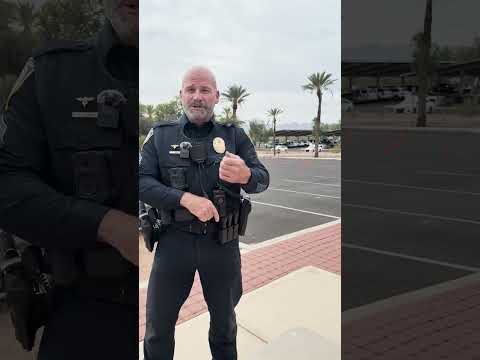
Sergeant Jerry Burns outlines drivers' duties during traffic stops in Lake Havasu
Summary
In a Traffic Tip Tuesday broadcast, Sergeant Jerry Burns explained what drivers must provide during traffic stops in Lake Havasu, when officers may order occupants out of a vehicle, how citation signing works, and that radar calibration challenges occur in court.
Sergeant Jerry Burns told Lake Havasu listeners on Traffic Tip Tuesday that drivers must produce a driver's license, vehicle registration and proof of insurance during traffic stops and that digital copies are acceptable. "When I conduct an enforcement stop on a vehicle, I approach, I introduce myself, and I advise the reason for the stop and ask you for your driver's license, registration, and insurance," Burns said.
The guidance explains what officers may lawfully ask for and what drivers can expect during stops. Burns said a physical driver's license or a digital copy will satisfy identification; if a driver does not have a card with them they can provide their name and date of birth. "If you do not have your driver's license with you...you can provide your name and date of birth," he said. He added that officers will accept a digital copy of insurance and that a tag alone on the back of a vehicle does not substitute for a current registration card.
Burns cited court precedent that allows officers to order a driver or passenger out of a vehicle for officer safety, saying, "Case law under Pennsylvania v. Mims requires you to do so. This also applies to passengers under Maryland v. Wilson." He said officers may also request that occupants remain in the vehicle.
On citations, Burns explained the difference between civil and criminal citations. "If you do not sign the civil citation, we will just write refused on there, and then we will end our traffic stop with you. If it's a criminal citation, then you will be required to sign it," he said, adding that signing is not an admission of guilt but a promise to appear in court.
Burns also addressed radar evidence: "Under the law, we do not have to show you our radar in the state of Arizona. The place to do that or the arena to do that is in court where you can challenge the calibration or the accuracy of the radar."
He framed enforcement as a safety measure. "After working 26 years in this job, seeing a number of fatal collisions, serious injury collisions, that our purpose out there is to change the behavior of a lot of drivers," Burns said, adding, "Please drive courteously and obey the rules of the road."
This broadcast provided guidance only; it did not enact any policy, impose requirements beyond existing law, or result in formal actions by a governing body.