Get Full Government Meeting Transcripts, Videos, & Alerts Forever!
Get email alerts on the Education Assessment topic
No spam. Unsubscribe anytime.
Fremont City Schools rises to 3.5-star district rating; early-literacy rating falls to 2 stars
Summary
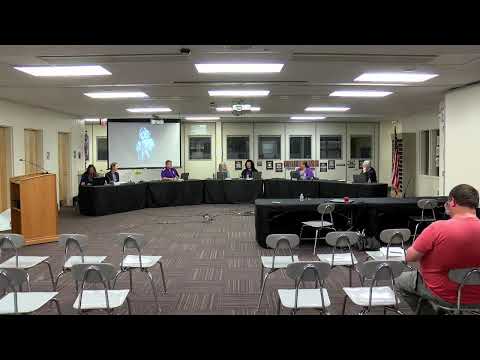
Assistant Superintendent Abby Abernathy presented the Ohio district report card to the Fremont City Schools Board of Education and said the district —scored 3.5 this year,— up from 3.0 last year, while the early-literacy component dropped from three stars to two.
Assistant Superintendent Abby Abernathy presented the Ohio district report card to the Fremont City Schools Board of Education at the work session, saying the district —scored 3.5 this year—, up from 3.0 last year. Abernathy said the district earned three to four stars in most content areas but that the early-literacy component fell to two stars.
Why it matters: the state report card aggregates multiple measures that the district and state use to assess student achievement, growth and readiness; early-literacy measures include third-grade proficiency on the Ohio State Tests, promotion to fourth grade and a multi-year measure of K' students who move from —off track— to —on track—. Those measures feed school- and district-level ratings and are a focal point for intervention planning.
Abernathy walked the board through the six report-card components: achievement and progress (combined they make up half of the score), gap closing, early literacy, graduation and college-and-career readiness. She said third-grade achievement and most tested grades showed the district performing at or above the state and similar-district averages.
On graduation, Abernathy reported a 94.2 percent four-year cohort graduation rate and said the five-year rate rose by about 3.5 percentage points. —Those both are up,— she said, crediting district supports that begin in earlier grades.
On early literacy, Abernathy said the district's early-literacy star rating dropped from three stars to two. She gave the following, district-provided figures during discussion: third-grade proficiency on the Ohio State Test (OST) fell from about 66 percent to about 58.9 percent; promotion to fourth grade declined from 100 percent to 97.9 percent; and the improving-K'1-literacy metric moved from 33.7 percent to 31.7 percent. Abernathy cautioned that several different submeasures feed the early-literacy score and said the district is examining each piece.
Board members pressed for context and comparisons. Abernathy said the Department of Education report includes comparable-district charts and she offered to produce a side-by-side comparison for the board. —I can look at those comparable districts and see where they—re at compared to where we—re at,— she said.
On causes and remedies, Abernathy emphasized that the district recently adopted a new K'5 ELA curriculum aligned with the state's science-of-reading guidance. She called the curriculum —very involved— for teachers and said the district expects it to support long-term gains. —This is a key component,— she said when asked whether the curriculum change is central to the early-literacy strategy.
She described school-level structures used to translate data into instruction: teacher-based teams (TBTs) that meet at a classroom level and building leadership teams (BLTs) that guide implementation. Abernathy said TBTs sometimes meet weekly during common planning times and that principals are adapting interventions, pacing guides and curriculum pacing to address low-performing standards.
Board members and the superintendent also discussed outside factors such as summer learning, family reading habits and instructional continuity. Abernathy declined to attribute early-literacy dips to any single outside factor, saying, —I don—t have any facts in front of me— to make that judgement.— She and board members noted that one advantage for ELA continuity is the state requirement that districts choose adopted materials responsive to the science-of-reading framework, which narrows variance across districts for that content area.
Discussion-only items included requests for more comparative charts and a deeper breakdown of which subgroups are driving gap-closing results. Abernathy said the district can identify individual students and cohorts for targeted interventions and will bring comparative district data to a future meeting.
For context, an earlier legislative report to the board raised statewide fiscal points: the board—s legislative speaker flagged a projection that roughly $1.7 billion in voucher-style funding could flow to private schools statewide over the next two years and said that shift could affect public-school funding streams, an item the board said it will monitor.
The district agreed to continue drilling into the report-card submeasures, monitor progress under the new ELA materials and provide a requested comparison to similar districts at a future board meeting.