
Tennessee Court Hears Appeal Over Juror Tie to Sheriff's Office and Voluntariness of Blankenship Confession
Get AI-powered insights, summaries, and transcripts
Subscribe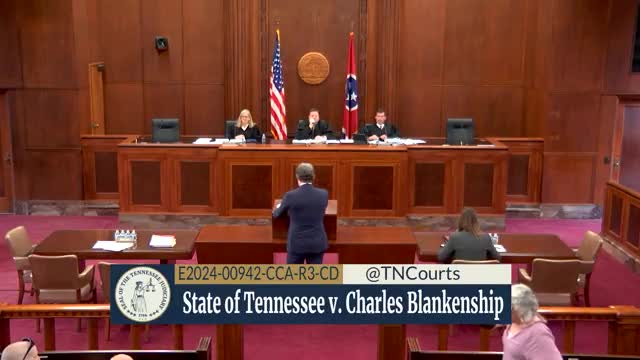
Summary
Charles Blankenship, convicted Feb. 16, 2023, of possession of methamphetamine greater than 300 grams and possession of a weapon as a convicted felon, urged an appellate panel to order a new trial or suppress his confession, arguing juror bias and that his statement to police was involuntary.
Charles Blankenship, convicted Feb. 16, 2023, of possession of methamphetamine greater than 300 grams and possession of a weapon as a convicted felon, urged an appellate panel to order a new trial or suppress his confession, arguing juror bias and that his statement to police was involuntary.
The appeal centers on two principal claims: that juror Nicholas Harrell failed to disclose a relationship to a law-enforcement supervisor who later supervised two of the state's witnesses, and that a statement Blankenship made to officers was induced by an implied promise that his son would not be charged. The issues, defense counsel Robert White told the court, undercut both the impartiality of the jury and the voluntariness of the defendant's admissions.
At oral argument White, attorney for the appellant, described the events leading to the prosecution. He said Monroe County deputies executed a search warrant at property where Blankenship lived and discovered methamphetamine and a firearm in barrels near a treeline. White told the court Blankenship's adult son, described at argument as having mental disabilities, fled toward the barrels and was not charged; Blankenship later told detectives he had possessed the items. White quoted part of the exchange he says occurred between a detective and Blankenship: "what do I have to do to make this go away?" and that the detective stated, in effect, "somebody's gonna have to ... go to jail for that," language White says created an implied promise that produced an involuntary statement.
Catherine Redding, arguing on behalf of the state, said the record does not support a presumption of bias from the juror's relationship. Redding summarized the timeline in the record: the offense occurred in November 2019 when the juror's father worked at the Madisonville Police Department (having served there since Feb. 2008). The father's employment moved to the Monroe County Sheriff's Office in July 2022, several months before trial in February 2023; he left that county position in March 2023. Redding argued the father was not involved in the investigation at the time of the offense and that the juror testified at the motion-for-new-trial hearing that he did not discuss the case with his father and did not have a personal relationship with the officers in the case. Redding told the panel the trial court credited Sergeant Martin's testimony over the defendant's and found no evidence the juror prejudiced the defendant.
Defense counsel pressed that the juror's silence during voir dire deprived the defense of the chance to exercise a challenge for cause or a peremptory strike. White said the voir-dire question asking whether prospective jurors had "any dealings with law enforcement not related to this case" should have prompted disclosure of the father's supervisory relationship. The state responded that the term "dealings" is commonly understood as transactional and that the juror's testimony at the post-trial hearing did not show prejudice or exposure of the jury to extraneous information.
On the suppression issue, Redding told the court the appellate record is incomplete: the trial judge reviewed a body-camera recording at the suppression hearing that the appellate record does not include in full. She said the unredacted recording and officer testimony supported the trial court's decision to deny suppression, and that the redacted recording in the record shows the interviewing officer repeatedly saying, "I can't make you any promises," and otherwise not overbearing the defendant. White countered that without the full recording on appeal the court cannot assess voluntariness and reiterated his argument that the detective's remarks created an implied promise at the outset of the interview and that Blankenship's initial question to the detective framed his later statements.
The state also addressed sufficiency of the evidence if the confession were excluded. Redding said officers testified the property contained numerous distinctive blue barrels and that the barrel holding the contraband was consistent with barrels next to the residence; she acknowledged the boundary between properties was not perfectly clear in the record and that knowledge of the contraband by Blankenship was a more difficult question if the confession were removed from evidence.
At the close of argument the attorneys told the panel they relied on their briefs for remaining issues and the court "submitted" the case for decision. No ruling was issued at the hearing.