Appellate panel questions jurisdiction to decide certified question without plea-hearing transcript
Summary
At an appellate hearing, defense counsel said the plea-acceptance transcript was not in the record while the state told the court that compliance with Tennessee Rule of Criminal Procedure 37 is mandatory; the panel took no immediate ruling.
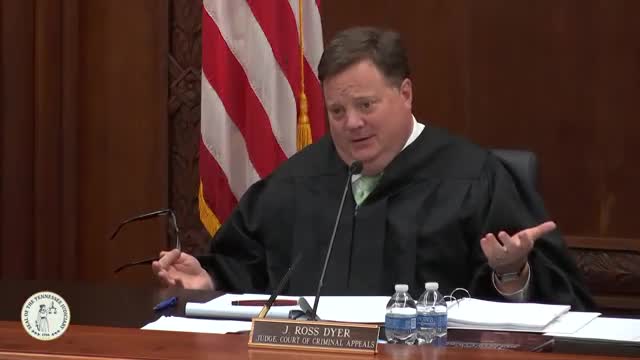
An appellate panel heard argument over whether it has jurisdiction to decide a certified question about the constitutionality of a police roadblock after defense counsel said the plea-acceptance hearing transcript was not in the record.
Joseph Mac Murray, an attorney with the Sullivan County Bar, told the court that the central issue "is the constitutionality of this stop," and urged the panel to allow the certified question to proceed despite alleged gaps in the record. Murray said he had sought and obtained leave to supplement the record and later told the court he had obtained the sentencing-hearing transcript from the Sullivan County clerk.
The state, represented by Courtney Orr, opposed suspending standard procedure. Orr argued that Tennessee Rule of Criminal Procedure 37 sets mandatory requirements for presenting a certified question and that Tennessee Rule of Appellate Procedure 2 does not permit suspending a criminal-procedure rule to create jurisdiction. "Compliance with Rule of Criminal Procedure 37 is mandatory and required for this court to have jurisdiction over a certified question before it," Orr said, adding that the transcript of the plea colloquy was not in the record and that the written plea waiver did not mention a certified question.
Orr also addressed the underlying constitutional claim about the roadblock. She told the panel that, on the record, the checkpoint met the relevant criteria used to assess constitutionality: commanding officers set the checkpoint in advance, the operation was publicized in advance (about a week to 10 days beforehand), written standard operating procedures were included as an exhibit, every car in the stopped direction was stopped except when traffic was released for safety, warning signs and marked patrol cars with lights on were used, and officers testified they took safety precautions. The state acknowledged one deviation from some precedents: officers stopped traffic in one direction only because of staffing constraints.
Defense counsel urged that the suppression motion and the plea colloquy made the certified question clear and dispositive. He said he had asked for and obtained an appellate bond at sentencing and had tried to create a fuller record. The panel and counsel discussed alternative procedural routes, including invoking Rule 2 to suspend appellate rules, but the state told the court it was not aware of authority allowing Rule 2 to cure noncompliance with Rule 37.
Panel members asked questions about what was in the record: whether any judgment existed, whether a Rule 32 post-conviction motion had been filed, and whether the plea colloquy appeared in the transcripts. The record, as described during argument, contained a written plea waiver but not the plea-acceptance transcript, no judgment was available in the record before the court, and no Rule 32 motion appeared to have been filed. Counsel later told the panel he had obtained the sentencing transcript and leave to supplement the record.
The panel did not announce a ruling during the argument and recessed, with no disposition recorded on the jurisdictional question or on the request to suspend rules under Rule 2.