
Finance committee hears July cash-flow report; officials warn December pension, debt payments could push city negative
Get AI-powered insights, summaries, and transcripts
Subscribe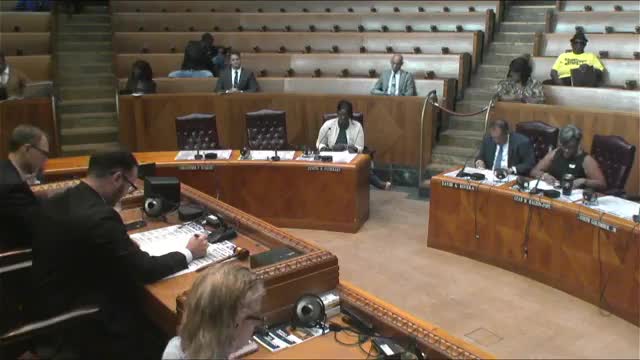
Summary
At a Sept. 23 Buffalo City Committee on Finance meeting, city officials reviewed the July 2025 cash-flow report showing a July 31 balance of $89.99 million and warned of projected negative cash balances from December 2025 through May 2026 unless one-time revenues and expense controls materialize.
City finance officials told the Buffalo City Committee on Finance on Sept. 23 that the city’s July 2025 cash position left it more vulnerable than a year earlier and that large December obligations — notably pension and debt payments — are likely to drive the city into temporary negative cash balances unless planned revenues arrive.
Deputy Controller Dwayne Laddell summarized the July cash-flow report, saying, “We began the year with $60,553,000 … leaving us with an ending cash balance for July 31 of $89,988,000.” He and other staff flagged that the July 2025 ending balance was about $6.9 million lower than July 2024 and that projections show a negative cash position from December 2025 through May 2026, peaking at roughly a $77.6 million shortfall before an expected recovery in June 2026 tied to a large state aid payment.
The committee heard the July numbers and the drivers behind them. Laddell and staff reported July receipts included higher property tax receipts (reported at about $78 million for July 2025 versus $52 million in July 2024) and slightly higher sales tax collections, while interest earnings and prescription rebate receipts were below budget for the year. The city recorded a July personnel cost of about $33.7 million, higher than the comparable month in 2024; health-insurance costs for retirees and active employees were also higher year over year.
Commissioner Nasworthy, the city’s commissioner of administration and finance, attributed some year-to-year differences to timing issues and contract-driven payroll changes and said the administration has already imposed a partial hiring freeze. “We froze $16,000,000 worth of personnel costs by not funding individual titles that were funded the year prior,” Nasworthy said, adding that his office is reviewing nonessential supply and service spending to find further savings.
Council members repeatedly raised concerns that the projected December cash pressures are primarily driven by two large, recurring obligations: a year-end police and fire pension payment (discussed in the meeting at about $57 million) and a second debt service payment (discussed as roughly $32 million). Staff stressed those are contractual or scheduled payments and central to the year-end cash picture. The finance office also noted a July debt payment of about $4.5 million and anticipated a second, larger debt payment in December.
The committee discussed several possible gap-closing sources that staff and members said had been included in planning: the planned sale of city parking ramps (included in the fiscal projections at roughly $26.5 million for the sale), scheduled state aid (staff referenced a scheduled December state aid installment and other state payments expected through the fiscal year), and tribal-compact distributions tied to a casino within city limits. Commissioner Nasworthy said prior-year timing had produced October tribal-compact payments near $4–$5 million and that staff were using that timing in current-year projections.
Several council members pressed administration officials on revenue enhancements and on improving collections. A council member said the city had issued about $7 million in fines over six years but reported collections of only about $400,000 and urged more aggressive collections and the new contract with a collections vendor that staff said is being implemented. Council members also discussed the role of overtime in driving both immediate payroll costs and longer-term pension liabilities, and several urged negotiation strategies to address overtime and pensionable-payroll growth.
Finance staff characterized the cash outlook as a timing and structural issue. Laddell and commissioner staff said that if the parking-ramp sale and the planned state aid are received as scheduled, the city would return to a positive position in late fiscal year 2026. Commissioner Nasworthy said title, survey and appraisal work on the ramp transaction is underway and that, in the event of a delay, a publicly disclosed short-term borrowing plan exists to cover timing gaps. He told the committee the administration expects to know by late winter or early spring whether contingency measures must be enacted.
Procedural actions recorded during the item included motions to open discussion (motion seconded by Council member Bowman), later a motion to close discussion and then a motion to table further action on the item (seconded by Council member Everhart); the committee moved to table the item following discussion.
Clarifying details discussed in the meeting included the following: July 2025 ending cash balance $89,988,000; July 2025 beginning-of-year cash $60,553,000; July personnel costs ~$33,700,000 (about $11.7 million higher than July 2024); July property tax receipts reported ≈$78,000,000 (about $26,000,000 higher than July 2024); July sales tax receipts ≈$7,200,000; first debt payment in July ≈$4,500,000 and a larger debt payment projected in December ≈$32,000,000; projected December police and fire pension payment ≈$57,000,000; projected peak negative cash ≈$77,600,000 (May 2026) and projected recovery ≈+$43,000,000 (June 2026); hiring freeze savings targeted at ≈$16,000,000 in salary funding; estimated average city health-insurance cost per position ≈$18,000. Where speakers did not supply exact figures beyond the report, staff described some amounts as projections or as “based on prior-year timing.”
Why it matters: committee members said the cash outlook will affect bargaining strategy, capital plans and the city’s approach to short-term borrowing. Several members urged immediate reforecasting, stricter collection practices and earlier, more frequent briefings to the council so decisions can be made before the large December outflows arrive.
Speakers listed in the meeting transcript for this item included Deputy Controller Dwayne Laddell; Commissioner Nasworthy, commissioner of administration and finance; Greg Smanski, investment and debt officer; President Pro Tem Bowman; Majority Leader Holden Pope; Council members Wyatt, Rivera, Blight, Preveiro, Norcoskie and Everhart; and one council member whose name was not clearly identified in the transcript (labeled in committee as “Council member (unnamed)”).
The committee did not take final fiscal policy votes on the cash-flow report at this meeting; the item was tabled for further action.