
Buffalo officials: thousands of low‑volume hydrants tied to aging mains; council seeks map and capital plan
Get AI-powered insights, summaries, and transcripts
Subscribe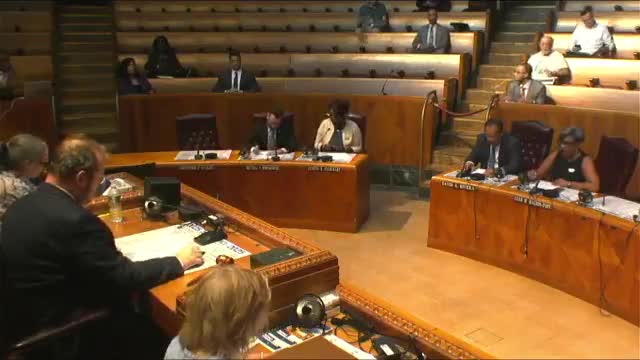
Summary
Council members pressed Buffalo Fire Department and the Division of Water about low water volume at hydrants after a multi‑house fire on Victoria Avenue, asking for maps, a prioritized capital plan and a dollar estimate to take to the governor.
At a Sept. 23 Committee on Community Development meeting, council members asked Buffalo Fire Department and the City of Buffalo Division of Water for a citywide plan after a fire in the Madison District revealed low water volume at nearby hydrants.
The discussion centered on water‑main capacity rather than hydrant mechanics, officials said, and council members requested a detailed map showing each hydrant’s condition, a list of projects in design or construction and a cost estimate the city could use when seeking state help.
Council members said the issue affects many neighborhoods and asked how the city is prioritizing replacements and repairs. The exchange followed a recent fire on Victoria Avenue that displaced multiple families and prompted public concern about whether local hydrants could provide sufficient flow.
Commissioner Ronaldo of the Buffalo Fire Department said "it is rare that an inoperable or low volume hydrant would contribute to a catastrophic loss of life and or property," describing the department’s operational procedures and redundancies. He explained that crews rely on multiple pumpers, onboard tanks and relay operations when a nearby hydrant does not provide desired volume.
Pete Merlo, principal engineer at the City of Buffalo Department of Public Works, Division of Water, said the problem is generally the distribution mains that feed hydrants rather than the hydrants themselves. He described a three‑phase maintenance program: a three‑year rotation that inspects and operates every hydrant, a summer painting program, and a winter program that visually checks hydrants at least six times per winter. "We annually replace about 150 hydrants in our system," Merlo said, and the water division keeps GPS locations and maps for every hydrant.
Merlo and other city officials gave these key details during the meeting: - Total hydrants in system: about 8,000. - Hydrants classed as low‑volume ("red top"): a little over 5,000. - Hydrants out of service for mechanical issues at the time of discussion: roughly 8–12. - Each fire pumper carries 750 gallons of water for immediate use while crews establish a hydrant feed; that tank supply typically lasts roughly five minutes on a single attack line. - Color coding used on hydrant bonnets: red = lower volume (mains typically 4–8 inches), blue = medium (10–12 inches), white = large mains (16–48 inches), yellow = out of service. - The Division of Water has a $75,000,000 distribution replacement program in design; previous recent capital work included a roughly $25,000,000 program. - Main replacements include full lead service replacement for properties when mains are rebuilt.
Council members repeatedly asked how the $75 million program would be prioritized. Merlo said priorities are driven by mains that "constantly fail" and by areas with inadequate fire flow, and that the board balances funding across system needs. "It's really addressing the mains that are breaking constantly and fire flow. Those are our top two," he said.
Several council members pressed for more transparency and community access to data. Council member Nowakowski asked for a copy of the hydrant map; Merlo said the water division can supply the map and that it identifies hydrants by condition. Council member Helton Pope and others asked whether residents could be given visible inspection dates or a way to verify a hydrant’s last inspection; Merlo said work orders are created and that the division can share inspection information on request but offered no immediate public portal.
Raymond Nasworthy, commissioner of administration and finance, confirmed the city received "a little over $331,000,000" in ARPA funds and said residents may reasonably expect better communication about infrastructure work. Council members urged the administration and departments to assemble a prioritized list and a dollar estimate for state and gubernatorial outreach.
The council concluded the item with informal directions rather than a final vote on capital funding. Members requested that Buffalo Fire, Buffalo Water and the administration deliver: - A map showing every hydrant with current status (white/blue/red/yellow) and GPS locations; - A prioritized list of water‑main replacement projects and those in design; and - A citywide cost estimate for addressing low flow areas to support state funding requests.
The committee recorded a motion to close discussion and a subsequent motion to table further action, both seconded, but the transcript does not record a formal roll‑call vote on the motion to table.
Council members said they want the maintenance schedule reviewed (Merlo described a three‑year operational rotation and more frequent winter checks) and asked the water division to consider ways to improve public notice when hydrants are inspected or taken out of service. Officials reiterated that the Division of Water is responsible for hydrant maintenance and repairs and that the fire department notifies dispatch when hydrants are used or reported out of service.
The committee chair said members had "homework" to review the map and capital project list and to prepare a package for the governor and other state officials during upcoming budget and legislative outreach.
Details, such as the exact size and schedule of individual main replacements and the full $75 million funding plan, were described as "in design" or "under consideration," not finalized at the meeting. City staff offered to provide project lists and maps to council offices for distribution to constituents.
The discussion closed with multiple council members urging faster prioritization of replacements in neighborhoods that consistently record low flows.
Ending note: The committee directed staff to return with the requested map, a schedule showing which hydrants are red/blue/white/yellow, and a dollar figure to inform state‑level funding requests. No formal funding decision was made at the Sept. 23 meeting; the matter remains in the planning and design phase.