
Torrance council accepts economic development update; directs staff to study Friendship events, façade revisions and Olympic-era options
Get AI-powered insights, summaries, and transcripts
Subscribe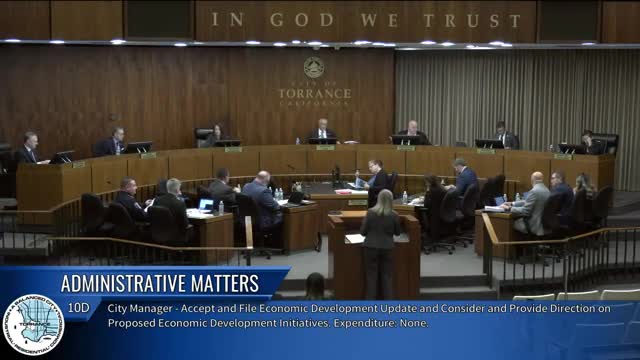
Summary
The Torrance City Council unanimously accepted an economic development update and gave staff direction to explore a set of initiatives including expanding Friendship City events, revising a facade grant program to offset permit/ADA costs, and exploring opportunities tied to the 2026 World Cup and 2028 Olympics and Paralympics.
The Torrance City Council on Sept. 23 accepted and filed an economic development update and gave staff direction to pursue several initiatives including a potential Friendship Games event, revisions to a commercial facade program to offset city permitting and Americans with Disabilities Act (ADA) compliance costs, and further exploration of opportunities tied to the 2026 FIFA World Cup and the 2028 Olympic and Paralympic Games.
City officials said the measures are intended to leverage Torrance’s hospitality and business assets to bring visitors and investment to the city while also backing retention and improvement efforts for local businesses.
Fran Fulton, the city’s economic development manager, summarized work since the council’s February update, including international delegations (notably from Oshu, Japan), use of location analytics (Placer.ai) to track visitation patterns, downtown revitalization projects and ongoing outreach to manufacturers, startups and retail prospects. Fulton told the council the city is also pursuing a property‑based business improvement district downtown and continues to market Torrance as a destination for sports delegations and visiting teams linked to major regional events.
Assistant City Manager Danny Santano told council members the office is “lean and nimble” and asked for policy direction on four items: whether to pursue a Friendship Games concept, whether to permit using previously allocated facade funds to offset city permit and ADA compliance costs, whether staff should further explore activations or hosting related to the World Cup and the Olympics/Paralympics, and whether city council travel related to Friendship City work should follow a $10,000-per-member annual allotment model (two policy options were presented).
During the discussion council members raised retention of existing businesses, the need for more granular metrics, and concerns about prevailing‑wage requirements that limit take‑up of facade grants. Finance Director Ian Daley provided high‑level fiscal context: business license totals have grown overall since 2019 and preliminary FY2025 revenues were about $10.8 million in business license tax receipts compared with $9.1 million in FY2019.
Council members then provided direction. By informal show-of-hands and subsequent confirmation in the staff report, council asked staff to: (1) explore the feasibility of a Friendship Games event (including potential international delegation partnerships); (2) develop a revised façade assistance approach that would allow city funds to cover or offset permitting fees and ADA compliance costs tied to exterior improvements (the staff memo noted approximately $242,000 set aside previously for commercial façade work); (3) further study opportunities to position Torrance for regional benefits from the 2026 World Cup and LA 28 Olympics/Paralympics (public‑viewing activations, street banners, partnerships, and fan events) and return with cost estimates; and (4) adopt the first travel option presented (staff recorded majority support for Option 1, which would make Friendship City travel funds available up to $10,000 annually per council member subject to the rules presented).
Mayor George Chen framed the discussion around maximizing local benefit: "If we do nothing, we're probably guaranteed we will get nothing," he said, urging staff to pursue concrete opportunities to bring visitors and spending to Torrance. Multiple council members emphasized retaining and supporting existing small and medium businesses so they can capture demand from major regional events.
Council voted unanimously to accept and file the economic development update and approved the staff directions described above; staff will return with detailed proposals and budget implications as they are developed.
Ending: Staff said materials and the update will be posted on the city’s economic development website and that staff will return with more specific cost estimates and implementation plans for any recommended programs or activations.