
Clallam County commissioners approve $5-per-parcel fee to fund Clallam Conservation District, 2-1
Get AI-powered insights, summaries, and transcripts
Subscribe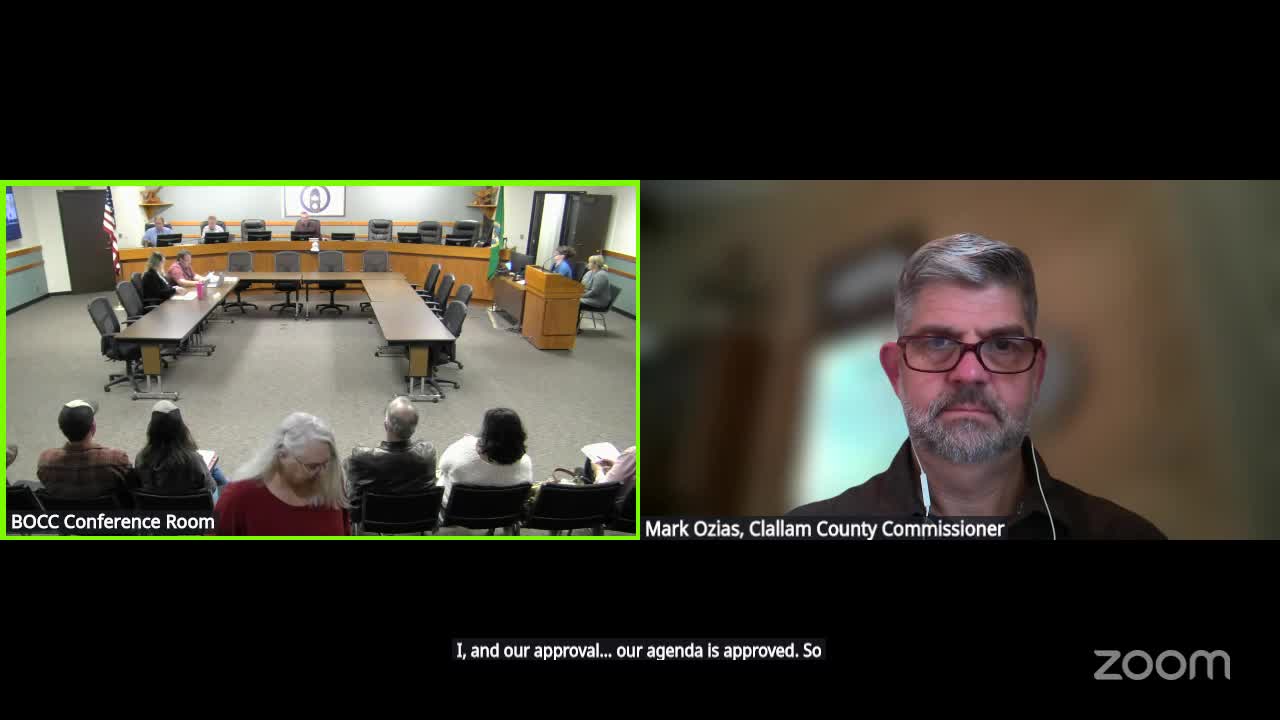
Summary
On Sept. 23, the Clallam County Board of Commissioners voted 2–1 to adopt a resolution instituting a $5-per-parcel annual charge to provide revenue for the Clallam Conservation District, including a 10-year sunset clause and required performance measures.
On Sept. 23, the Clallam County Board of Commissioners voted 2–1 to adopt a resolution instituting a $5-per-parcel annual charge to provide revenue for the Clallam Conservation District, including a 10-year sunset clause and required performance measures.
The board opened an extended public-comment period that drew more than two dozen speakers from across Clallam County. Supporters said the fee would stabilize the district’s work with farmers, homeowners and wildfire preparedness; opponents called it an unwanted new tax and questioned the district’s financial controls.
Why it matters: Commissioners said the fee will supply roughly the district’s projected shortfall and give the district steady operating revenue for planning and programs, while opponents argued the district can cover shortfalls from reserves or grants and that elected officials should not impose a new recurring charge without broader public approval. The measure was carried with conditions inserted in the resolution — including annual reporting on metrics and a 10-year review/sunset.
Public comment and evidence: Jake Seager (resident, District 3) urged commissioners to reject the fee, telling the board, “Commissioners, you've been elected to serve and protect the people. You're failing regarding the CCD parcel fee.” Opponents raised multiple concerns in public comments: alleged bookkeeping errors, perceived insider relationships between the district and local NGOs, and the district’s need for a formally designated treasurer under state law. Virginia Shugrin (resident, Sequim) cited RCW 89.08.215 and said the district “must designate a treasurer by resolution.”
Supporters emphasized services to farmers and homeowners. Laurel Hargis (Port Angeles homeowner) said she benefited from local farms and the district’s programs and encouraged others to review the district’s website. Tim Wheeler (farmer/resident) noted the district’s plant-distribution record, saying the conservation district “has donated 494,000 native plants to 7,700 people since they started giving away plants in 1990.” David Mattern (Port Angeles property owner) said he has used the district’s consultations and called $5 “de minimis.”
District response and accountability measures: Kim Williams, identified in the meeting as the district manager, described the district’s financial controls and state audits, saying, “We have a pretty big system of checks and balances. … All of our audits have come back clean with no findings.” Williams said the district uses an outsourced bookkeeper, monthly balanced budgets, and board oversight, and that projected budget tables presented were condensed projections rather than line-by-line accounting.
Commission deliberations and split vote: Commissioners discussed the district’s role and how the fee fits with county priorities. One commissioner (speaking in favor) framed the district as a nonregulatory partner that helps deliver voluntary solutions to pollution, wildfire risk and farm support and said the comprehensive plan supports partnering with organizations such as the conservation district. Another commissioner said the fee would be difficult to endorse for parts of the county with different economic conditions and declined to support the motion, but framed that vote as a challenge to the district to produce measurable returns in the next 10 years.
Formal action: A motion to approve the resolution instituting the rates and charges was moved and seconded during the meeting and passed by a 2–1 vote. The resolution as adopted includes accountability language: specific performance measures, a prohibition on automatic escalation during the term, and a 10-year sunset review. The board chair announced the motion’s passage and thanked the public for participating.
What the resolution does and next steps: The adopted resolution authorizes the county to collect a $5-per-parcel annual charge in unincorporated Clallam County to fund the conservation district’s services and programs, requires reporting on metrics, and sets a 10‑year sunset and review. The district and county will implement the reporting and tracking provisions required by the resolution; the county will continue to receive public questions about appeals (the agenda noted the assessor’s office as responsible for landowner appeals under the fee). The county did not record any further formal direction to staff beyond adopting the resolution.
Ongoing concerns and community reaction: Many speakers renewed concerns about transparency, the district’s accounting and the district’s governance (including the question of a designated treasurer). Supporters who spoke said the fee was small relative to services and would enable continuity of programs. Several residents said they had collected signatures opposing the fee; speakers on both sides urged greater outreach and better public information. The board majority emphasized that the resolution includes metrics and a sunsetting mechanism to allow future review.
Ending note: The board’s 2–1 approval ends the immediate question but leaves open a 10-year review and ongoing public scrutiny of the district’s reported metrics and fiscal management.