
Licensing board raises questions after CEU audit finds missing records, $250 settlement offered
Get AI-powered insights, summaries, and transcripts
Subscribe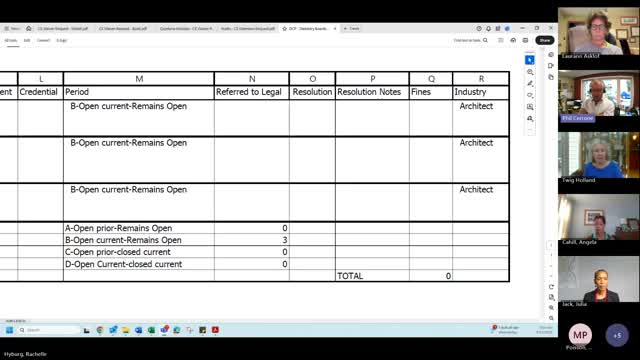
Summary
The Connecticut Architectural Licensing Board discussed a computer CEU audit that flagged hundreds of renewal records as incomplete and a staff letter offering a $250 settlement to some licensees; board members asked staff to confirm whether the division had authority to offer the settlement and to report violations to NCARB.
The Connecticut Architectural Licensing Board on Sept. 23 discussed the results of an electronic continuing-education audit that flagged hundreds of renewal entries as incomplete and noted a staff offer of a $250 settlement to some licensees.
Board members said the computer review showed about 150 architects listed less than the required 12 continuing-education hours and about 82 architects omitted course names from the renewal fields. Board members and outside representatives said many licensees had been notified by staff, and a number of licensees responded by sending the $250 payment rather than submitting documentation of completed courses.
Why it matters: The board said the settlement letter, and whether the division had authority to offer it, could affect compliance incentives and public confidence in the CE requirement. Members also raised the possibility that inconsistent messaging from the division is generating confusion among licensees and producing spikes in waiver and extension requests.
Board discussion and next steps Board members asked staff to confirm whether the division was authorized to offer a $250 settlement in lieu of proof of CE completion and to report confirmed violations to the National Council of Architectural Registration Boards (NCARB). A staff member said she would raise the issue with her supervisor and follow up with the division director, Jason, who was not present at the meeting. "Yep. I can bring it up to her, her boss, Pam," a staff member said during the meeting when asked to coordinate follow-up.
Board members described the audit as primarily a computer check of which renewal fields were completed rather than a substantive review of course verification. Several board members said the computer audit exposed an honor-system gap: the online renewal form can be filled in without a manual audit of each course entry. One board member summarized the concern as: if licensees can pay a settlement instead of documenting coursework, the continuing-education requirement would be undermined.
Board members asked staff to seek clarification from the division director on three points: (1) the legal or regulatory authority used to set the $250 settlement; (2) whether the division intends to use the settlement as a recurring option; and (3) whether confirmed violations will be reported to NCARB so other jurisdictions can be notified. The board asked staff to copy the board chair on correspondence with the division director and to report back at a future meeting.
Staff said the division had already notified the group of licensees whose records showed missing data; staff acknowledged some recipients had paid the settlement amount already. The board did not adopt new policy at the Sept. 23 meeting; members limited action to requesting clarification and possible correction of the language sent to licensees.
What the record shows The discussion in the meeting packet and during the Sept. 23 session identifies the audit results (missing hour totals and missing course names), the $250 amount offered in settlement letters, and the board's decision to request confirmation from division leadership about legal authority and reporting to NCARB. The board directed staff to follow up and report back; no vote to change policy or rescind the settlement letters was recorded.
Looking ahead Board members said they want clearer messaging to licensees and to see the division consult the board or its staff liaisons before sending mass communications that affect compliance expectations. Staff said they would contact the division director and escalate the questions as needed.