
Most students unfamiliar with 'Operation Gigawatt'; Malloy urges permitting changes for low-emission energy
Get AI-powered insights, summaries, and transcripts
Subscribe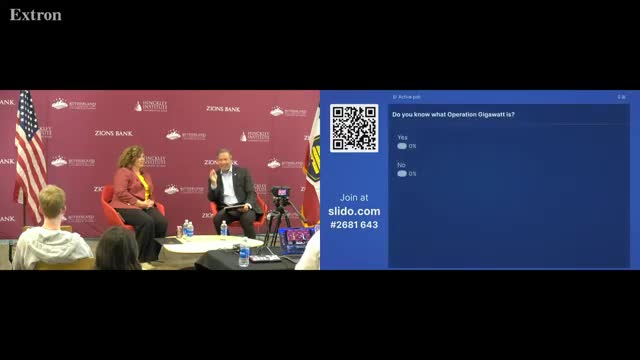
Summary
At a University of Utah event, Congresswoman Celeste Malloy said about 90% of attendees had not heard of Operation Gigawatt and argued federal permitting barriers limit development of low‑air‑quality‑impact sources such as nuclear and geothermal energy.
Salt Lake City — During a Sept. 23 Hinckley Institute forum, Congresswoman Celeste Malloy told students that a large majority of the audience (roughly 90%) said they had not heard of "Operation Gigawatt," the governor's stated priority for expanding energy production in Utah. Malloy described the initiative as a priority intended to boost future energy supply and said federal permitting processes are a key obstacle to building low-emission energy projects. "Operation Gigawatt is the governor's priority that he's outlined for bringing more energy production to Utah," Malloy said, noting her work on the House Appropriations and Interior subcommittees gives her jurisdictional interest in natural-resource policy. She said she is working on measures to ease permitting for energy sources that have relatively low air-quality impacts, specifically naming nuclear and geothermal power. "One of the things I'm working on is trying to make sure that things like nuclear energy and geothermal energy that have a low impact on air quality are able to be permitted," Malloy told the audience. "We have the technology for them, but we're not building the plants. And part of it is federal policy that makes it hard to get them permitted." A student asked about air quality concerns tied to bringing in more energy production; Malloy responded that making permitting for low‑impact technologies easier could allow Utah to increase generation while protecting public health. The audience response suggested limited public awareness of state energy priorities even among politically engaged students. Malloy framed energy policy as a mix of state priorities and federal jurisdiction. She also referenced her committee assignments to explain why she spends time on permitting and resource questions, and said she hopes reforms will let Utah produce more energy while keeping residents healthy. The discussion did not reference specific bills or regulatory text; Malloy described general goals and permitting obstacles rather than detailed legislative language.