
Mayor announces more than $9 million for Indigenous programs after Tribal Nations summit, council members describe commitments
Get AI-powered insights, summaries, and transcripts
Subscribe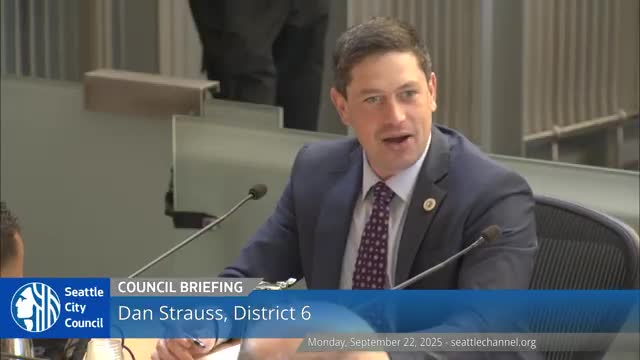
Summary
Seattle leaders said the mayor announced over $9 million in investments for Indigenous-led organizations at a Tribal Nations summit; council members described specific allocations including $1.8 million for a residential treatment center and $7 million toward a tribal interpretive center and waterfront operations.
At a Sept. 22 Seattle City Council briefing, council members who attended a Tribal Nations summit said the mayor announced more than $9 million in new investments for Indigenous-led organizations and projects, and council members described several specific allocations and next steps.
Council member Tammy Juarez, who detailed the summit during the briefing, said the investments included $1.8 million “which will be a 92‑bed residential treatment facility offering expanded behavioral health services rooted in cultural traditions” for the Thunderbird treatment center and a $7 million designation for a tribal interpretive center and waterfront operations tied to a memorandum of understanding with the Muckleshoot Indian Tribe. Juarez also said the mayor’s office designated $500,000 for demolition related to a Seattle Indian Services Commission property in Little Saigon and that the total announced exceeded $9 million.
The Tribal Nations summit brought tribal leaders, city department directors and staff together for government‑to‑government discussions, council members said. Juarez described the summit as “collaborative, urgent, and solutions‑oriented,” and said department directors were asked to state commitments and next steps. Council member Strauss and others who spoke at the briefing supported continued follow‑up and quarterly check‑ins on outcomes.
Council members said the funding designations aim to support behavioral‑health capacity, economic participation by tribal entities, and long‑standing commitments tied to waterfront and seawall work. Juarez said the Thunderbird treatment center funding is intended to expand culturally rooted behavioral‑health services and that further work is needed to “close that funding gap” so the facility can operate at full capacity.
Juarez also said the mayor’s office has designated funding for demolition to enable transit‑oriented development with affordable housing and commercial space at a Seattle Indian Services Commission property in Little Saigon. The council members said they will continue to work with the budget chair and mayor’s office on allocations during the budget process.
Council members who reported on the summit said they plan continued oversight and coordination with city departments, the Office of Economic Development, Department of Neighborhoods and Indigenous‑led organizations to implement the commitments announced at the summit.
No formal council votes or ordinance adoptions occurred during the briefing on these items; council members said the spending designations were announced by the mayor’s office and will be considered during the budget process and relevant committee work.
Less critical details: Juarez thanked several staff and community leaders by name for organizing the summit and said additional events—an economic summit in 2026 and a tribal nations public safety summit—are being planned to continue the collaboration.