
Westlake projects multi‑million deficit; board adopts FY26 appropriations
Get AI-powered insights, summaries, and transcripts
Subscribe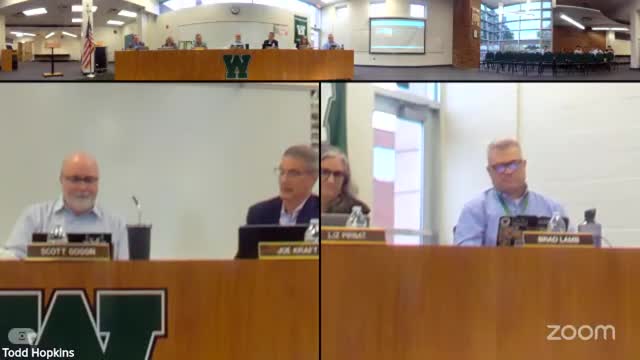
Summary
The Westlake Board of Education approved a revised four‑year financial forecast and FY26 permanent appropriations after Treasurer Ramon Hopkins told the board the district has moved into deficit spending driven largely by rising health care and benefits costs and a $10 million transfer to a capital improvement fund.
At its Sept. 22 meeting, the Westlake City School District Board of Education approved a financial forecast and adopted fiscal‑year 2026 permanent appropriations after Treasurer Ramon Hopkins warned the district is projecting multi‑million dollar deficits in the coming years.
Hopkins told the board the district expects revenue for the year of about $58.6 million using conservative assumptions but noted that, "when we consider returning some advances ... it's $59.3 million for this year." He said planned expenditures are just under $65 million. "This year it's projecting a $5,500,000 deficit," Hopkins said. "I'll be honest." He added that, in his view, actual deficit spending will likely fall in the $3 million to $4 million range.
The forecast lists several drivers of the projected shortfall. Hopkins said salary and benefits account for the largest share of spending and that health‑care costs are a primary pressure: "Benefits are up, about $900,000, that tied directly to 11% increase ... health care costs. Health care alone runs us around, 8 to $9,000,000 a year," he said. Hopkins also cited volatile reimbursements for high‑cost special‑education placements (he said the district applied for more than $1 million last year but received about $181,000) and declining interest income as factors.
Hopkins told the board the district transferred $10 million last year into a capital improvement fund (fund 070) and that the board could rescind all or part of that transfer to improve the operating forecast. He said the district’s bottom line is sensitive to that decision.
The board approved the forecast (agenda item 5a) and then adopted the FY26 permanent appropriations (5b). Trustees also approved a package of related treasurer items (5c–5j) in a single vote. The motions carried on recorded roll calls.
Why this matters: The forecast and appropriations establish the legal spending limits for the year and frame the district’s short‑term choices about staffing and programs. Hopkins told members that, "there's only two ways you can pick budget options. You either raise your revenue or reduce your expenses." He reminded the board the district has not passed an operating levy since 2006 and said it would be premature to put a levy on the ballot in 2026 given state‑level uncertainty.
Board members asked for more transparency about the $10 million capital transfer; Hopkins agreed to add a note to the district assumptions documenting the move and the board’s plan for the fund. During discussion he also warned that statewide political developments could change the district’s options: Hopkins noted the current state budget debate over limits on carryover balances and mentioned a citizen initiative circulating to amend the state constitution to eliminate property taxes, which he said would be "enormous" in its ramifications if it advanced.
The board’s action package included other routine housekeeping approvals referenced in the treasurer’s report, such as returning advances to the general fund and authorizing the treasurer to pursue potential unclaimed funds held by the state. Hopkins asked for authority to pursue any unclaimed funds on behalf of the district; the board approved that request as part of the treasurer’s package.
Looking ahead: Hopkins said the state changed the forecasting calendar; districts will now file forecasts in August and February rather than November and May, and this year the board had to approve the forecast no later than Oct. 15. Hopkins recommended continuing conservative assumptions and reviewing the capital fund transfer if the board wants to alter the longer‑term outlook.
No new levies or staffing reductions were approved at the meeting; the actions taken set the district’s legal spending limits for the year and leave policy choices — including whether to seek voter approval for new revenue or to reduce expenditures — for future deliberation.