
Council committee reviews Creekside mixed‑use development agreement; developers, CIC outline phasing, incentives and completion guarantees
Get AI-powered insights, summaries, and transcripts
Subscribe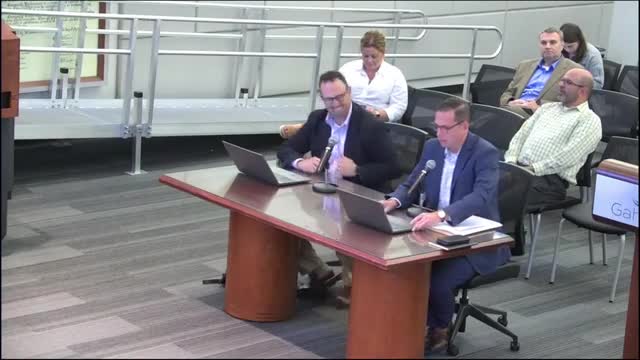
Summary
Economic Development Director Jeff presented a draft development agreement Sept. 22 to enable a multi‑phase mixed‑use redevelopment of the Creekside District, including two mixed‑use buildings with about 263 apartments, a 55–70‑room hotel, restaurants and a parking garage, and a second phase of 24 townhomes; the agreement sets incentives, timelines and completion guarantees and was scheduled for first reading Oct. 6.
Economic Development Director Jeff addressed the Committee of the Whole on Monday, Sept. 22, 2025, to present a draft development agreement that would pave the way for a multi‑phase mixed‑use redevelopment of the Creekside District. The agreement, negotiated between the Gahanna Community Improvement Corporation (CIC) and a developer team led by Benson Capital and Connect Real Estate, would provide the economic framework and land control needed for construction of new apartments, a hotel, retail and a parking garage and would use tax incentives to fund on‑ and off‑site improvements.
The proposal matters because it would redevelop most CIC‑owned parcels in Creekside and the adjacent city parking lot: the draft describes a two‑phase project with phase 1 consisting of two mixed‑use buildings on Mill Street (about 263 apartments, a 55–70‑room hotel, two restaurants, coworking space and a parking garage) and phase 2 comprising 24 townhomes on High Street. The developers say the total construction cost is roughly $105 million.
Under the draft, the city and CIC would contribute their assembled land to the project (the agreement uses a nominal sale price), and the developers would seek additional financing and state programs. The agreement lists available incentives and financing mechanisms discussed in the meeting, including a pre‑1994 Community Reinvestment Area (CRA) 100% property tax abatement for 15 years, a non‑school tax increment financing (TIF) arrangement that would channel certain incremental revenues into project costs, and the potential creation of a new community authority (NCA) that could collect hotel, retail or millage charges. The team also said it would pursue state programs such as the Transformational Mixed‑Use Development (TMUD) tax credit.
Economic impact and accountability figures presented to the committee included an estimated annual local economic activity in the project's ZIP code of about $7.1 million, a broader annual economic impact of about $10.4 million, roughly $1.4 million in annual local/state/federal tax revenue from operations, and about 74 on‑site jobs at buildout. The development team and city staff estimated the TIF could generate about $10 million over its life and suggested the city’s net 30‑year fiscal benefit in the materials could be about $23.6 million versus roughly $5.5 million in direct incentives, not counting the value of the roughly $100 million in site improvements once completed.
Council members and staff pressed the development team on multiple issues. Concerns and clarifying requests included: parking and public access (Councilmember McGregor and others noted the High Street lot is used by area residents and worshipers and asked whether the new private garage will replace evening/event parking and whether it will be free to the public); the timing and phasing of land transfers and whether phase‑2 parcels should be transferred only after phase‑2 financing and permitting are secured; the need for additional exhibits and more complete on‑ and off‑site improvement lists; traffic and parking studies; the details and enforceability of the completion guarantee; and whether certain state tax credits (TMUD) are a condition for the project’s feasibility.
Developers described construction and product details. Frank Benson IV, principal of Benson Capital, said the project team is a local investor group with ties to Gahanna. Bob Lamb, executive vice president of development for Connect Real Estate, described the team’s experience and an industrialized construction method called Connect Housing Blocks that creates modular steel units off‑site; the team said the approach shortens the on‑site construction period and can reduce material waste. Connect agreed to pursue LEED certification for building units where feasible and promised to support Creekside organizations, internship programs with the school district and trail extensions, and to reserve 10% of residential units for households at about 80% of area median income.
The draft agreement includes accountability and risk‑mitigation measures described to the committee: a completion guarantee requiring phase 1 to be substantially complete within 36 months of permit approvals and financing; reconveyance language that would return parcels to the city or CIC if required performance milestones are not met; step‑in rights for the city tied to financing in case of default; and a 60‑day due‑diligence period following signature. The document also contemplates shared TIF and NCA receipts (50% shared until eligible costs are repaid), reduced city application and review fees, and other exhibits and purchase‑and‑sale agreements to be added during the post‑agreement phase.
The committee did not vote to approve the agreement at the Sept. 22 meeting. Members asked for more detail and additional exhibits, and the city attorney said legal review is in progress. The committee voted to place the ordinance on first reading on Oct. 6 and to return it to committee for further review on Oct. 13.
Speakers quoted in this article spoke at the Sept. 22 Committee of the Whole meeting and include Economic Development Director Jeff; Mayor Jadwin; Frank Benson IV, principal and founder, Benson Capital; Bob Lamb, executive vice president of development, Connect Real Estate; Nate Green, Montrose Group (advisor); CIC members George Morris and Jody Carter; and council members who questioned the team: Councilmembers Renner, Schnetzer, Jones, McGregor, Bowers and Padova.
What’s next: The administration and the developer team will provide the outstanding exhibits and supporting materials requested by council, the city lawyer will circulate a redline of the draft agreement, and the committee scheduled first reading on Oct. 6 with an expected return to committee on Oct. 13 for more detailed review and answers to council questions.