
Valley View board adopts $324 million operating budget after public hearing
Get AI-powered insights, summaries, and transcripts
Sign Up Free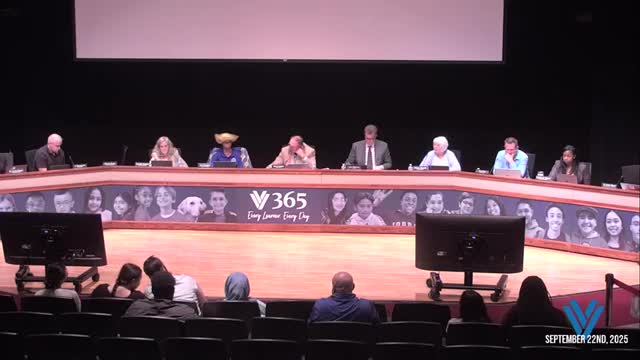
Summary
After a public hearing with no public commenters, the Valley View School District Board of Education adopted a $324 million operating budget for fiscal year 2025–26, citing a strong cash reserve and a structural deficit in the education fund driven by slower state replacement-tax revenue and rising personnel costs.
The Valley View School District Board of Education on Sept. 22 adopted the fiscal year 2025–26 operating budget after holding the required public hearing. The board approved resolution 2602 to adopt the budget by roll call vote with all members voting yes.
The budget document presented by John Renich, the district's budget presenter, lists nearly $324,000,000 in operating expenditures, excluding about $82,000,000 in on-behalf pension payments. Renich said the tentative budget had been on public display for 30 days and the required public-notice affidavit was included in the board packet. “Tonight’s presentation is called ‘Making a Grade,’” he said at the start of the hearing.
Why it matters: The budget balances significant ongoing instruction priorities against mounting pressure from declining replacement-tax revenues and rising personnel costs. The administration highlighted both a strong liquidity position and a looming structural gap that will require action in future years.
Key figures and drivers - Property taxes: the district’s largest revenue source, accounting for about 64% of budgeted revenues (approximately $230 million). - Evidence-Based Funding (EBF): budgeted at about $54 million, an increase of roughly $700,000 over the prior year. - Corporate personal property replacement tax (CPPRT): Renich told the board CPPRT dropped from roughly $32 million in 2023 to an estimated $12–14 million for this cycle — a decrease the presentation identified as a major budgetary pressure. - Expenditures: salaries and benefits make up roughly 76% of operating costs (about 63% salaries and 13% benefits). The budget assumed a 4% salary increase for planning purposes. - Net operating position: Renich said the education fund shows a structural deficit of about $3.2 million once accounting for the nutrition fund surplus; he cautioned that without action the deficit could grow in subsequent years. - Cash reserves and ratings: the district expects roughly 140 days cash on hand (well above the Government Finance Officers Association benchmark of 90 days). Renich noted Valley View holds an AA1 rating from Moody’s.
Spending priorities called out in the presentation include continued investment in classroom instruction and literacy supports, a planned phonics program for K–2 aligned to the Illinois comprehensive literacy plan, about $3.3 million annually for technology lifecycle replacement, and approximately $3.9 million for facilities projects. The budget also accounts for staffing for the new early-childhood center listed in the presentation (about 20 full-time equivalent positions).
Public process and board action The public hearing produced no speakers on the budget. After the hearing, a motion to adopt resolution 2602 passed unanimously in a roll-call vote. The board chair thanked staff for the presentation and for maintaining stewardship of taxpayer dollars.
What’s next Administration and the board will monitor the structural deficit and revenue trends — particularly CPPRT and property tax growth limited to CPI rates — while balancing investments in instruction, technology, and facilities. The board indicated ongoing attention to controlling salary-and-benefit growth to align with revenue limits.
Ending: The adopted FY2025–26 budget emphasizes instructional spending and fiscal reserves while flagging the district’s need to manage personnel cost growth and reduced replacement-tax revenue to preserve long-term financial health.