
Connecticut advisory panel issues interim COVID-19 vaccine guidance, stresses shots for youngest children and oldest adults
Get AI-powered insights, summaries, and transcripts
Subscribe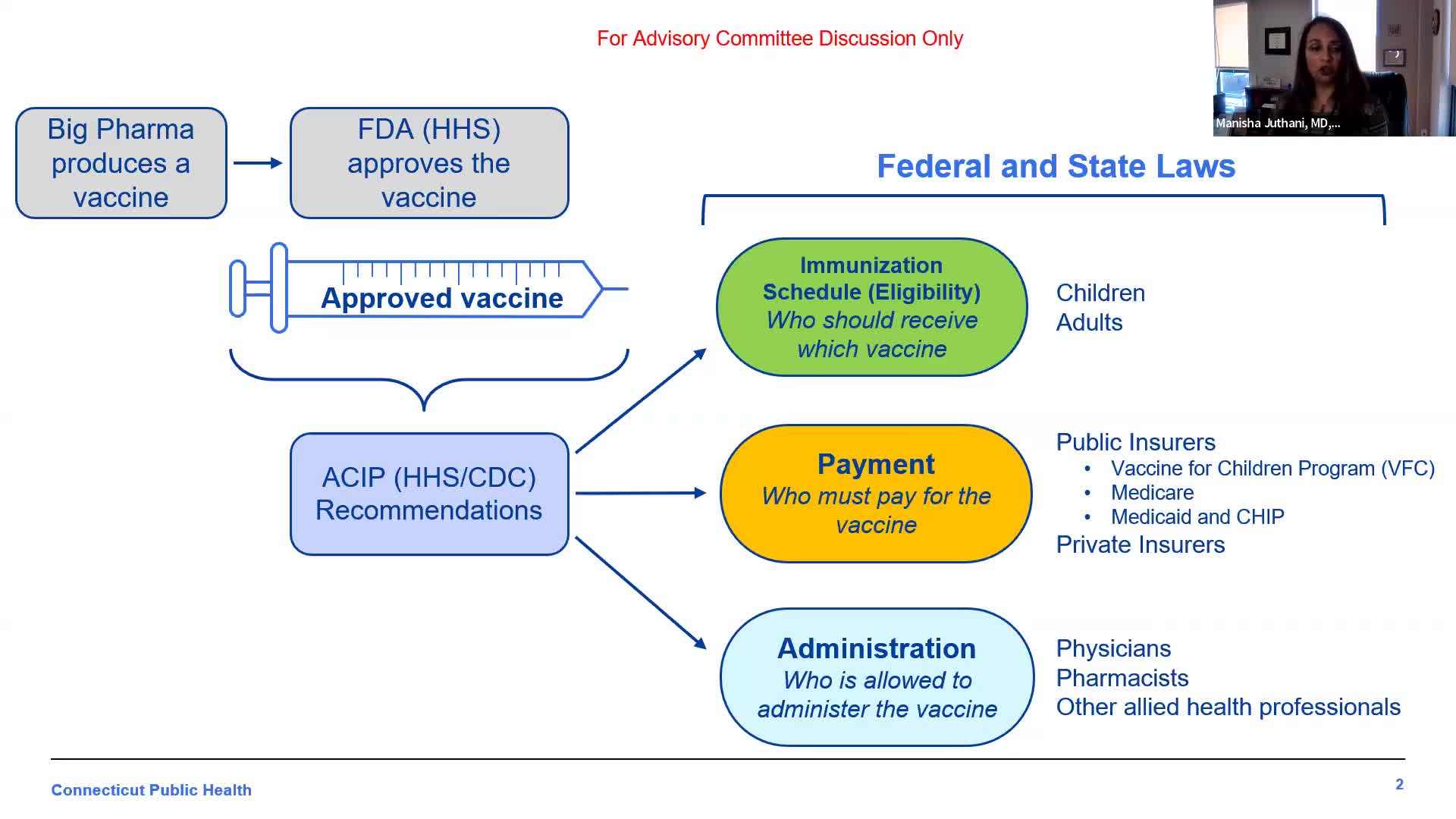
Summary
At its first meeting, the Connecticut Department of Public Health advisory committee reviewed interim COVID-19 guidance emphasizing vaccination for children 6–23 months and older adults, discussed “shared decision making” language, and flagged pharmacy access, insurance coverage, and next steps.
Connecticut Department of Public Health Commissioner Manisha Juthani convened the state'appointed Advisory Committee on Vaccinations for its first meeting to review interim guidance on respiratory viruses and COVID-19 vaccines and to discuss how recommendations translate to coverage and access.
The committee focused on groups the department identified as highest risk: children ages 6 months to 23 months and older adults, particularly those 75 and older. Commissioner Juthani said, "we do believe at this point in time, based on the conversation of ACIP, we are, of course, waiting to see what the acting CDC director actually authorizes, so this is still in flux." She and committee members urged clear public messaging while acknowledging federal recommendations remain the primary driver of insurance coverage.
Why it matters: ACIP and FDA actions affect who is eligible, whether insurers must pay, and where people can receive vaccines. Committee members pressed for harmonized language across professional societies and clearer operational guidance for pediatricians and pharmacists.
Most urgent facts - DPH issued interim COVID-19 vaccine guidance to reduce public confusion while awaiting final CDC action. Commissioner Juthani described the guidance as intended to clarify eligibility and access. - Committee members and DPH staff stressed that children 6 months to 23 months and adults 75 and older experienced the greatest morbidity and mortality in the 2024'25 respiratory season and should be prioritized for vaccination; Juthani said the evidence makes vaccination "very clear" for those groups. - For adults 65 and older the committee debated wording; Juthani said, "I believe that should be vaccinated for anybody 65 and older is the recommendation," while several clinicians warned that "shared clinical decision making" language has in past cycles reduced access.
Supporting detail and context Commissioner Juthani outlined the federal-to-state flow: vaccine developers seek FDA authorization; ACIP issues clinical recommendations that affect insurer coverage; state law and agencies govern school immunization standards and the Department of Public Health's authority for certain child and nursing-home vaccination rules. She emphasized that DPH's authority over adult vaccination is limited to nursing-home residents.
Pharmacy and payment issues were a recurring concern. Juthani described a Department of Consumer Protection memo that gave pharmacies a 30'day window to follow prior ACIP guidance while waiting for final CDC direction, and she said DCP remains in close contact with pharmacies about how to implement the new recommendations. Pharmacist-and-insurer interactions matter because many adults receive vaccines at pharmacies, and large self-insured employer plans are not regulated by Connecticut's Insurance Department.
Clinicians on the call said the language used by professional bodies matters in practice. Geriatrics specialist Eileen Pangolinan said of prior "shared decision making" recommendations for RSV and COVID vaccines, "we lose ground" and warned that weaker language can reduce uptake among older adults. Infectious disease physician Al Shaw and other members said shared decision making can create administrative barriers if pharmacists or providers interpret it as optional rather than recommended.
What the committee asked DPH to do - Continue to refine public-facing guidance while awaiting CDC action. - Coordinate with the Department of Consumer Protection and the Connecticut Insurance Department on pharmacy administration and coverage questions; Juthani said DCP's commissioner has offered to brief the group at a future meeting. - Provide concise, harmonized materials for front-line providers and pharmacists summarizing ACIP/FDA/CDC positions once finalized.
Next steps and outlook Commissioner Juthani said the advisory committee will meet again after the next ACIP session in October to review finalized federal guidance and the acting CDC director's authorization. "This is still a moving target," she said. The committee did not take votes on policy changes; its role is advisory to DPH.
Ending note Committee members asked DPH to prioritize clear, concise materials for clinicians and the public and to track access points so patients who call their pediatrician or pharmacy can find where a vaccine is available.