
High school enforces Texas cell-phone law; staff outline medical and instructional exceptions
Get AI-powered insights, summaries, and transcripts
Subscribe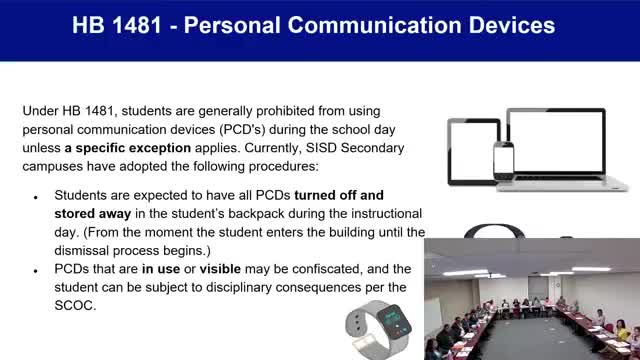
Summary
School leaders described how the district is implementing Texas House Bill 1481 at the high school, including a step-based discipline ladder, medical and IEP/504 exceptions, dual‑credit supervision rules and early data on enforcement.
At a school board meeting, high‑school administrators summarized how the district is implementing House Bill 1481, the new Texas law that restricts student use of personal communication devices during the school day. Administrators said the district requires devices to be turned off and stored, allows documented medical exceptions and permits supervised use for dual‑credit or other approved instructional activities.
Why it matters: The law changes daily routines for students, staff and families and has led administrators to adopt a written hierarchy of interventions, new parent communications and procedures for medical and instructional exceptions.
Administrators told the board that the district has adopted a stepped discipline approach. “The device is confiscated. The student can pick up the device at the end of the day,” a presenter said, describing the first‑offense step. For subsequent offenses, parents must come to the campus to collect the device and the student may receive detention or Saturday school as consequences. The presenter told the board that “9 percent of high school students have had a consequence associated with House Bill 1481; less than 1 percent have needed a second consequence.”
School leaders described medical and accommodation exceptions. A staff presenter said students with documented medical needs must submit physician documentation for a campus review and, where appropriate, an IEP or 504 committee may approve an accommodation allowing device use. The same presenter said, “If they have a hearing aid…we requested documentation from a physician” before approving on‑campus device use. Administrators also said a student who relies on a phone to read glucose data can usually keep the device in a backpack while the monitor continues to send readings; staff will review such cases individually.
Dual‑credit and other instructional exceptions were addressed. Administrators said college classes held on district campuses are treated like college classrooms: students may use required devices under the direct supervision of the instructor for two‑factor authentication or instructional tasks, provided the use is limited and supervised. The district also said it has posted a cell‑phone FAQ and explanation of the law in its September ParentSquare newsletter and that ParentSquare’s language features will be used to provide Spanish translations.
Administrators reported effects on campus climate. “We’ve seen a net positive impact on instruction. Students have been less distracted during the school day, more focused on instruction,” Mr. Kennedy, a campus administrator, told the board. He said teachers have adjusted classroom activities and that administrators have observed increased peer interaction during lunch and fewer social‑media‑driven conflicts.
Operational notes: The district said phones remain off until dismissal, when students may check messages. Bus and dismissal procedures allow device use only after students are released at dismissal. If a student refuses to surrender a device when requested, the district treats that as insubordination and applies the student code of conduct. Administrators noted that some campuses share students between ninth‑grade and main high‑school campuses and that staff are coordinating procedures for shared classes.
What’s next: Administrators said they will continue to refine communications and supports for families, monitor discipline data as the school year progresses and follow the law’s requirements for documented medical exceptions.