DHCS details wellness coach billing codes, rates, time rules and documentation
September 22, 2025 | Department of Health Care Access and Information, Agencies under Office of the Governor, Executive, California
This article was created by AI summarizing key points discussed. AI makes mistakes, so for full details and context, please refer to the video of the full meeting. Please report any errors so we can fix them. Report an error »
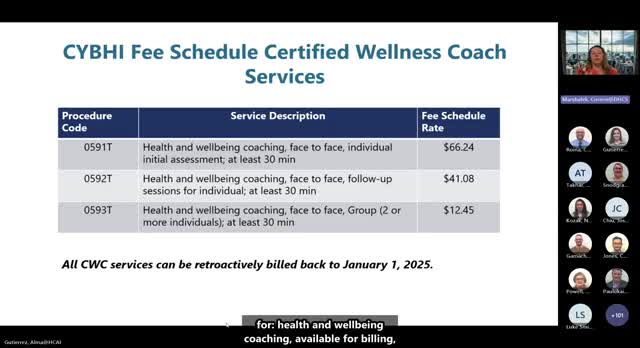
Codes, rates and basic rules: DHCS listed three CWC procedure codes. ‘‘0591T’’ is the individual initial assessment (face‑to‑face or telehealth, minimum 30 minutes) reimbursed at $66.24; ‘‘0592T’’ is the individual follow‑up session (face‑to‑face or telehealth, minimum 30 minutes) reimbursed at $41.08; and ‘‘0593T’’ is the group session code (two or more individuals, face‑to‑face or telehealth, minimum 30 minutes) reimbursed at $12.45 per participant. Presenters said those CWC service codes may be billed retroactively to Jan. 1, 2025.
Time‑based billing and the midpoint rule: Amar Takkar and other presenters emphasized the time rules: a midpoint rule applies so a minimum of 16 minutes is required to bill a 30‑minute unit (the midpoint of 30 minutes, 15, plus one minute). The initial assessment code (0591T) may not be billed on the same day as a follow‑up (0592T) or a group session (0593T). Frequency limits described: the initial assessment has a maximum of two units per year per provider; follow‑up and group codes allow up to three units per day per provider. Presenters said only direct service time counts toward billable units; documentation, appointment‑book maintenance or administrative tasks are not billable.
Documentation and records: DHCS said LEAs and IHEs must comply with service documentation and medical record availability requirements that support billing, including billing records, service delivery reports, treatment plans when clinically appropriate, remittance advices, and identification of the person providing services. For non‑licensed practitioners working under direction of a licensed clinician (for example, a wellness coach supervised by an LCSW), the claim should include the supervising licensed practitioner where statutorily required. Presenters also noted that LEAs participating in CYBHI do not have to complete annual cost reports or random moment in time surveys required by some other programs.
Examples and non‑billable scenarios: Presenters gave examples. A 40‑minute group life‑skills session for 30 students would be billed under 0593T with one unit per insured student; a 45‑minute individual session followed by a 20‑minute follow‑up on a different day would be billed as two units under 0591T and one unit under 0592T. Non‑billable examples included coordination time when the student was not present, and documentation time (such as completing paperwork) because CWCs may bill only for direct service time.
Telehealth: DHCS confirmed telehealth video that is face‑to‑face via video meets the face‑to‑face requirement; audio‑only contacts are not billable.
Ending: The agency urged careful documentation of time and service content to meet the 16‑minute minimum and to avoid submitting claims for non‑billable activities.
View the Full Meeting & All Its Details
This article offers just a summary. Unlock complete video, transcripts, and insights as a Founder Member.
30-day money-back guarantee
Sponsors
Proudly supported by sponsors who keep California articles free in 2025

