
State defines Certified Wellness Coach education, hours and supervision rules
Get AI-powered insights, summaries, and transcripts
Subscribe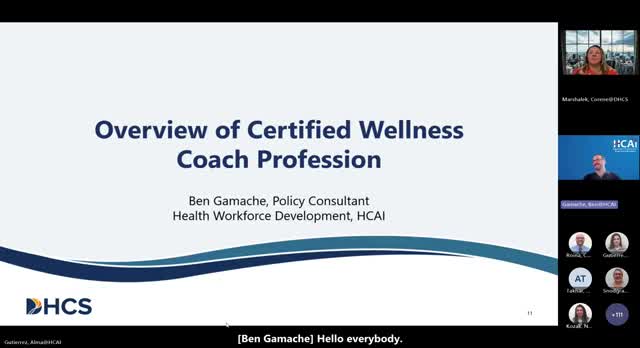
Summary
HCAI and DHCS presenters outlined two certification pathways for Certified Wellness Coaches (education and workforce), accepted majors, required hours, supervision expectations and recertification rules.
California officials described the Certified Wellness Coach (CWC) credential, two certification pathways and supervision expectations during a webinar on the CYBHI fee schedule. Ben Dimash of HCAI said the credential is intended to expand the school‑based behavioral health workforce and defined two paths: an education pathway tied to specific degrees and a workforce pathway that validates relevant supervised experience.
Who can qualify: Dimash said the education pathway accepts associate or bachelor’s degrees in specified majors — social work, human services, addiction studies and psychology — combined with minimum direct preclinical practice hours. The workforce pathway lets current employees document supervised experience; Dimash said the workforce path requires 1,350 hours for Wellness Coach 1 and 2,700 hours for Wellness Coach 2, “which is roughly equivalent to, 1 year of full time in an education setting” for the 1,350‑hour level.
Certification and oversight: HCAI is the certifying entity, Dimash said, and coaches must maintain active certification and recertify every two years. He noted certifications require verification such as transcripts and supervisor verification forms that applicants upload as part of their applications. Dimash also emphasized that CWCs “cannot operate independently and they must operate under appropriate supervision,” explaining that supervisors in school settings should be PPSC credential holders or licensed clinicians, and that outside schools the supervising clinician must be licensed.
Why it matters: Certification determines who may bill under the CYBHI fee schedule for wellness‑coach services and is intended to create an entry point into behavioral health careers while strengthening retention by enabling billing for coached services.
Operational notes from presenters: HCAI provides a CWC status search tool for employers (requires legal first and last name and certification ID), a certification walkthrough deck, and supervisor forms to document hours. Presenters advised employers and applicants to consult the walkthrough and the HCAI support team for specific questions about documenting hours and combined employment histories.
Ending: HCAI urged employers to confirm certification status before billing and to plan supervision and regular check‑ins for CWCs as part of implementation.