
Council OKs schematic design for Ultra Sports Complex Phase 2, approves preconstruction work despite operational questions
Get AI-powered insights, summaries, and transcripts
Subscribe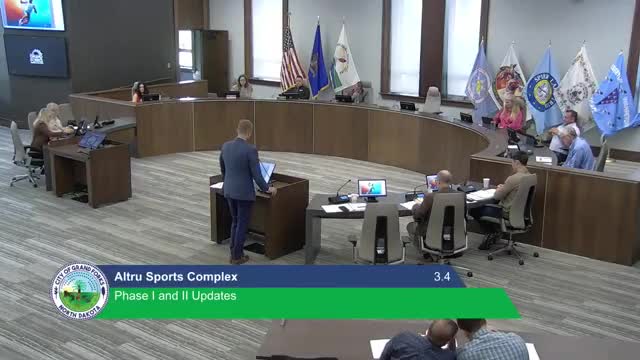
Summary
The Grand Forks City Council Committee of the Whole voted Monday to advance schematic design and preconstruction work for Phase 2 of the Ultra Sports Complex, endorsing a four-court addition with integrated sports-training space while requesting firm operating-cost estimates before construction bids are sought.
The Grand Forks City Council Committee of the Whole voted Monday to move forward with schematic design and preconstruction work for Phase 2 of the Ultra Sports Complex, endorsing staff’s recommendation for a four-court addition with consolidated sports-training space while directing staff to return with refined cost and operations estimates. The motion passed after a voice vote with one dissent.
City staff said schematic design will allow the project team to refine costs and prepare firmer bid packages; staff also presented two conceptual options — a 4-court, 60,000-square-foot addition and a 2-court, 38,000-square-foot option — and requested authority to proceed with design work and a construction manager at-risk preconstruction fee.
The council’s action follows months of design and stakeholder engagement by the city, GLG (design team) and the Park District. Under the preferred 4-court option staff estimated a phase-2 construction cost of about $19.5 million and a total project all-in estimate of about $109.5 million; the 2-court option was estimated at about $13.7 million construction and a $103.6 million all-in budget. Staff stressed these are conceptual, rough-order-magnitude estimates to be refined in schematic design.
City project manager Todd Phelan told the committee the design team developed program options with park-district operators, youth sports groups and other stakeholders to maximize flexibility and year-round use. "We are really trying to be holistic and create an extension of Phase 1," Phelan said. The four-court option includes spectator seating for roughly 1,600 (using portable, tip-and-roll bleachers), multipurpose rooms, satellite concessions, and about 7,000 square feet of integrated sports-training space adjacent to the turf facility.
Oliver (construction estimator) summarized estimated costs and cautioned they are conceptual. "These are rough-order-magnitude costs based on similar projects and Phase 1 pricing; schematic design will allow us to refine the estimate," he said. The team reported the 4-court construction estimate at about $19.5 million and the 2-court estimate at about $13.7 million; both totals include contingencies but not a separate owner contingency or escalation allowance at this stage.
The council also approved a change-order estimate to complete site infrastructure work needed to bring Phase 2 online: an additional $483,260 for pavement, earthwork and utility extensions. City staff said the work includes added sanitary and water utility runs, extra concrete pavement, earthwork and relocation of the onsite construction job trailer; McGough (construction manager) provided the pricing breakdown.
Park District representatives said consolidating sports training and court space in one facility is intended to improve operational efficiency and revenue potential. Park District representative (Mister Elliot) said the district currently rents about 10,000 square feet for sports-training programming at a privately owned facility and that moving training onto the Ultra site should create synergies and reduce future rental costs. "There are synergies by pulling people off the turf, off the aquatics, off the basketball courts," he said.
But several council members pressed staff for more detailed operating projections before committing major design and construction funds. Park District staff reported Phase 1 operations were expected to run a roughly $370,000 annual subsidy; Phase 2 operational shortfall was not yet finalized. "For Phase 2, that would be a bigger challenge for us, and that's where we'd have to find out what those Phase 2 losses would be and what the park district would be able to absorb," the Park District said.
Council Member Sasowski voiced concern about adding courts without firm commitments from local user groups on rentals and about the effect on taxpayers. "I'm really struggling right now with moving forward to spend $20 million when we don't have agreement from the clubs to participate within the facility," she said, and later voted against the motion.
Supporters, including Visit Greater Grand Forks, said a larger, single-site facility improves tournament logistics and increases the city’s ability to attract events that bring hotel stays and visitor spending. Julie Regg of Visit Greater Grand Forks said youth tournaments produce substantial direct spending; the city, park district and Visit Greater Grand Forks are discussing a shared event-manager role to help secure tournaments and assist volunteer organizers.
Council members directed staff to proceed with schematic design but to return with updated, more detailed cost estimates and an operations/maintenance forecast by January 2026. Staff said schematic design should take roughly 10–12 weeks and that key decision points remain: a January cost update, design-development refinements, and later requests for Guaranteed Maximum Price approvals for construction phases.
The motion to approve schematic design and preconstruction work was moved by Council Member Berg and seconded by Vice President Weigel; it passed on a voice vote with one dissent. The council also approved the $483,260 site infrastructure change order under administrative authority to keep Phase 2 readiness work aligned with ongoing Phase 1 construction.
If the council declines any subsequent approvals after schematic design, staff said the city would retain the developed design documents and could pause or reschedule construction actions. The city emphasized this is a multi-step process with multiple formal approvals ahead of any construction contracts.
Clarifying details presented at the meeting included the $483,260 site increment (paving $57,000, water main $97,000, sanitary sewer $97,000, earthwork $232,000, job-trailer relocation $54,000, plus contractor insurance/fees), the 7,000-square-foot sports-training proposal embedded in both options, and the Park District’s current leased training space of about 10,000 square feet at a private facility.