
Nashville review board returns multiple OPA findings, flags body‑camera, evidence and child‑safety concerns
Get AI-powered insights, summaries, and transcripts
Subscribe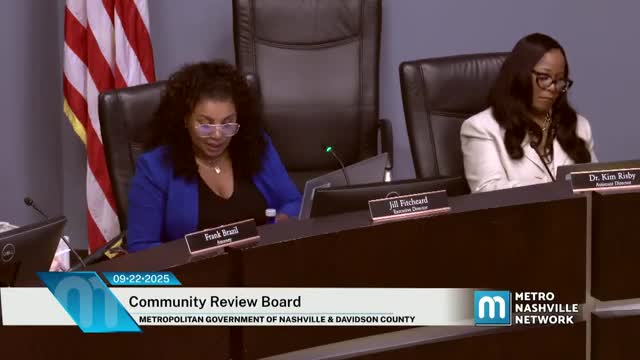
Summary
The Nashville Community Review Board voted to send multiple Office of Professional Accountability investigations back for further review on Oct. 1, citing missing body‑worn camera footage, factual inconsistencies and evidence‑handling concerns.
The Nashville Community Review Board voted on multiple motions at its Oct. 1 meeting to send OPA investigations and related documents back for additional review, citing factual discrepancies and missing or non‑recorded evidence in several cases.
The board authorized the executive director to return two documents with errors to OPA, a motion introduced during discussion of case closures. "I move at this time that we authorize the executive director to return the 2 documents, wherein the mistakes are made with this," a board member said; the motion passed unanimously by voice vote.
Why it matters: board members said the errors could change investigative findings or discipline. Several reviewers flagged (1) body‑worn camera (BWC) footage that was not recorded or not included in OPA case files, (2) apparent inconsistencies between OPA narrative language and underlying evidence, and (3) missing evidence chain‑of‑custody steps.
Major case actions and concerns
- Evidence handling (CC2023‑026): The board reviewed a case in which a family member volunteered to retrieve a phone after a fatal crash. The compliance monitor told the board the phone was retained by a detective and then held for six to seven months before families sought its return. The board noted that MNPD procedure requires evidence be logged into property before the end of the officer’s shift; one board member said similar failures previously resulted in suspensions. The board authorized the executive director to return the documents to OPA for correction.
- TLO access and honesty (NCRB 2024‑043): In a complex review about an MNPD officer who used the TLO database to locate a detective’s personal number, OPA concluded the officer’s use of TLO and subsequent calls were authorized and found allegations unfounded. The board’s reviewer recommended adding a potential violation for honesty and truthfulness and asked that OPA reexamine whether the investigation relied excessively on the subject officer’s statements and omitted available witness interviews; the board voted to send the matter back to OPA.
- Child welfare, evidence of drug activity and officer remarks (CC2024‑069): The board reviewed a traffic stop in which a 13‑year‑old remained in a vehicle while the driver and passenger were detained for marijuana possession. Body‑worn footage showed the child in the vehicle for about 19 minutes; medics were present and the child was handed to family members at the scene. Several board members urged that the incident should have prompted a child‑protective services notification because of possible drug exposure and the presence of scales in the car; the board adopted the report and added a comment that a referral to child‑protective services "might have been warranted." The motion to approve passed.
- Body‑worn camera policy and conduct (CC2024‑056): A complainant alleged profanity and discourtesy by an officer directing traffic after a large event; the officer’s body camera was not activated while working a fixed traffic post. OPA concluded lack of video was "unfounded" based on its reading of policy, but the board’s reviewer called OPA’s investigation deficient and asked that the case be returned for fuller witness interviews and that MNPD policy on when BWCs must be activated be reviewed. The board approved returning the case to OPA and requested MNPD clarify whether BWC activation should be required for fixed‑post public‑facing encounters.
How the board separated discussion and decisions
Discussion: Board members debated whether OPA had interviewed available witnesses, whether investigators had obtained all relevant BWC files, and whether chain‑of‑custody or clerical errors were present in OPA correspondence.
Direction: The board directed the executive director to return specified documents and requested corrected evidence and missing BWC clips where OPA indicated files were not attached.
Decisions: The board passed motions to (a) authorize the executive director to return documents with errors to OPA, (b) send several case reviews back to OPA for further investigation or clarification, and (c) include a comment on CC2024‑069 that a child‑protective referral might have been warranted.
Board members emphasized that returning OPA files is not a disciplinary decision but a request for fuller investigation, citing MOU responsibilities to receive complete investigative packets.
What’s next: The executive director said the board will follow up with OPA and the chief’s office to obtain missing video and corrected narrative language before issuing final determinations. The board also discussed convening the MOU committee to consider procedural changes ahead of the MOU’s annual renewal in November.
Quote attribution: Quotes in this article are drawn from the board meeting transcript and are attributed to speakers listed in the meeting record.