Committee advances rewritten MFTE program with multiple amendments after heated public comment
September 22, 2025 | Seattle, King County, Washington
This article was created by AI summarizing key points discussed. AI makes mistakes, so for full details and context, please refer to the video of the full meeting. Please report any errors so we can fix them. Report an error »
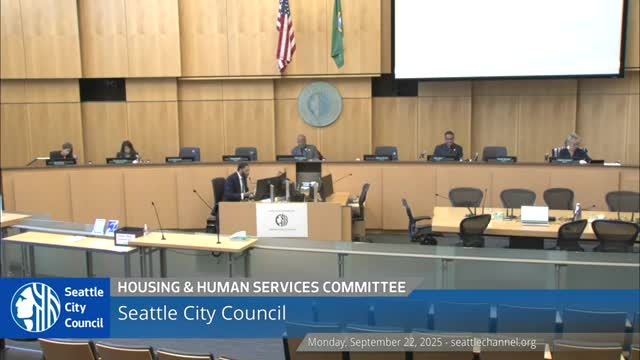
The MFTE proposal, often referred to in the meeting as "program 7" or "P7," would replace the current program in use ("P6") and changes income and rent limits, unit classifications, and administrative rules for qualifying projects. Supporters said the changes are intended to restart stalled housing production, while renters and tenant advocates urged caution, more renter input, and protections for existing residents.
Why it matters: MFTE is one of Seattle's primary tools for incentivizing workforce housing (units aimed at households between middle and lower incomes). Changes to the program affect rent caps, income eligibility for regulated units, and the incentives owners receive; they can influence how many family-sized units get built and whether existing rent-restricted units remain affordable when projects are rebuilt or extended.
Most important actions and outcomes
- The committee moved and recommended passage of council bill 121055 as amended. The committee recorded a 5-0 favorable recommendation to send the bill to the full City Council for final action.
- The committee adopted multiple amendments to refine unit definitions, reporting and implementation deadlines, extension rules for expiring projects, and incentives for two- and three-bedroom units. Key adopted changes include raising the AMI and rent level for "alternative" one-bedroom units (amendment 1 adopted), adding administrative deadlines and a streamlined income-verification process (amendment 3), permitting certain redevelopment projects to use MFTE without providing additional replacement units (amendment 4), allowing projects completed under P6 in 2025 to convert to P7 (amendment 5), and adding a sunset date for the program (amendment 13). Several other technical and implementation amendments were also adopted.
What speakers said
- Tenant advocates urged delay and stronger renter protections. Holly Willis, policy manager at the Seattle/King County Coalition on Homelessness, urged the committee to reject amendments she said would reduce public benefit and to renew P6 for a year to allow comprehensive renter review. She also asked the council to adopt amendments that would increase affordability for smaller MFTE apartments.
- Representatives of the development community said MFTE is essential to restart construction. Raymond Connell of Holland Partner Group said the program is not a panacea but is one way to restart housing production when cranes are scarce.
- Renter leaders and commissioners said P7 raised allowable rent and AMI caps and encouraged very small units rather than family-sized housing. Kate Reuben, co-executive director of BCR and interim co-chair of the Seattle Renters Commission (speaking in a professional capacity), recommended rejecting P7 and extending P6 for one year to allow more renter engagement. Several tenants and property managers urged the committee to preserve larger two-bedroom units and to allow certain expiring properties to renew their exemptions.
Implementation and deadlines
- The committee added administrative timelines. The Office of Housing (OH) must publish director's rules on unit selection, comparability and distribution, and update its compliance manual (including tenant self-certification options) by dates specified in adopted amendments. The bill as amended explicitly ties MFTE rents to HUD median income definitions for annual adjustments.
- Extensions and conversions: The committee adopted provisions allowing projects that completed under P6 in 2025 to convert to P7, while grandfathering existing tenants at their P6 income/rent levels (they remain regulated at the older AMI so long as the tenant remains in the unit). Projects expiring in 2025 were given extra time to apply for 12-year extensions and come into compliance.
Dissent and concerns
- Public commenters and some council members raised concerns that the proposal, as drafted, increased maximum AMI and rent caps and could incentivize smaller units rather than two- and three-bedroom units needed by families. Some amendments were specifically designed to incentivize larger family-sized units and to require more robust reporting on tenant demographics and affordability outcomes.
Next steps
- The committee recommended the bill to the full City Council with the adopted amendments; council staff said the earliest likely date for full council consideration is Oct. 14, 2025, given the upcoming budget work, though the schedule could change. If adopted by the council, the ordinance will set the new rules for projects applying for MFTE credits or seeking extensions.
Ending note: The meeting combined robust public comment from renters, tenant advocates and developers with detailed technical debate about AMI thresholds, unit definitions and administrative capacity. The committee used amendments to balance competing priorities: encouraging production, especially of family-sized units, while adding reporting, deadlines and grandfathering protections for existing tenants.
View the Full Meeting & All Its Details
This article offers just a summary. Unlock complete video, transcripts, and insights as a Founder Member.
30-day money-back guarantee
Sponsors
Proudly supported by sponsors who keep Washington articles free in 2026

