Get Full Government Meeting Transcripts, Videos, & Alerts Forever!
Get email alerts on the Air Quality topic
No spam. Unsubscribe anytime.
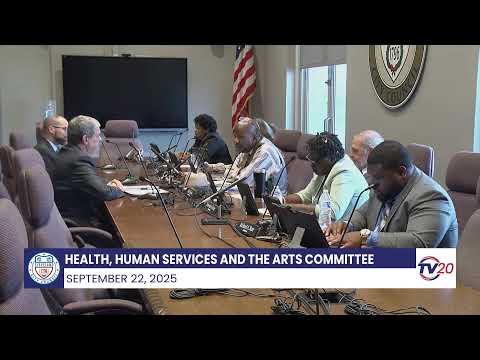
Committee approves ODH radiation-monitoring grant; presses for anti‑idling signs and community outreach
Summary
The Health, Human Services and Arts Committee approved ordinance 9722025 to accept a Ohio Department of Health grant to support air radiation monitoring; members sought clearer dollar figures, asked about monitoring protocols and emergency response, and discussed anti‑idling enforcement and outreach in Glenville.
The Health, Human Services and Arts Committee approved ordinance 9722025 to accept a grant from the Ohio Department of Health to support air radiation monitoring, and members used the same meeting to press for anti‑idling signage and community outreach in Glenville. A health department representative told the committee that the Ohio Department of Health (ODH) currently collects and analyzes air samples and that the local grant would formalize the monitoring arrangement.
Committee members said the item matters because the monitoring site lies between two nuclear power plants and because residents have raised air‑quality concerns. Council members pressed staff for clearer funding numbers, details on who performs analyses, and how emergency protocols would work if elevated readings occurred.
The health department representative told the committee, “This is a request for us to accept a grant from the Ohio Department of Public Health,” and said the department is arranging sample collection and lab analysis through ODH. Commissioner David Hearn, Division of Air Quality, described the monitoring setup: “We have an air monitoring device that is located at Park Lakefront Airport. And this device just pulls in air and... screens out any particulates including any radiologic materials. And then... we collect the samples and they are sent to the Ohio Department of Health Lab and analyzed.” He said collections are done on a weekly or biweekly cadence and that ODH has established protocols for measuring and responding to results.
Committee members pressed for financial clarity. A committee speaker said the council summary did not include an estimated cost; the health department representative said the draft indicated a $7,070,000 figure but that a firm dollar amount had not yet been transmitted because the money from ODH is appropriated at the federal level. The representative said, “We are assuming based on previous grants that it will be consistent. And that's how we developed our budget for this legislative request.”
On roles and emergency response, Hearn and department staff said local partners would be involved if an issue arose. Hearn said state protocols guide response and that the fire department and a regional team participate: “We involve the fire department... the Cuyahoga County Office of Emergency Management, our team, Emergency Management. And so it's all hands on deck.” The health department representative added that the ODH bureau that handles radiation would lead analyses and communications when necessary.
Members also discussed non‑radiation air concerns. The committee noted an amended anti‑idling ordinance that gives the health department authority to assist enforcement and to place signage. Committee discussion said the department has put a budget request for additional signs and planned promotions around the anti‑idling ordinance. A council member asked staff to bring the grant and cost details to the finance committee and said staff would re‑circulate the information to council members and finance.
Committee members invited the air quality team to meet with residents at a planned community meeting at True Vine Church in the Glenville neighborhood to discuss local air quality and idling. One council member said, “Air quality is very, very, very, very, very important,” and asked staff to present localized data and outreach plans. Staff agreed to attend and to provide materials for finance and for the community meeting.
Formal action on ordinance 9722025 was recorded as approved during the session; no mover/second or roll‑call tally was provided in the transcript. Committee discussion made clear that (1) ODH is currently conducting sampling and analysis at its expense, (2) the local grant would fund local monitoring work but the final grant amount was not yet confirmed, and (3) emergency response would follow established state and regional protocols involving fire and emergency management partners.
Next steps noted by committee members included staff delivering the grant figures and budget details to the finance committee, re‑circulating grant documents to council members, and participation by the Division of Air Quality and the health department in the scheduled Glenville community meeting. The committee adjourned after the approvals and invitations.