Get Full Government Meeting Transcripts, Videos, & Alerts Forever!
Get email alerts on the Procurement topic
No spam. Unsubscribe anytime.
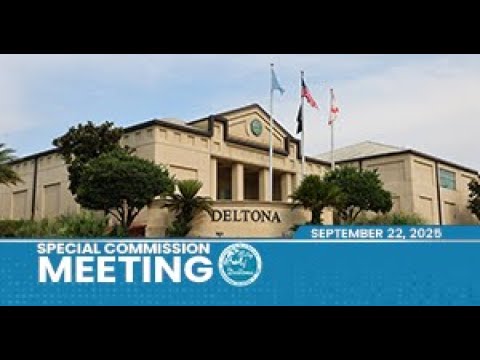
Deltona commission raises city manager's unbudgeted spending limit to $75,000 after heated debate
Summary
After months of ad-hoc limits, the Deltona City Commission voted to restore the March purchasing rule for budgeted items and set the city manager's unbudgeted spending authority at $75,000; a prior attempt to fully revert to the March policy failed in a tie.
The Deltona City Commission on Tuesday restored the March 2025 purchasing policy for budgeted line items and voted to give the city manager authority to approve unbudgeted purchases up to $75,000 without returning to the commission.
The change came after a lengthy debate about how frequently staff must bring purchases to the dais. Finance Director McKinney told commissioners that the March 3 resolution (Resolution 2025-25-29) had allowed the city manager to purchase items fully line-itemed in the adopted budget in any amount, set the manager's unbudgeted authority at $50,000 and required any formal solicitation over $100,000 and all capital improvement program (CIP) items to come back to the commission for approval. He said a June 23 consensus vote (not adopted as a resolution) had effectively lowered the practical threshold to $25,000 and that, since July 21, staff had been returning dozens of purchase items to the commission as a result.
"What was passed in March 3, resolution 20 25 dash 29 was for all goods and services budgeted and capital that it's line itemed in the budget. The city manager had authority to purchase. His line item approval that was not budgeted was $50,000," McKinney said, adding that anything over $100,000 that required formal solicitation still had to come back to the commission.
Commissioner Emma Santiago moved to revert the purchasing policy to the March version. Vice Mayor Harriot seconded that motion, but a later roll call produced a tie and the motion failed. After public commenters urged limits that still allow emergency repairs and routine operations, Commissioner Novick moved, and Commissioner Santiago seconded, an amendment to adopt the March purchasing policy approach while increasing the city manager's unbudgeted threshold to $75,000. The commission approved that motion on a roll call vote (Yes: Commissioner Novick; Commissioner Santiago; Vice Mayor Harriot; Mayor Vila; No: Commissioner Veil Vasquez; Commissioner Caldwell).
During discussion, commissioners debated where emergencies should draw on city funds and how contingency dollars are accessed. McKinney said the city does not maintain a separately labeled "emergency fund" but has contingency amounts that can be transferred when authorized; he cited roughly $250,000 in general-fund contingency and about $500,000 in water/sewer contingency. Commissioners also cited a statutory disclosure rule discussed during the meeting: elected officials and staff with signing authority above certain thresholds must file a Form 1 financial disclosure (the transcript referenced a $35,000 threshold in that context).
Public commenters pressed for accountability and clarity. Resident Kathy Bridal told the commission to give the manager authority for true emergencies while retaining commission oversight for non-emergency, higher-value spending. Allison Rue, another commenter, said she supported raising the limit to at least $50,000 for operational flexibility but opposed removing oversight for substantial unbudgeted expenditures.
The new arrangement keeps the March 2025 rule that budgeted, line-itemed purchases may be completed by the city manager without returning to the commission, preserves the requirement that formal solicitations/competitive procurements above the statutory solicitation threshold be presented to the commission, and sets the city manager's authority for unbudgeted purchases at $75,000. Commission direction left CIP purchases and items in CIP-designated funds to continue coming to the commission regardless of amount, consistent with the March guidance McKinney summarized.
The commission recorded that the June consensus had created significant extra agenda items and staff work and said the revised threshold should reduce repeated returns to the dais while preserving elected oversight for larger or capital procurements.
Commissioners also asked staff to place a purchasing-policy workshop on a future calendar to finalize details and a clearer written resolution reflecting the changes.
Less-critical details: the commission first voted to add the purchasing-policy item to the agenda earlier in the meeting (passed 4-3), and the discussion included questions about Form 1 compliance and contingency balances; McKinney offered to provide comparative thresholds from nearby municipalities.