Get Full Government Meeting Transcripts, Videos, & Alerts Forever!
Get email alerts on the Municipal Empowerment Act topic
No spam. Unsubscribe anytime.
Administration proposes time‑limited post‑retirement hiring flex and new OPEB commission in Municipal Empowerment Act
Summary
Administration witnesses described provisions in the Municipal Empowerment Act to allow short, time‑limited critical‑shortage exemptions for rehiring retirees and to establish a renewed commission to study OPEB liabilities and options for local fiscal stability.
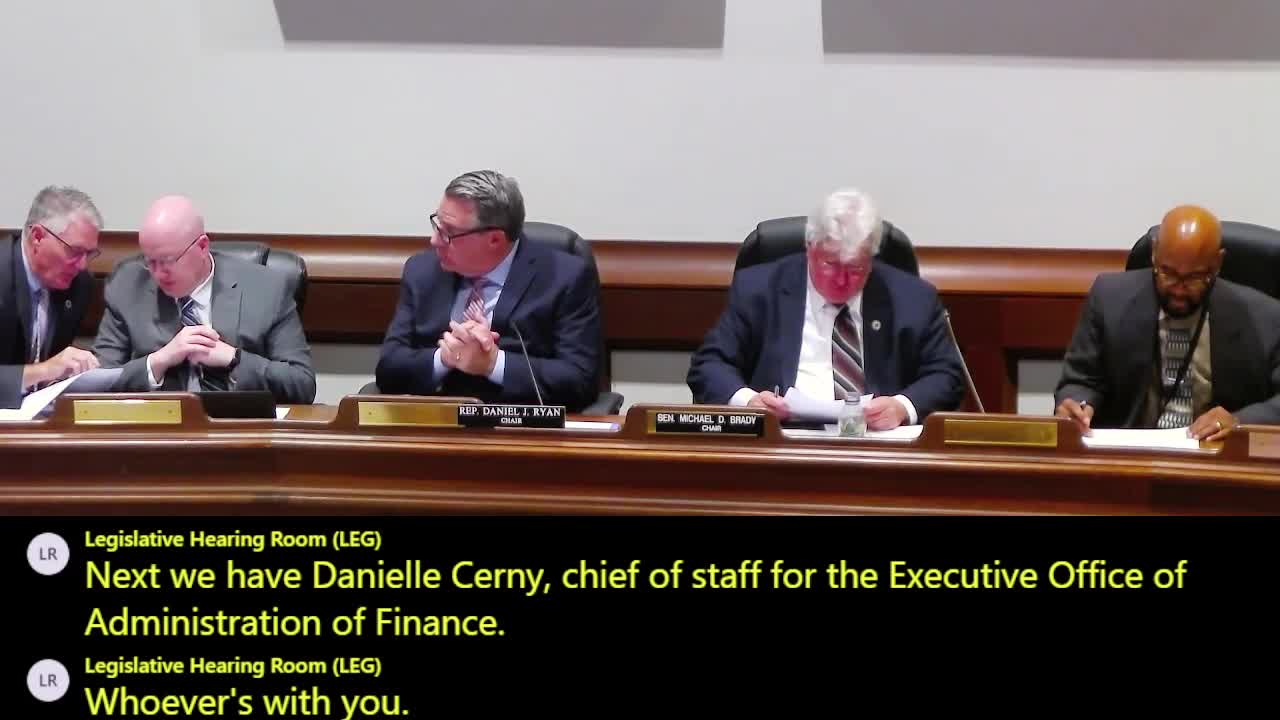
Danielle Cerny, chief of staff to the Secretary of Administration and Finance, and Sean Cronin, senior deputy commissioner at the Division of Local Services, told the Joint Committee on Public Service that the administration’s Municipal Empowerment Act (H.56) includes two main provisions before the committee: a time‑limited expansion of post‑retirement employment exemptions for critical‑shortage positions and a renewed commission to examine other post‑employment benefits (OPEB) liabilities.
The lede: the administration proposes allowing a municipality or state agency to request a two‑year “critical shortage” designation for a specific position or class of positions, permitting retired state or municipal employees to return to work without being subject to current caps; the provision would sunset after three years overall unless extended.
The nut graf: officials said the proposal is a short‑term, tightly circumscribed fix to staffing shortages while longer‑term pipeline and training solutions are developed. Cerny said the proposal was informed by listening sessions with over 130 municipal leaders and was updated after consultation with the Inspector General to include time bounds.
Details offered: the critical shortage designation would require evidence of genuine recruitment efforts, modeled on the Department of Elementary and Secondary Education (DESE) process for teacher shortages; initial approvals would last two years and extensions would require documented ongoing shortage. The administration emphasized the exemption is an interim measure and that they are investing in pipeline programs such as a local finance fellowship that has placed 73 community college students in municipal internships over three years.
On OPEB, Cerny said municipal OPEB liabilities total roughly $53 billion based on a 2021 report and dwarf unfunded pension liabilities; unlike pensions, municipalities are not legally required to fully fund OPEB. The Municipal Empowerment Act proposes establishing a renewed OPEB commission comprised of local officials, labor and finance experts to study benefits, costs and shared responsibilities, and to recommend reforms.
Municipal officials supported the bill as a practical tool. Dave Kaufman, legislative director of the Massachusetts Municipal Association, and local HR leaders Jen Breaker (Danvers) and Emily Russo (East Hampton) described municipal experience filling specialized roles and said carefully documented, time‑limited rehiring of retirees prevents service disruptions while pipelines are built.
Questions from committee members focused on safeguards against gaming the exemption. Cronin and administration witnesses said applications would require demonstration of meaningful recruitment efforts and would be treated as an option of last resort.
Ending: No committee action was recorded at the hearing; supporters urged the committee to report the Municipal Empowerment Act provisions favorably to provide municipalities short‑term flexibility while pursuing longer‑term workforce and OPEB reforms.