
Talent leaders review draft RFQ for Gateway site, discuss incubator funding and land-disposition options
Get AI-powered insights, summaries, and transcripts
Subscribe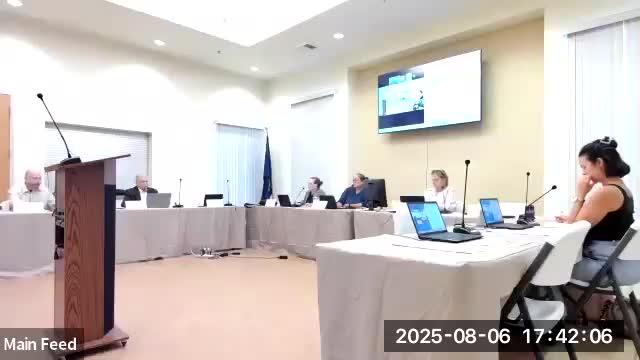
Summary
Councilors and staff reviewed a draft request for qualifications for the Gateway redevelopment site, discussed whether the city should sell or retain land, possible discounts to support an incubator hub, and constraints from state affordable‑housing incentives and prevailing‑wage rules.
Talent City Council members and the Talent Urban Renewal Agency reviewed a draft request for qualifications for the Gateway redevelopment site on Aug. 6, focusing on how the city will dispose of land, what incentives to offer potential developers and how the site might support a separate business‑incubator “gateway hub.”
The RFQ, presented by consultant Matt Brinkley of Greentop Planning, was described as an early‑stage document intended to preserve flexibility. “This is the first part of kind of a two‑step process in approving the RFQ,” Brinkley said, and the city will return in September with a near‑final version for approval.
Councilors and staff debated whether the city should transfer private ownership of much of the parcel or retain some public ownership for shared uses. Alex (city staff) said the agency has discussed a business incubator and has been talking with regional partners about funding and scale; he said roughly $1 million from sale proceeds of the balance of the site could be proposed toward building a hub. “I proposed approximately a million dollars from the sale of the balance of this site towards that,” Alex said.
The council heard details about financing tools that could change the economics of a deal. Staff noted a state tool promoted by Oregon Housing and Community Services (OHCS) that can help middle‑income housing (targeted at 80–120% of area median income), but that using the tool effectively means foregoing some tax revenue for up to 10 years. Matt Brinkley warned that discounts on the land exceeding a statutory threshold can trigger prevailing‑wage requirements: “Writing down that land value by more than $750,000 requires…the threshold at which a developer has to use prevailing wage,” he said. Staff later said comparable land sales they had reviewed were “around $400,000 an acre,” and that the balance parcel’s market total was about $1,500,000, though that depends on whether a buyer is willing to pay market price.
Councilors asked staff to keep the RFQ open to mixed‑use proposals that include commercial space and middle‑income housing (80–120% AMI), and to include background documents such as the Salazar architect report and a commercial market study as appendices to the RFQ. Several councilors said the RFQ should clearly signal the city’s priorities — for example pedestrian‑friendly design and commercial space to support economic recovery — and that scoring criteria should be aligned with those priorities.
On timing and next steps, staff said the RFQ would be revised based on comments and returned in September at an advanced draft; councilors were asked to consider who should serve on a scoring or recommending panel when the city evaluates submissions. No formal motions or votes were taken during the discussion; the item concluded with staff taking direction to refine the RFQ and return with a more complete draft.
Meeting participants noted multiple unresolved constraints: (1) regional and state review and concurrence (OHCS must concur for certain funding pathways), (2) the cumulative amount of city/agency incentives that would count toward prevailing‑wage thresholds, and (3) tradeoffs between maximizing revenue from land sale and using land value or other incentives to secure desired program outcomes.
Questions remain about exact land appraisal, whether incentives such as system‑development charge (SDC) deferrals will be offered, and how much of the site the agency will retain. Staff said the RFQ can present incentives as items for negotiation rather than formal commitments.