
Leon Valley council adopts 0.54504 property tax rate to cover budget shortfall, fund public safety
Get AI-powered insights, summaries, and transcripts
Subscribe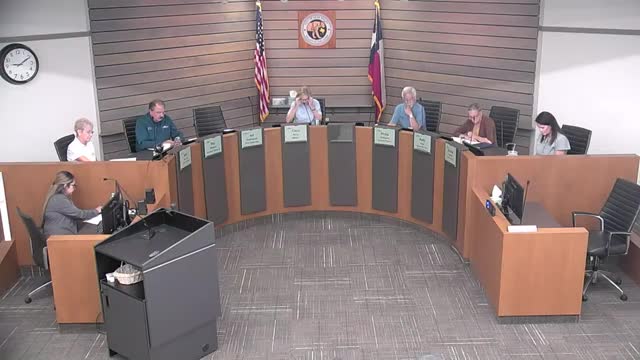
Summary
On Sept. 20 the Leon Valley City Council voted 3–2 to adopt a 0.54504 property tax rate for fiscal 2025–26, directing most of the increase to maintenance and operations to address revenue losses and add public-safety staffing.
LEON VALLEY, Texas — The Leon Valley City Council voted 3–2 on Sept. 20 to adopt a property tax rate of 0.54504 for fiscal year 2025–26, allocating 0.497818 for maintenance and operations and 0.047222 for interest and sinking. Councilors who supported the measure said the increase was necessary to cover a significant drop in taxable value and to fund additional public-safety personnel. The vote followed public comments urging the council to prioritize police, fire and emergency medical services and a sustained council debate over alternatives and reserves.
The adopted rate, the council was told, exceeds the no-new-revenue rate and was presented as a response to an estimated $46 million reduction in the city’s taxable value. Councilor Ivana Orozco moved the 0.54504 rate; the motion passed with three ayes and two nays. The council recorded its votes as: Councilor Bolton — no; Councilor Hile — no; Councilor Campos — yes; Councilor Roscoe — yes; Councilor Mersch — yes.
City staff and councilors described the adoption as an attempt to stabilize ongoing operations without relying on one-time reserves. Councilor Victor Campos summarized the city’s revenue mix, saying the city relies heavily on property-tax revenue and has not realized the valuation gains larger jurisdictions have reported. “We rely — 42% of our revenue comes from property taxes,” Campos said during the meeting, noting Bexar County and San Antonio’s larger revenue bases and the city’s $46 million removal from the tax rolls.
Council discussion and public comment emphasized public safety. Multiple residents urged the council to raise the rate to preserve police, fire and EMS service levels. Resident Abraham Diaz told the council, “You fund public safety first, and then everything else after that,” and described personal experience with delayed mutual aid responses. Councilors and residents also discussed a year-and-a-half-old study recommending the city add three firefighters; several councilors said the adopted increase is intended to begin addressing that staffing need.
Councilors debated alternatives before the final vote. Proposals considered during the meeting included a 0.51504 rate (which failed for lack of a second), a 0.52504 option that would have funded one firefighter and would have phased in additional hires, and a 0.54 figure discussed earlier in the process. A motion to adopt 0.52504 (moved by Councilor Bolton and seconded by another councilor) failed by a 2–3 recorded vote. After additional discussion and a brief recess for staff to prepare revised calculations, Councilor Orozco moved the 0.54504 rate that ultimately passed.
Staff clarified limits on using reserve and special funds to pay ongoing personnel costs. A staff member explained that while reserves can be used, “you should never use reserve funds to fund salaried positions because eventually, you run out of reserves,” and that the city’s economic and community development fund already had budgeted commitments. The council was told the economic-development reserve showed approximately $933,000, but much of that revenue had been allocated in the proposed budget; about $200,000 remained in a project-funding line that could be repurposed but would reduce project spending.
Councilors weighing the proposal pointed to several cost pressures: rising health insurance and other operating costs, projected reductions in sales and property values, and rising water rates from the San Antonio Water System (SAWS) that staff said will increase rates about 26% over five years. Councilor Hile, who proposed a lower rate earlier in the meeting, said household incomes and local cost pressures make increases difficult for many families. “When you’re making $57,000 a year, it is going to be very difficult to have a tax increase as minor as it seems,” Hile said.
The council also discussed revenue previously provided by red-light camera fines, which funded six police officers and administrative positions. Several speakers noted that loss of that revenue would put additional pressure on the general fund. Councilors discussed phasing in firefighter hires over multiple years to reduce near-term burden on households while beginning to address staffing shortfalls.
The council opened several opportunities for public comment and heard a mix of support and concern. Several residents, including Richard Blackmore and Abraham Diaz, said they would accept a tax increase if it preserves safety services. Others urged a more gradual approach to hiring. Staff repeatedly reminded the council that the proposed tax rate is set annually and can be changed in future years if conditions improve.
The council adjourned at approximately 9:48 a.m. and noted the next regular meeting is scheduled for Oct. 21. The adopted 0.54504 rate will be posted as part of the city’s budget and required taxpayer-impact materials.