Get Full Government Meeting Transcripts, Videos, & Alerts Forever!
Get email alerts on the Water Infrastructure topic
No spam. Unsubscribe anytime.
Springdale water utility: existing lines fall short of fire-flow needs for proposed hangar expansion
Summary
Springdale Water Utilities staff told the Airport Commission that a 6-inch line serving the airport delivers roughly 1,000 gallons per minute—below a 1,500 gpm minimum often required for hangar expansions—and outlined upgrade options, funding limits and next steps for further modeling.
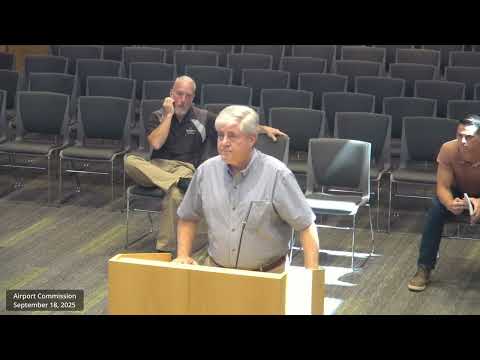
Springdale Airport commissioners heard detailed hydraulic modeling on Sept. 18 showing the airport’s existing 6-inch water main cannot deliver the fire flow likely required to support proposed hangar expansions.
Springdale Water Utilities staff engineer Rick (last name not specified) told the commission the hydrant at the end of the existing 6-inch line produced “about a thousand gallons plus or minus per minute” in field tests and that an 8-inch replacement would raise flow only slightly—still short of the 1,500-gallon-per-minute threshold the commission discussed for expanded hangars.
The presentation combined field flow tests and computerized hydraulic models. Rick outlined several reinforcement scenarios—upsizing lines on Powell Street, interconnecting with larger mains to the west and a longer bore from a 16-inch line on Old Missouri Road—but said costs and construction complexity vary widely. He told commissioners a 12-inch replacement along the full route would add only “another 50 gallons a minute” in the model results, and that “there’s multiple ways of getting potential capacity” but several routes would require extensive off-site work.
Commissioners and utility staff discussed options that could involve cooperation with nearby projects. Rick said a connection coordinated with planned Powell Street work could reduce off-site paving disturbance; the utility also modeled a potential tie-in through a nearby school site as a cost-sharing opportunity. The commission chair (name not specified) emphasized funding limits, saying, “Remember, when we’re talking about utilities like this, we can only use state funding. We cannot use federal funding for this.” A commissioner suggested boring under the airport from the 16-inch main on Old Missouri Road; Rick said the hydraulics could be modeled but that costs for a bore would be high.
Several specific measurements and model outcomes were cited during the discussion: a modeled hydrant flow of about 992 gpm at the end of the 6-inch line; field/model results of roughly 2,400 gpm at a recently installed 8-inch line fed from Powell Street; and modeled improvement to about 1,468 gpm further west—still below the stated 1,500 gpm minimum. Commissioners discussed on-site segments (labeled in the utility analysis as segments 1–3) versus principally off-site segments (segments 4–5), and Rick recommended engaging a fire-safety specialist to determine building-level requirements such as firewalls or sprinklers if hangars are enlarged.
On next steps, Rick offered to run additional “what-if” scenarios and said the utility staff would provide the commission with copies of the model outputs. Commissioner Jim Gardner asked the utility to produce a PDF of the presentation; Rick agreed: “Give us a couple hours. We’ll sit down. We can go through all this stuff,” and staff agreed to send the materials to airport staff member Beth for distribution. The commission did not take formal action on the matter at the meeting.
Why it matters: fire-flow capacity determines whether existing hangars can be enlarged without substantial building upgrades or whether new water mains and hydrants—and the resulting construction cost and disruption—are needed before development can proceed.
The commission’s discussion identified both technical and funding constraints: the utility said on-site upgrades are generally eligible for state grant funding (the group discussed an available state grant program that staff said provides about $300,000 per year), but work that touches off-site infrastructure may not qualify under that program and would require different funding sources.
The commission directed staff to pursue further hydraulic modeling, to share the models and PDF materials with commissioners, and to coordinate follow-up meetings that can review specific routing and cost scenarios.
No motions or votes were taken on water-infrastructure projects during the Sept. 18 meeting.