Get Full Government Meeting Transcripts, Videos, & Alerts Forever!
Get email alerts on the Building Code Single Stair topic
No spam. Unsubscribe anytime.
Committee hears overhaul to allow single-stair midrise apartments; vote deferred while fire-code language is finalized
Summary
Councilmember Ryan Dorsey introduced council bill 25-0062 to allow newly built single-stair residential buildings up to midrise heights under prescribed safety standards; the committee postponed a vote while identical language is drafted into both the building and fire codes.
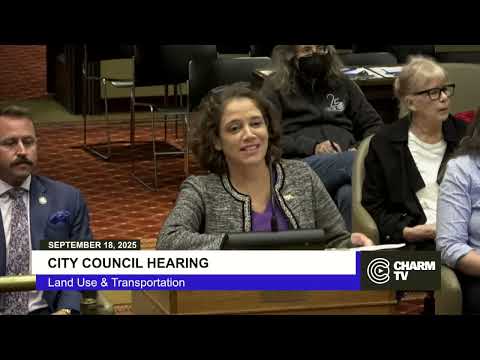
Baltimore City Councilmember Ryan Dorsey (Third District) presented council bill 25-0062 to the Land Use & Transportation Committee, proposing to amend the city's building code to permit newly constructed single-stair residential buildings up to mid-rise heights under specified safety standards. The sponsor described the change as aligning new-construction rules with the International Existing Building Code's allowances for single-stair renovations, and said the proposal would allow smaller-footprint, more varied apartment buildings while keeping fire-safety protections in place.
Dorsey and other supporters said the rule that requires two stairways for new buildings over three stories forces large, cookie-cutter buildings, increases costs and limits unit variety. He described the bill's safety requirements, which include full sprinkler systems, pressurized stairwells, fire-rated walls and doors, limits on unit count per floor and maximum travel distances from units to the stair. "The bill is barely 2 pages long and basically it is nothing but a list of ways to address fire safety above and beyond what we require for other buildings," Dorsey said.
The Baltimore City Fire Department, represented by Captain Dennis Dawson, testified in support of the bill as amended and explained technical safety elements to the committee. Captain Dawson described a pressurized stairwell as "a mechanical system that serves to evacuate the stairwell of any smoke," and noted pressurization and sprinkler design standards used in taller buildings can be adapted to the proposed midrise standard. The fire department said it worked with sponsors on a set of amendments but late-arriving drafting requirements meant the identical text must be copied into the fire code as well as the building code; that additional drafting need delayed the committee—rom voting on the bill that day.
Agency reports: The Law Department (Desiree Lecke) approved the bill for form and legal sufficiency following sponsor amendments. The Planning Commission voted in favor. The mayor's finance office and the Department of Housing and Community Development filed favorable reports or indicated support in committee. The fire department stated it supported the building amendments it had worked on with the sponsor.
Public testimony was broadly supportive from design and housing advocates. Dustin Watson of AIA Baltimore said the change would "propel sustainable development" and argued single-stair design can reduce circulation footprint, increase light and ventilation, and open small lots to feasible development. Jack Bevere, a small developer, said the two-stair rule increases the "loss factor" of otherwise usable square footage and that smaller-footprint single-stair projects can keep unit sizes larger and more affordable. The Baltimore Regional Housing Partnership highlighted how new housing options could expand affordable opportunities near resource-rich neighborhoods.
Opponents and cautious commenters raised questions about enforcement and the link between code changes and housing affordability. Keandra Pryor of Reservoir Hill asked that the bill text explicitly state it applies to new construction (the sponsor said it amends the International Building Code local text, not the IEBC that governs existing-building alterations) and asked that amended language be circulated publicly; supporters and the sponsor agreed to provide the final draft. Carson Ward, an online commenter, urged stronger affordability safeguards and criticized permitting and enforcement shortcomings in the city.
Action: The committee did not take a final vote on bill 25-0062. Councilman Dorsey said the fire department submitted additional technical amendments late in the day and that those changes must be drafted into both the building and fire codes word-for-word; because of this drafting requirement, Dorsey asked that the bill be added to the committee's voting session at the start of next week's hearing so the Department of Legislative Reference can prepare the matched amendments. The item was therefore postponed; sponsors said they will meet individually with committee members and with DLR to finalize language before the next session.
Why it matters: Sponsors and several housing-advocacy groups told the committee the change could enable more infill development on small lots, allow a wider mix of unit sizes and reduce construction costs that currently push developers toward small, high-rent units. Fire officials said carefully crafted sprinkler, compartmentation, pressurization and construction-type requirements are fundamental to achieving equal or better life-safety outcomes.
Next steps: DLR will prepare matched language for the building code and the fire code; the sponsor expects the committee to take up a vote at the beginning of the next hearing. Agencies and unions that participated said they would continue to review the specific drafting to ensure the fire-code text aligns exactly with the building-code amendments before the committee vote.
Ending: With drafting outstanding, the committee held the measure for one week to allow DLR to complete matched amendments and to allow committee members time to review the final text.