Get Full Government Meeting Transcripts, Videos, & Alerts Forever!
Get email alerts on the Retail Clustering Small Box topic
No spam. Unsubscribe anytime.
Baltimore committee advances ordinance to regulate new "small box" discount stores
Summary
The Land Use & Transportation Committee voted unanimously to recommend council bill 25-0040 with amendments that create a new zoning category and conditional-use review for new small-box discount stores; sponsors said the measure aims to curb clustering, protect local retailers, and require community review.
Baltimore City—ouncil committee members voted unanimously to recommend council bill 25-0040, which would add a new "small box establishment" use to the zoning code and require conditional-use review before new discount-merchant stores can open in C zoning districts. The Land Use & Transportation Committee approved the bill with a package of technical amendments Friday.
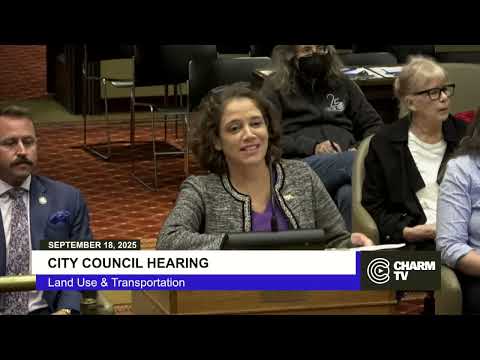
The measure was presented by Council Vice President Sharon Green Middleton (Sixth District) and co-sponsor Councilwoman Odette Ramos (Fourteenth District). Middleton told the committee the bill responds to a rise of closely clustered discount stores and said sponsors and agencies worked through several drafts with the law department and legislative drafters. Ramos said the bill "is making it a conditional use in all C zoning districts, C1 through C5," so new small-box stores must appear before the zoning board and the community.
Supporters and sponsors said the ordinance is intended to prevent saturation of discount retailers that they and community members say can limit shopping choice, displace independent grocers and specialty shops, and worsen food access in some neighborhoods. Ramos and Middleton emphasized that grocery stores, pharmacies, fuel stations and thrift stores are not the target of the law, and that the law department revised the bill to avoid singling out specific chains. "The law department said let's not do it that way. Let's do all of the small box stores, even if they're family owned," Ramos said.
Key provisions explained at the hearing and in sponsors' materials include: - New defined use: a "small box establishment" classification placed into the zoning code and building code so a permit/use approval is required before opening. - Conditional use: small-box establishments would be a conditional use in C1—1 zoning, meaning approval by the zoning board and community notice is required. - Distance requirement: the sponsors told the committee the bill includes a spacing rule to prevent new small-box stores from locating within roughly a half-mile of another such store. - Non-targeted exemptions: grocery stores and businesses primarily selling pharmacy or hygiene products are exempt.
The law department told the committee the revised language addresses earlier legal concerns. Jeff Hochsteller of the law department said, as the department—xplained in its report, the amended bill is legally sufficient and that conditions attached to a conditional-use approval typically "run with the land," so conditions remain in effect despite changes in ownership. Brandon Canoy of the planning department said the planning commission recommended approval of the bill with the amendments and noted a prior drafting typo had inadvertently omitted the distance standard; the commission's intent was to retain the spacing requirement.
Community members and civic organizations testified in favor at the hearing. Dwayne Alexander, a resident of Liberty Heights and Wabash, described three discount stores on a single block and said the businesses "are filthy" and contribute to poor food access. Diana Emerson, executive director of Waverly Main Street, said a Dollar General on her Main Street declined an MOU and then repeatedly allowed trash to accumulate and increased security costs for nearby merchants. Michelle Lafavorid, a former zoning hearing examiner, supported the bill with law-department amendments and urged careful drafting on nonconformities and renewal periods. Sharon Jones, speaking for the Liberty Coalition of Neighborhoods and Healthy Neighborhoods, said the bill "allows our communities to have a voice in who we bring into our communities."
Council members on the committee asked about enforcement and how a community could ensure conditions are followed over time. Ramos and Middleton described the use of memoranda of understanding (MOUs) negotiated at conditional-use hearings and the possibility of attaching terms as enforceable conditions; the law department cautioned that the enforceability of any side agreement depends on its drafting but agreed that conditions approved by the zoning board can be made municipally enforceable. Ramos also said the initial sponsor proposal to make a small-box conditional-use approval lapse immediately when a business left was removed after legal review; instead, the standard two-year abandonment/discontinuance period used elsewhere in the code will apply.
Action: The committee voted to adopt the sponsors' four-page amendment package and then voted in favor of recommending the bill, as amended, to the full council. Motion to move the bill was made by Vice President Sharon Green Middleton. Roll call recorded seven votes in favor, zero opposed. The bill will proceed to the full City Council with the committee's recommendation.
Background and next steps: Sponsors said the bill grew from community complaints about clustering of discount retailers and that Johns Hopkins, the planning department, law department and the mayor dministration collaborated on language. The bill will be scheduled for full-council consideration with the committee-adopted amendments. Committee members and sponsors said they will continue outreach to communities and clarify enforcement pathways in subsequent drafting if needed.
Ending: The committee hearing was followed by a voting session that approved the amendments and recommended the bill to the full council. The sponsors said they will continue work with the law department and community groups as the measure moves forward.