
Port of Alaska seeks change order authority, readies condition assessment and terminal work
Get AI-powered insights, summaries, and transcripts
Subscribe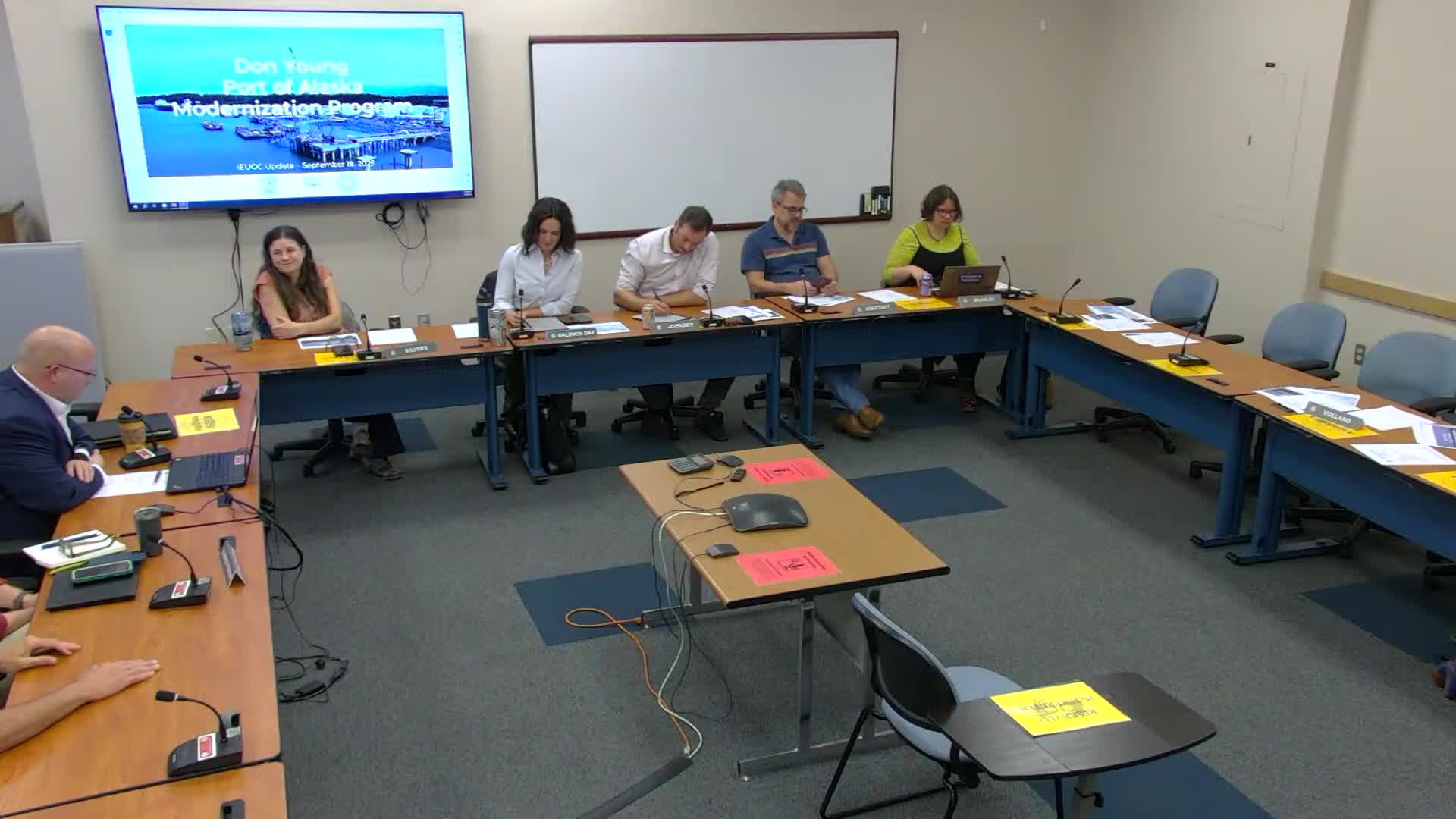
Summary
Port leaders briefed the Assembly committee on an $85,000 change‑order authority request for fender repairs, a POL‑2 condition assessment RFP, Terminal 1 construction milestones and related contract negotiations, including an extension request on crane agreements and ongoing director recruitment.
The Assembly’s Infrastructure, Enterprise and Utility Oversight Committee heard updates on multiple Port of Alaska projects and related procurement and personnel matters, including a change‑order authority request and a port condition assessment. Eric Adams, program manager with Jacobs, told the committee the Port of Alaska is seeking change‑order authority of $85,000 to repair unexpectedly corroded fender components on an existing contract.
Why it matters: the work is tied to ongoing port operations and larger Terminal 1 construction plans, and the committee was notified that additional Port decisions and contract negotiations will appear on upcoming assembly agendas.
Adams summarized contract history for the fender repair work. "Initial base contract was awarded to Swalley for $925,000," he said, noting a later change order added about $293,000 and that the current total contract value is about $1,200,000. He said the port will request authorization for $85,000 in additional change orders — roughly $55,000 to address rusted beams identified when fenders were removed and a remaining $30,000 for welding and replacement steel — and that an agenda item authorizing the change is scheduled for the next Tuesday assembly agenda.
Adams also said the port issued an RFP for a POL‑2 condition assessment with a 60‑day period of performance from notice to proceed and an expected completion in January 2025; the assessment is intended to outline POL‑2 deficiencies and replacement costs. He told the committee the Terminal 1 program remains on an overall schedule that anticipates site work beginning in 2026 and cited a federal MERIT grant agreement that will unlock $50,000,000 in federal funds once executed.
Mike Abbott, who introduced himself as the new interim port director, said he is five or six days into the role. "My name is Mike Abbott. I'm the new interim port director," Abbott said. Abbott acknowledged an ongoing Track J fence project and confirmed he would ask staff to check that port budget authority remains available to remove the old fence and install the new one as agreed by prior negotiations and a 2023 ordinance that rededicated Track J to public park use.
Committee members raised neighborhood and construction‑schedule concerns tied to Terminal 1 work, including pile driving windows. Christopher Constance, an assembly member who spoke for nearby Government Hill residents, reiterated a request that a two‑hour quiet window on Sundays be preserved if possible. Adams said the contractor’s baseline schedule shows six days per week and that the port will coordinate noise and routing with stakeholders during construction.
On crane agreements and related procurements, municipal staff asked the committee to continue crane agreement items to allow further negotiation; staff asked for two additional meetings to finalize terms. The committee was also told a Matson representative will be invited to introduce themselves to the committee and that a Port Advisory Board appointment (Miss Tungle) will appear on a subsequent agenda.
On staffing, Abbott said the port director search has been widely posted and that more than a dozen applicants passed initial screening; first‑round interviews are underway. Peggy Wood Pearson, identified in the meeting as municipal manager, and Abbott said the selection committee hopes to make an offer by October and, realistically, to have a permanent director in place later in the year if negotiations and notice periods allow.
There were no formal votes on port items during the meeting; staff noted several items (the change order authorization and crane agreements) will appear on future agendas for formal action.
Looking ahead: the committee was asked to expect formal agenda items for the change order authorization, continued crane agreement negotiation items, a POL‑2 condition assessment outcome, and Port Advisory Board appointments.