
Council approves festival lodging license for large events, including Sundance visit
Get AI-powered insights, summaries, and transcripts
Subscribe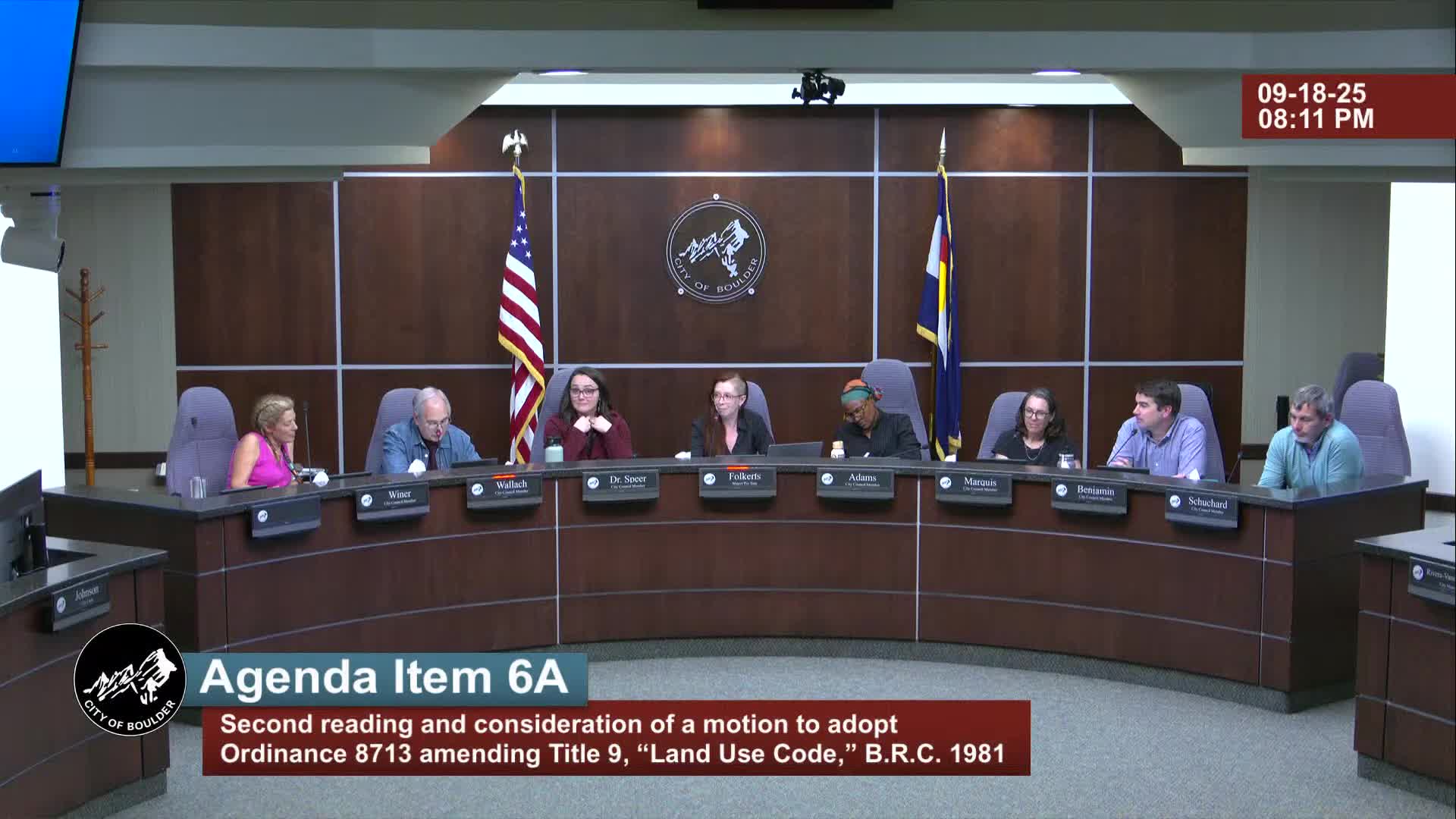
Summary
The council passed an ordinance creating a time-limited festival lodging license to allow owners to rent properties during city‑designated festivals; staff will finalize a festival-event definition and an online application and will monitor impacts on housing and hotels.
Boulder City Council approved Ordinance 87 15 on second reading to create a festival lodging rental license that allows property owners to rent dwelling units during city‑designated festivals for a capped number of days per calendar year.
The council voted 7–1 in favor of the measure. Councilmember Adams cast the lone recorded no vote.
The license is modeled on the city’s short‑term rental program but is limited to festival periods set by a future festival‑event license the city will define administratively. Under the ordinance as adopted, property owners may use the festival license for up to 29 days per calendar year (10 days before a qualifying festival, the festival period itself, and nine days after) and the license would be valid for four years. The city will collect short‑term‑rental taxes on nights rented under the license.
Chris Meschuk, Deputy City Manager, said the ordinance was developed after Boulder was awarded hosting of the Sundance Film Festival beginning in 2027 and other potential large events. He said staff’s goals were to "keep it simple," provide additional lodging capacity during large events while protecting the city’s long‑term housing stock and to avoid allowing a unit to hold multiple types of city rental licenses at the same time.
Staff said owners of units that already hold a long‑term rental license or the existing year‑round short‑term rental license would not be eligible for an overlapping festival license for the same unit. The festival license would expand eligibility to additional ownership types, such as LLCs, unless council amends that provision; council debated but did not adopt an amendment tonight to limit festival licenses to principal residences only.
The council and staff discussed several implementation questions: how the city will define a qualifying festival (staff plan to create a festival event license and a working definition, including an example threshold of events that expect to exceed local hotel capacity), whether ADUs should be treated differently, how tenants might sublet with landlord permission, and how to monitor and enforce compliance. Staff said the license would be administered online, with a $190 application fee (amortized to $47.50 per year over the four‑year license period), and that enforcement will build on the city’s existing short‑term rental monitoring tools.
Staff and several council members also stressed the ordinance is the start of an iterative process; councilmember Nicole said the city should “pass this tonight knowing that we are going to be looking at this, monitoring, seeing how the impacts are going to come over time and that we will be able to change things.” Staff said a web page and application would go live the day after council action and that the first licenses could be issued in early December, with the ordinance effective in November following third reading and ministerial processing.
Council chose not to adopt an amendment that would have exempted second homes from eligibility; the council instead approved the ordinance as drafted and directed staff to monitor impacts and return with implementation details and potential refinements. Ordinance 87 15 passed on second reading and will come back on the consent agenda for third reading; if approved at third reading it would take effect in early November.