
Nampa leaders review draft form-based code, ask public and panels for feedback by Oct. 1
Get AI-powered insights, summaries, and transcripts
Subscribe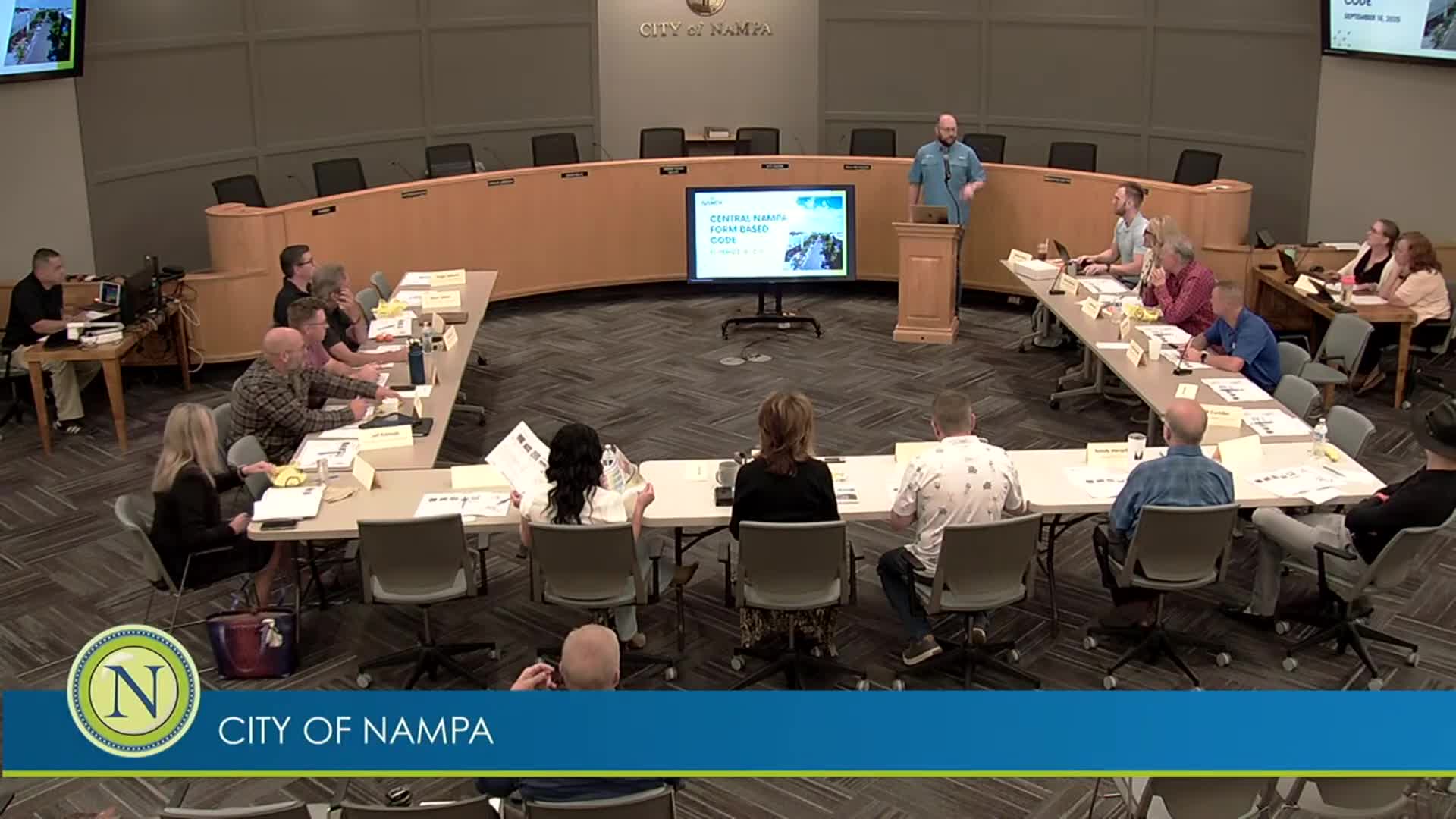
Summary
City staff and consultants presented a draft form‑based code for downtown Nampa at a joint workshop on Oct. 5, asking city council members, Planning and Zoning commissioners and the Nampa Development Corporation for written feedback and marking a path toward administrative review of design that staff said will speed approvals for projects that meet the new standards.
City staff and consultants presented a draft form‑based code for downtown Nampa at a joint workshop on Oct. 5, asking city council members, Planning and Zoning commissioners and the Nampa Development Corporation for written feedback and marking a path toward administrative review of design that staff said will speed approvals for projects that meet the new standards.
The draft would subdivide downtown into a more constrained Central Historic (CH) district and larger surrounding districts (CD, C11, C16, CR), spell out required architectural character in the CH, and set development standards including sidewalk/setback and stepback rules, designated frontage types and limits on some uses. “Form‑based code gives them a known framework to work within,” said Ben, a presenter, describing the goal of clearer, more predictable review for developers and staff.
Why it matters: staff said the code is intended to protect historic character near the train depot and along key corridors while giving more flexibility outside the strict historic core so developers get faster, more predictable decisions. The approach shifts review from broad, discretionary judgement toward checklists of form elements (massing, materials, roof and window types) that staff can verify administratively when an application meets the standards.
Key provisions and examples discussed - Historic core (CH): staff proposed five required architectural categories for CH — Romanesque, Renaissance revival, Neoclassical, Art Deco and Streamline Moderne — and said the CH would have more “required” elements while outer districts would see more recommendations. Morgan, a staff member, said CH “is the most strict district in the form‑based code.” - Setbacks, sidewalks and BTZ (build‑to zone): for major and minor arterials staff recommended a minimum 10‑foot sidewalk/setback with a 10–15 foot build‑to articulation that yields a 5‑foot pedestrian amenity area (planters, outdoor seating) behind the sidewalk; on other streets that articulation would be 0–5 feet. Presenters repeatedly explained that the 10‑foot figure refers to minimum sidewalk width and the extra 5 feet is intended for amenities, not the pedestrian circulation path. - Stepbacks: above roughly two stories (presenters cited “after the second story, or I believe it’s 30–35 feet”), facades would step back 10–15 feet to reduce perceived massing along frontages and preserve viewsheds to the depot. - Uses and conditional permits: the draft’s land‑use table generally encourages ground‑floor commercial/retail in the CH and allows residential on upper floors; drive‑throughs would be disallowed across the downtown. Staff listed alcohol/liquor sales, retail tobacco, wine shops, barbers and certain microbreweries with retail elements as uses flagged for conditional use permits in some locations; event space is shown as a potential conditional use and drew discussion.
Process and review roles Rodney Ashby, Planning and Zoning Director, explained staff’s intention that design standards be clear enough for administrative approvals when applications meet the checklist. He said planning commission and design review would still participate when projects need additional interpretation or conditional use review: “Most of the design review stuff is just handled by code and by staff review,” he said. Commissioners and council members repeatedly asked how to ensure consistent administration; staff replied the code includes prescriptive definitions (window transparency percentages, material percentages, roof types) so staff review becomes a “meet/not meet” checklist.
Questions and concerns raised Council members and commissioners raised market and character concerns: several members asked whether the five CH styles are too restrictive or—conversely—whether including Streamline Moderne could permit buildings that don’t “feel” like downtown. Staff repeatedly invited council and commissioners to note additions or deletions on the response sheets and to identify places (for example the CH boundary near Eleventh and Twelfth and the Lloyd Square area) that should be reviewed in light of planned street changes. Councilman Griffin and others emphasized that staff should provide a concise executive summary for outside readers; staff agreed to produce a short, plain‑language sheet linking common developer questions to the detailed code sections.
Next steps and items for the public Staff asked attending boards and council members to return marked feedback sheets (or photographed copies) by Oct. 1 and promised to resend the draft form‑based code link and to provide printed copies on request. Presenters also said they would add locally recognizable photos to the materials to illustrate how local buildings fit listed styles. The Nampa Development Corporation’s feasibility study for Lloyd Square was discussed; staff said the NDC adopted the study and the council agenda item was scheduled for Oct. 20.
What was not decided No ordinance or formal vote was taken at the workshop. Commissioners and council members offered direction and questions but did not adopt the draft. Staff said the code will move to legal review and the formal public hearing process once the draft and landmark designations are finalized.
Ending note Staff and the consultants encouraged anyone with questions to request a follow‑up meeting or virtual briefing; Rodney Ashby reiterated that staff will follow up with links, deadlines and printed materials and asked participants to return comments so the code can be refined prior to legal review and public hearings.