
Mineola board hears detailed briefing on PILOT revenue, long‑term budget risk and reserve plan
Get AI-powered insights, summaries, and transcripts
Subscribe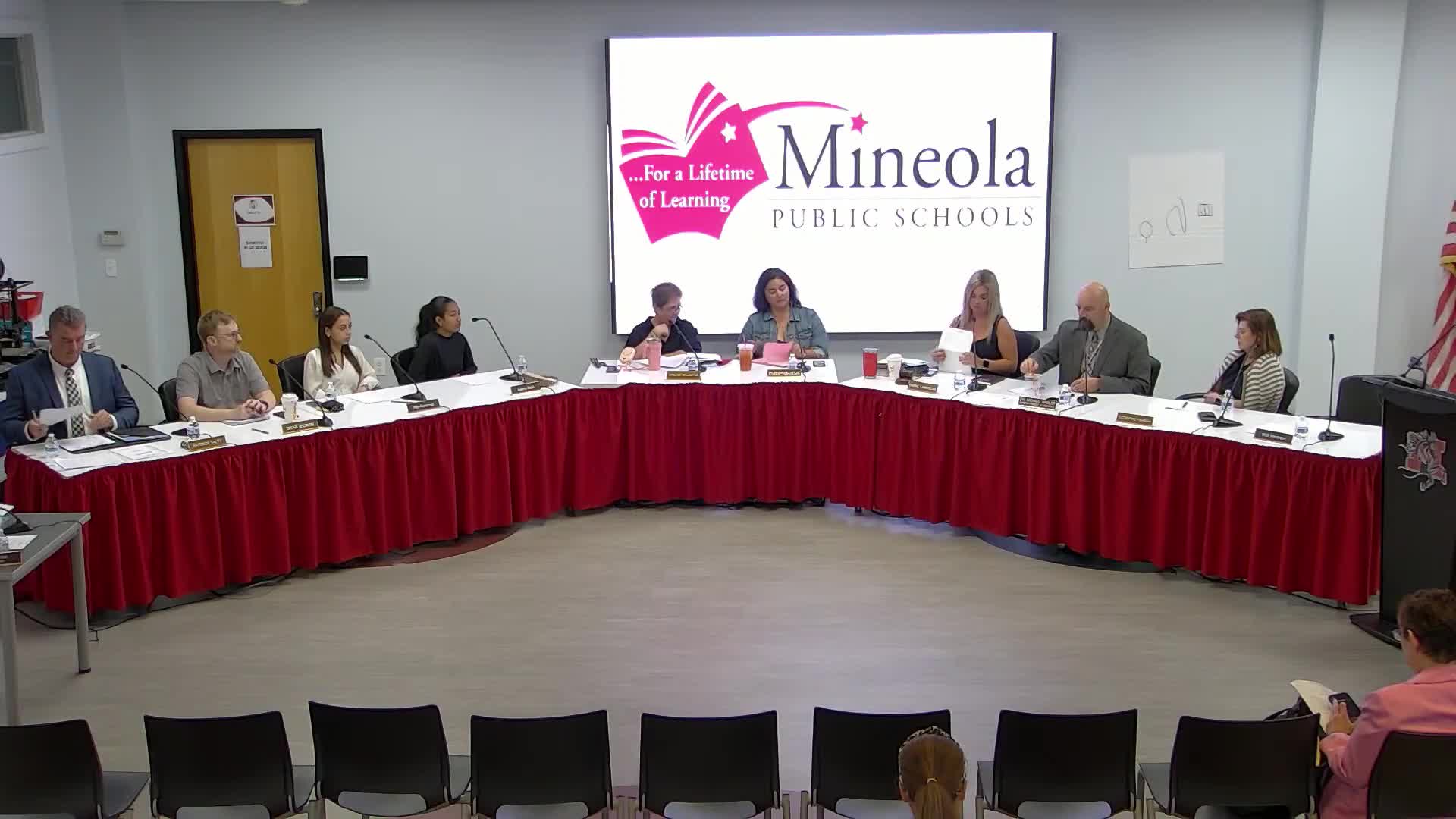
Summary
Superintendent Michael Nagel told the Mineola Union Free School District Board of Education on Sept. 18 that payments‑in‑lieu‑of‑taxes, or PILOTs, are a material non‑tax revenue stream for the district but also a long‑term budget risk if multiple PILOT schedules end in the same years.
Superintendent Michael Nagel told the Mineola Union Free School District Board of Education on Sept. 18 that payments‑in‑lieu‑of‑taxes, or PILOTs, are a material non‑tax revenue stream for the district but also a long‑term budget risk if multiple PILOT schedules end in the same years.
Nagel said the district currently receives roughly $3.8 million a year in PILOT revenue as part of a broader revenue package that supplements the tax levy and state aid for the district’s $112 million budget. He told the board that those PILOT dollars are cash outside the tax levy and therefore do not directly increase the school tax‑levy cap calculation.
The superintendent said the district’s approach is to account for PILOT receipts in the budget but to treat those funds as one‑timeable capital resources: “We want to keep it in the budget, and at the end of the year treat it as a surplus and move it to a capital reserve,” he said, so that if a PILOT payment falls away the district would trim capital projects rather than programs or staff.
Why it matters: several PILOT contracts in Mineola finish at staggered dates; when multiple contracts drop off in the same year the district would face a revenue gap large enough to raise the tax levy beyond its normal range unless offsets are found. Nagel warned that because the county assessor, the Nassau County Industrial Development Agency and the state assessment process control class proportions and collections, the district cannot fully predict or control the timing or size of future receipts.
Board members and staff said the district has 16 active PILOTs, with additional proposals under discussion, and that the adjusted base proportion (the county’s distribution of tax burden among property classes) is a critical variable. “The only way homeowners stay whole is if the adjusted base proportion for that year is adjusted,” Nagel said.
Trustee comments emphasized both opportunity and uncertainty. One trustee noted the district is relatively fortunate that businesses carry a substantial portion of the tax burden (about one‑third), but also said that the district must plan for years when PILOT revenue drops. Board members asked whether PILOT payments are guaranteed; Nagel replied they are estimates subject to assessment and collection and that actual receipts can vary.
Discussion versus decision: the PILOT briefing was informational. The board did not adopt a new policy at the meeting; Nagel said the district has begun using PILOT proceeds as a capital reserve test this year and will continue to refine the approach. He also cautioned that state aid projections are an additional uncertainty that could affect the plan.
Context: Nagel explained how PILOTs enter the district budget separately from the tax levy and reviewed county assessment mechanics and the New York State tax‑levy cap. He showed a schedule of current PILOT contracts and a multi‑year projection that highlighted years with potential revenue “cliffs.”
What’s next: the district will continue to monitor PILOT schedules, consult with the Nassau County assessor and IDA, and use year‑end surplus planning to place discretionary PILOT receipts into a capital reserve so operating programs are less exposed if the payments decline.
Ending: board members expressed support for the cautious, reserve‑oriented approach and thanked Nagel and staff for the detailed presentation, while noting the need to keep residents informed if the picture changes.