Get Full Government Meeting Transcripts, Videos, & Alerts Forever!
Get email alerts on the Waste Management topic
No spam. Unsubscribe anytime.
Planning board approves transfers of two special-waste landfill permits to Select Water Solutions; neighbors seek groundwater oversight
Summary
The planning commission approved transfers of two special-waste landfill conditional-use permits to Select Water Solutions LLC while neighbors urged stronger groundwater oversight and clarity about what wastes the sites will accept.
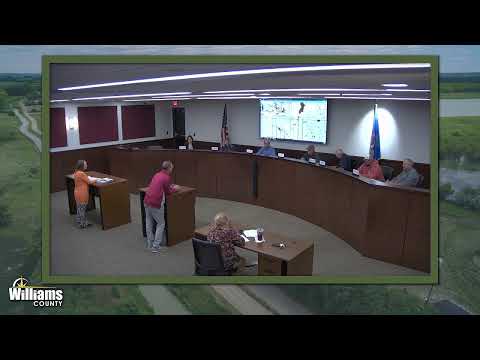
The Williams County Planning and Zoning Commission voted to approve the transfer of existing conditional-use permits for two special-waste landfill sites to Select Water Solutions LLC, planning staff said. The two permits cover an existing special-waste landfill (LU0077-25) and a site that includes a disposal well (LU0078-25). Both sites have operated for years and the applicant is required to reapply because conditional-use permits are not automatically transferable between companies.
At the hearing neighbors expressed long-standing concerns about groundwater contamination and the types of wastes that would be accepted at the sites. Susan Zimmerman, who said her family farm borders the landfill, said she is chiefly worried about possible contamination of household and stock wells and asked whether state agencies would test nearby wells. “I’m really kind of concerned about oversight,” Zimmerman said. “Are they going to be testing, like, our water wells to look for contamination, periodically over time?”
Kim Henderson, representing Select Water Solutions, told the commission the company drilled a Class I injection well last year specifically to handle leachate from the landfill — the water that collects within the landfill and is routed to a leachate pond. Henderson said the Class I permit went through North Dakota Department of Environmental Quality (NDDEQ) public review and is currently permitted but the well is not yet in service. “We did get the permit, and the well is drilled, but it is not in service yet,” Henderson said. Henderson also said Select has not applied to accept Class II waste (oilfield-generated waste) at the site and that taking produced-water or flowback would require additional permitting.
Commissioners and staff described applicable state oversight. A planning participant noted that the North Dakota Industrial Commission oversees saltwater-disposal/injection wells and that the NDDEQ oversees landfill permitting and groundwater monitoring. Henderson said monitoring wells are installed on site and that Select is required by its permit to sample groundwater wells multiple times per year; monitoring results are submitted to NDDEQ and are available through agency records or public records requests.
Public commenters asked about the depth of the injection well; Henderson initially described a deeper well but then corrected the record, saying the well depth is 6,136 feet. Neighbors asked whether the landfill had accepted frac fluid or other oilfield waste in the past; Henderson said the site had not applied for Class II authorization and that the Class I well is intended for leachate. Select acknowledged it may seek additional permits in the future but said it has not applied to receive Class II wastes at this site.
After discussion the commission approved the transfers. Planning staff said the sites have existing stormwater management plans recorded in February 2019 and that Select must provide reissued state permits (examples cited in staff materials included permit numbers 0079, 0372, 22717 and W0349S0823D) reissued in the company’s name as required by state agencies. Commissioners emphasized that oversight and enforcement of groundwater monitoring rest with NDDEQ and the Industrial Commission, not the planning board.
The approval transfers the county-level conditional-use permits to Select Water Solutions but leaves operational oversight, groundwater monitoring, and waste-class authorizations under state agencies’ jurisdiction. Neighbors were advised to contact NDDEQ and the Industrial Commission for detailed monitoring records and for questions about injection-well authorizations.