Get Full Government Meeting Transcripts, Videos, & Alerts Forever!
Get email alerts on the Disaster Recovery topic
No spam. Unsubscribe anytime.
Pinellas County approves Horn LLP contract to run $813 million disaster-recovery program
Summary
The Board of County Commissioners approved a contract with Horn LLP to implement the county's $813 million Community Development Block Grant–Disaster Recovery program. Commissioners and staff emphasized speed and oversight; some members pressed for extra safeguards after procurement concerns.
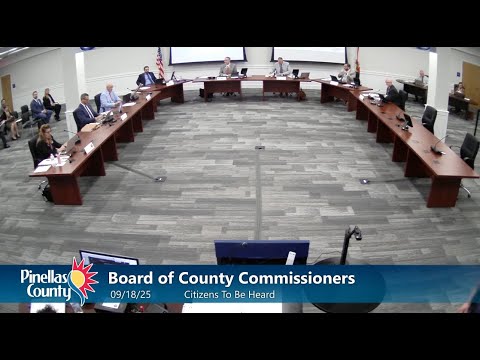
The Pinellas County Board of County Commissioners voted 5–1 on Sept. 18 to award an implementation contract to Horn LLP to manage housing and other programs funded by an $813 million CDBG–Disaster Recovery (CDBG‑DR) grant from HUD.
Why it matters: The contract centralizes delivery of housing repairs, reimbursements and rental assistance intended to get federal recovery dollars quickly into residents' hands while county staff say they will retain oversight to guard compliance with federal rules.
Assistant County Administrator Matt Spoor told commissioners the county submitted its action plan in late May and received HUD approval June 30, then the grant agreement on July 30. “We ran a thorough and competitive procurement,” Spoor said in introducing the contract, and he described the county’s strategy to limit local administrative overhead so more funding goes to residents. The county capped its own administrative reimbursement at 3 percent (the action plan decision), Spoor said, and the vendor’s activity‑delivery costs are budgeted as a “not to exceed” amount equal to roughly 10.4 percent of the contract the county will sign.
Contract structure and scale: The contract before the board is a not‑to‑exceed agreement totaling $565,000,000, of which approximately $478,000,000 (about 85 percent) is beneficiary pass‑through funds for applicants and contractors; the vendor implementation and management budget lines together are listed at $86,800,000. Spoor said the county is staging an initial set of “people‑first” programs—homeowner rehab and reconstruction, homeowner repair reimbursement, homeowner assistance, small landlord rehabilitation and disaster relief payments—with public applications targeted to begin in October.
Implementation and staffing: Spoor and Kevin McCandrew, director of Building and Development Review Services, said the county will hire about five full‑time, grant‑funded staff to manage oversight while the contractor runs intake centers, call centers, inspections and construction management. Spoor said Horn had already been staging operations at risk, hiring case managers and preparing intake centers so the program could move quickly once approved.
Oversight and safeguards: Commissioners pressed for clarity about procurement, subcontracting and past vendor performance. County staff and the clerk’s office said federal rules (2 CFR 200 series) govern procurement and bonding for construction subcontractors and that the county contract incorporates those requirements. Spoor noted the contract includes specific controls about related‑party subcontracting and federal procurement rules, and he said the county retains contract oversight and the ability to cancel for convenience.
Questions from commissioners focused on: why the county is limiting its administrative reimbursement to 3 percent rather than the 5 percent HUD allows; how many county FTEs are required (the county plans five); whether Horn or any affiliated firm will self‑subcontract for construction work (staff said Horn is not a general contractor and does not own construction firms); and contingency options if performance problems emerge. Ken Burke, the clerk, reviewed procurement follow‑up and said the county would audit as required based on performance or triggers, not merely name changes.
Vendor controls and system reliability: Commissioners asked about Horn’s case‑management platform (Canopy). Horn’s technical representative, Jenna Abbey, told the board the firm addressed a prior qualified audit opinion by adding ticketed QA controls (Jira) and now offers the county access to a test environment for evaluation before any change goes to production.
Votes and next steps: The board approved the contract after debate. Commissioners and staff said the county will return to the board with program policy guidelines in early October and launch the first public programs later that month. Spoor said the county would provide regular updates on implementation metrics, including dollars out the door and participant counts.