Get Full Government Meeting Transcripts, Videos, & Alerts Forever!
Get email alerts on the Pfas Food Wildlife topic
No spam. Unsubscribe anytime.
Expert: PFAS testing in food and wildlife is feasible but costly, method-dependent
Summary
A Battelle researcher told the Legislative Study Commission that PFAS testing in food and wildlife is technically possible but hampered by limited validated methods, high lab costs and complex exposure calculations; he urged targeted funding and careful choice of sampling approaches.
At the Sept. 12, 2025 meeting of the Legislative Study Commission on the Environmental Health Effects of PFAS, John Patelli, a Battelle Memorial Institute researcher and former toxicologist with the New Hampshire Department of Environmental Services (DES), told commissioners that detecting PFAS in food and wildlife is technically possible but expensive and analytically complicated. "We do have the methods to do it, but it's costly and resource intensive, and it really requires a lot of scrutiny," Patelli said.
Patelli told the commission that drinking-water standards (maximum contaminant levels, or MCLs) do not directly translate to food because intake assumptions differ; screening values for food are commonly in parts-per-billion rather than parts-per-trillion. That difference arises, he said, because people typically do not consume the mass equivalents that drinking-water risk calculations assume. He gave the example that converting a drinking-water intake to pounds of food would equate to eating roughly 18 chicken breasts a day.
The researcher described several practical constraints for food and wildlife surveillance: the small set of inter-laboratory-validated analytical methods for tissues and foods; frequent interferences in complex food matrices that can produce false positives on lower-resolution instruments; and high per-sample costs. Patelli said a baseline fish analysis costs roughly $300 per fish and that guidance-quality sampling commonly requires at least five fish per water body, making broad surveillance expensive. "You start doing the math of how many water bodies or lakes you want to sample, you get into the hundreds of thousands to millions of dollars very quickly to monitor and track for this, and that's just for fish," he said.
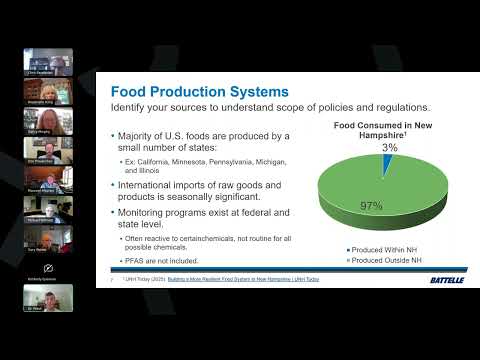
Patelli described local and regional research collaborations and data sources that commissioners could use for policy decisions: DES sampling and advisories on southern New Hampshire ponds; Dartmouth, Clarkson University and EPA Region 1 work on shellfish and invertebrates; U.S. Geological Survey (USGS) food-web studies; and forthcoming Battelle publications on finfish from the Gulf of Maine and expanded food-web sampling in lakes with existing advisories. He said New Hampshire likely produces only about 3% of the food its residents consume, noting that most food consumed in the state is produced elsewhere, which limits the reach of state-level product standards.
Commissioners and community members asked about recent state advisories and whether new sampling had been done. Patelli said Dartmouth had resampled several ponds (including Horseshoe Pond in Merrimack), that preliminary results were similar to earlier findings, and that the researchers were still completing QA/QC before sharing final data with DES. He also noted that some states are finding PFAS in fish even where no local industrial source is known.
On plants and crops, Patelli said uptake varies by compound, plant species and plant tissue: "Short chains and carboxylic acids are more likely to be taken up than longer chains and sulfonic acids," and uptake patterns differ between protein-rich and water-rich crops. He cited Maine's ongoing research into biosolids and crop uptake as a regional resource.
Patelli offered options for legislative or programmatic focus: statewide lab contracting or bolstering in-state capacity; subsidized soil and water testing through extension services (UNH Extension was specifically mentioned in the commissioner's discussion); targeted sampling to support fish-consumption advisories; and source reduction through product bans to limit new inputs. He also warned that mandatory product or food testing without accompanying protections for producers could create litigation and market-access risk for farmers and small producers and thus discourage voluntary testing.
The presentation closed with a set of practical trade-offs for policymakers: choose where testing and funding yield the greatest public-health benefit, prefer surface-water screening where possible (to avoid costly tissue sampling), and invest first in validated methods and lab capacity before launching large surveillance programs.