
Newton County Schools details layered safety plan; board authorizes random weapon screenings
Get AI-powered insights, summaries, and transcripts
Sign Up Free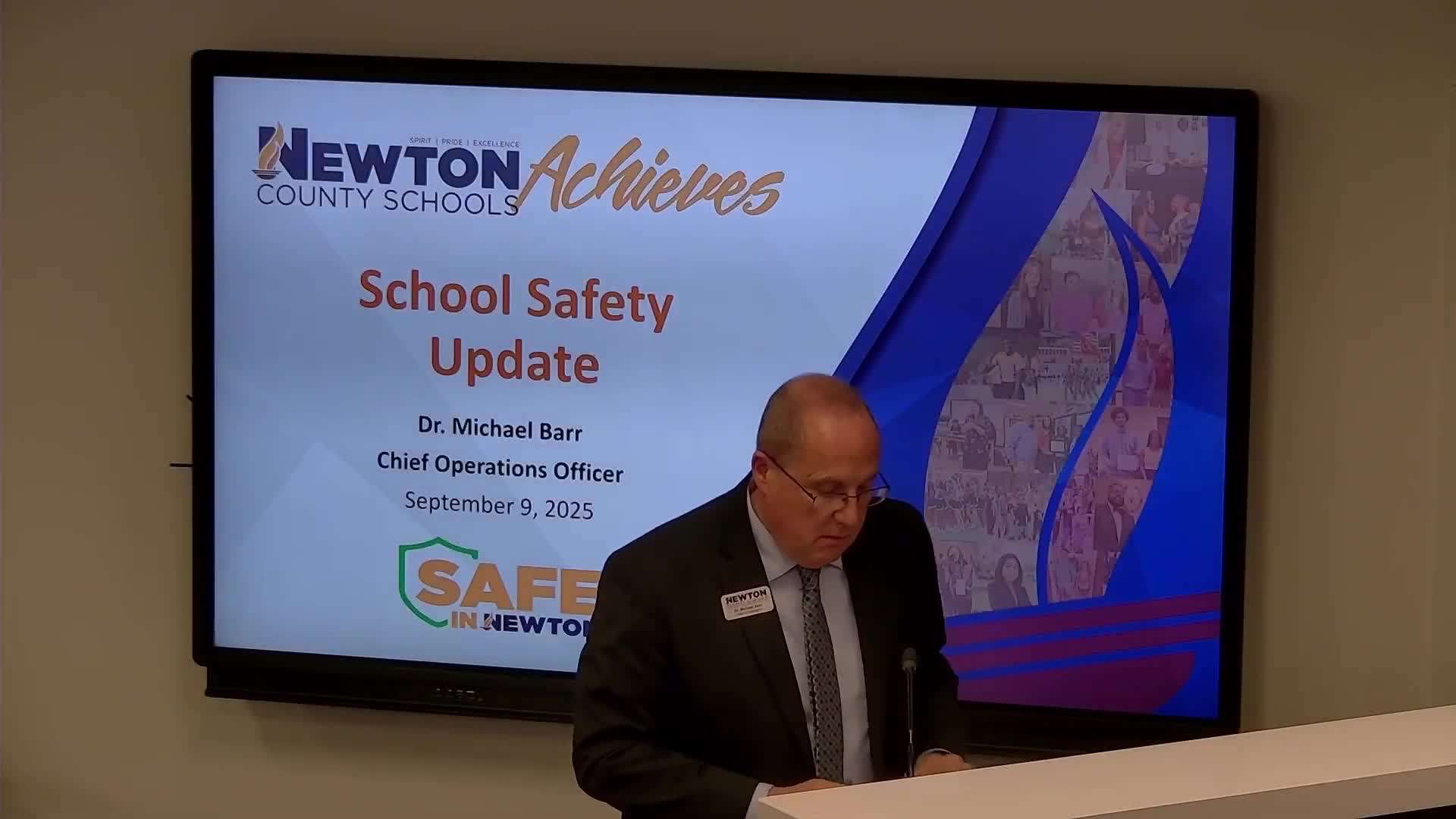
Summary
A district safety official presented a layered safety update to the Newton County Board of Education that emphasized staff training, emergency procedures and technology investments, and noted the board authorized random weapon screenings for middle and high schools following a March 2025 pilot.
A district safety official told the Newton County Board of Education about the district’s layered safety approach and the investments the board has approved to strengthen school security, including authorization of random weapon screenings in middle and high schools for the 2025–26 school year. The presentation focused on two of the district’s four safety pillars: people, plans and procedures, and investments in infrastructure.
The official said the district’s safety strategy rests on trained staff, clear emergency plans and consistent procedures. “People are the foundation of our safety efforts and represent the district's first line of defense,” the safety official said. Schools conduct regular drills and hold school- and district-level safety meetings that include principals, assistant principals, school resource officers, nurses and safety teams; action items are documented and shared with district staff for follow-up.
The presentation described two types of lockdowns used by the district: preventative lockdowns, for potential concerns in the area when there is no immediate threat inside the building, and emergency lockdowns, used only when there is an immediate threat to student or staff safety. The official advised parents not to go to or call schools during a lockdown because doing so can interfere with emergency response.
The district detailed partnerships with local and state partners that support preparedness and response, including the Newton County Sheriff’s Office, local police departments, emergency management, fire and EMS, juvenile court, the Newton County office of the Georgia Department of Family and Children Services, Newton County Public Works, the Georgia Emergency Management Agency and the Georgia Department of Education. The official also said the district receives training from the U.S. Secret Service’s National Threat Assessment Center.
On infrastructure and technology, the official said 13 schools already have secure entryways and that adding secure entryways at remaining schools is in the district’s capital improvement plan, with completion scheduled by December 2029. The district has installed an EPIC communication system and interoperable radios to connect schools and first responders, and a safe crisis alert system that the presentation said the district has operated since 02/2011. The board invested $2.1 million in fiscal year 2025 and $2 million in fiscal year 2026 for upgrades to the safe crisis alert system and implementation of the EPIC system; EPIC had been installed in all but five schools at the time of the presentation and installation in the remaining schools was expected by October (installation year not specified).
The district reported that there is a school resource officer (SRO) at every elementary school funded by board commitments of $1.5 million in fiscal year 2025 and $1.8 million in fiscal year 2026. The Newton County Sheriff’s Office provides SROs for middle and high schools under a partnership that the presentation said included $1.4 million in fiscal year 2025 and $1.5 million in fiscal year 2026.
Following a pilot that began in March 2025, the board authorized random weapon screenings in middle and high schools for the 2025–26 school year. The presentation said the board approved $416,000 over the two most recent fiscal years to purchase equipment for those screenings.
The official described other technologies in use or being piloted, including vehicle-identification (Flock) cameras, enhanced security cameras, weapons-detection systems and the district’s safe crisis alert system. Bus-safety training and required drills for fire, severe weather and intruder alerts were also highlighted.
The presentation closed by reiterating that the district’s safety framework rests on four pillars — people, plans and procedures, investments in infrastructure, and code of conduct and mental health supports — and by offering to remain for board questions and discussion.