Lifetime Citizen Portal Access — AI Briefings, Alerts & Unlimited Follows
Haslet engineers press TxDOT on sight-distance and design choices for Avondale-Haslet rail crossing
Loading...
Summary
City and consultant engineers told the Haslet City Council that the proposed Avondale‑Haslet grade‑separated crossing requires additional analysis of sight distance and queuing after Lee Engineering’s review found approach geometry could fall short of stopping‑distance standards under certain queues.
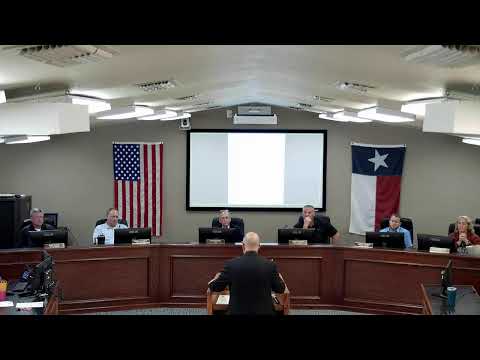
Haslet city engineers told the council on Sept. 17 that they have asked TxDOT’s design team to address sight‑distance and queuing at the proposed Avondale‑Haslet grade‑separated crossing over the railroad, and that preliminary consultant analysis shows the proposed bridge geometry may leave some approaches below stopping‑distance standards under certain queue lengths.
Traffic consultant Jody Short of Lee Engineering said he analyzed the 60% schematic plans and measured available sight distance against required stopping distance under a range of queuing scenarios. “We measured the available site distance at various points across the roadway…we've identified a range between when you have a queue present of between 360 and 560 feet, you're just slightly under the standard,” Short said, summarizing the firm’s queuing and sight‑distance review.
Short and city engineers said TxDOT’s earlier schematic included a -6% grade on the approach; a subsequent design reduced that to about -5.6% by raising FM 156 roughly 5½ feet. TxDOT has agreed to study whether further elevation changes on FM 156 would provide the additional sight distance the city’s analysis indicates is needed.
Kimley‑Horn associate Carl Dezee presented an alternative concept that would span Schoolhouse Road and FM 156 and land farther east, which would reduce right‑of‑way takes on adjacent properties and provide different ramp geometry. City engineer Mike Anderson said the two main bridge approaches under discussion are: (1) a center‑supported bridge with fewer, taller supports that would need about 12½ feet of additional right‑of‑way on each side, and (2) a straddle‑bent (horizontal bent) configuration that would require roughly 37½ feet of additional right‑of‑way and larger impacts to adjacent development.
Council members asked about costs and funding sources. Anderson and Jeff Neal of NCTCOG discussed a potential state funding source created by Senate Bill 1555, which set aside funds for off‑system grade separations; Anderson said preliminary project estimates for one conceptual option are in the $85,000,000 range and that a 10% match would be required if SB 1555 funds were used. Neal said the Transportation Commission will publish application criteria on Oct. 1; any award process and timetable would follow that notice.
City staff flagged several points for follow up: detailed queuing and stopping‑distance analysis at the revised bridge profile, further evaluation of the center‑supported versus straddle‑bent options for impacts to adjacent driveways and utilities (including water and sewer relocations), and a refined cost and schedule comparison for the short versus long bridge options. TxDOT and the bridge design team told the council they will revisit grades and sight‑distance calculations and return with refined data.
Why this matters: the Avondale‑Haslet crossing sits where a grade separation must balance railroad clearance, approach grades, and the city’s need to preserve access for new developments; design choices will affect right‑of‑way takings, utility relocations and long‑term ability to widen Haslet Parkway.
Next steps: TxDOT’s design team will revisit grading and sight‑distance calculations and report back; city staff will track potential SB 1555 funding and coordinate with NCTCOG and regional partners on possible matching funds and application timing.