Get Full Government Meeting Transcripts, Videos, & Alerts Forever!
Get email alerts on the Wastewater Infrastructure topic
No spam. Unsubscribe anytime.
Chesterfield staff seek $168 million Procter Creek plant expansion, request $21 million appropriation
Summary
Chesterfield Utilities staff presented a request to award a roughly $168 million contract to MEB General Contractors for the first phase of the Procter Creek Wastewater Treatment Plant expansion and asked the board to appropriate $21 million from the rate stabilization reserve to fund the work and construction inspection.
Chesterfield Utilities staff on Oct. 5 asked the utilities board to award the first-phase contract for a major expansion of the Procter Creek Wastewater Treatment Plant to MEB General Contractors and to appropriate $21,000,000 from the rate stabilization reserve to cover remaining project funding and construction inspection costs. The project would expand the plant’s design capacity from 27,000,000 gallons per day to 54,000,000 gallons per day and is expected to take about five years, with completion around 2031.
The request came during a presentation by Mister Hayes, a Chesterfield Utilities staff member, who described the work as the initial phase of a multi-phased master plan first identified in 2012 and entered into the utility’s rate model in 2016. “The project before you tonight is the first phase of a multilayered master plan to expand that facility from 27,000,000 gallons a day to 54,000,000 gallons a day, doubling the size of the facility and providing our residents over 90 years of future wastewater capacity,” Hayes said.
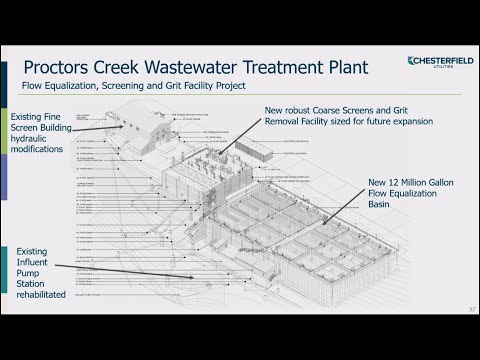
Hayes outlined four primary components: hydraulic improvements to the fine screen building including larger effluent piping and a bypass to a flow equalization basin sized for 54 MGD; complete rehabilitation of the influent pump station including replacement of eight pumps and new impellers; installation of a new core screening and a modern grit removal facility; and construction of a 12,000,000-gallon flow equalization basin composed of three side-by-side reinforced concrete basins with a footprint comparable to a football field and about 40 feet deep.
Hayes said the equalization basin functions as a hydraulic “shock absorber,” reducing peak flows and producing a more consistent wastewater strength into treatment processes, which can reduce chemical and electricity use. “These large basins act as mixing pools so the quality or the strength of wastewater is more consistently fed into the treatment process,” Hayes said. He added that the basin will allow operators to “dial in” treatment and reduce operating costs, savings the utility plans to pass on to customers through more affordable rates.
Board members asked for operational and financial context. One board member asked about current average and peak flows; Hayes said the plant’s permitted/design capacity is 27,000,000 gallons per day, while average treatment is about 18,000,000 gallons per day and peak flows sometimes exceed 27,000,000 gallons per day. When asked where treated effluent is discharged, Hayes said it is released to the James River and that the plant’s discharge is “of a higher quality, a more consistent quality than the James River water currently.”
Hayes and board members also discussed future reuse opportunities. Hayes said the utility is exploring a potential reuse project that could supply nonpotable water to nearby industries and that the expansion could support a reuse system producing as much as 15,000,000 gallons per day initially. A board member asked whether companies using reused water would be charged; Hayes said a separate reuse utility and rate model would be required and that connection fees and rates would fund infrastructure and reserves for future replacement.
Financial details presented in the meeting included a project construction estimate described as “just a little bit above a $168,000,000,” and a requested additional appropriation of $21,000,000 from the rate stabilization reserve to fully fund the project and cover inspection and engineering during construction. Hayes estimated annual electricity expenses for the plant in “the neighborhood of” $2,000,000 but said he did not have a complete figure for annual chemical costs during the presentation. The project is expected to reduce per‑gallon treatment costs over time, Hayes said, but no specific payback period for the capital investment was provided.
Hayes noted the project supports “just in time” capital spending by shaving peak flows and deferring the need for additional treatment trains. He said the master plan is phased and that the current contract award request represents the first major construction phase. The presentation and the funding request were placed on the board’s consent agenda; the transcript does not record a formal vote or final board action on the award or appropriation during the excerpt provided.
Background details offered during the presentation: the Procter Creek plant opened in 1975 and has been expanded over time to a current design capacity of 27,000,000 gallons per day; the need for a larger facility was first identified in 2012, and detailed design work for this phase began in 2021. Hayes estimated the construction timeline at about five years with completion around 2031. The utility is using its rate model and connection fees to fund expansion components rather than shifting the entire capital burden to existing ratepayers, Chesterfield Utilities staff said.
If approved, the contract would be one of the largest construction projects in Chesterfield Utilities history. The board’s presentation included operational and funding clarifications but the transcript does not show the board’s final vote on the requested contract award or the requested appropriation.