Get Full Government Meeting Transcripts, Videos, & Alerts Forever!
Get email alerts on the Public Safety Fire Ems topic
No spam. Unsubscribe anytime.
Chesterfield Fire and EMS warns volunteer decline and aging population are straining EMS; asks board to fund ambulances and part‑time EMS staff
Summary
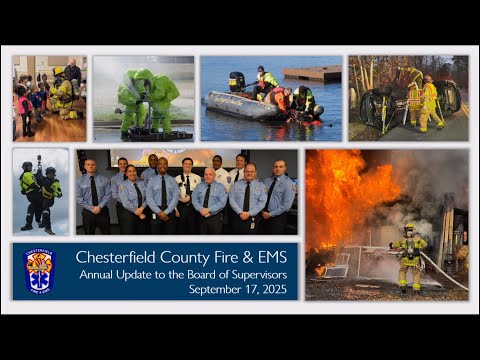
Chief Center, Fire and Emergency Medical Services chief, told the Chesterfield County Board of Supervisors at a work session that the department handled a record number of incidents last fiscal year and faces persistent staffing and coverage pressures driven by an aging population and a decline in volunteer responders.
Chief Center, Fire and Emergency Medical Services chief, told the Chesterfield County Board of Supervisors at a work session that the department handled a record number of incidents last fiscal year and faces persistent staffing and coverage pressures driven by an aging population and a decline in volunteer responders. "Throughout the last fiscal year, our members reported for duty and handled over 55,000 incidents, another record for the department," Chief Center said.
Why it matters: Rising EMS demand and fewer volunteer resources have left some response districts without ambulance coverage at times, increasing response times and requiring career firefighters to cover gaps. The department proposed adding three 24‑hour career ambulances over a five‑year period and creating part‑time EMS‑only positions to improve peak coverage and provide more consistent EMS standbys at special events.
The presentation and key figures
Chief Center said 76 percent of the department's incident volume was EMS related and that career and volunteer members transported more than 33,500 patients last year. "Over 67 percent of patients transported last year were 65 years of age or older," he said, noting the county's fastest‑growing demographic places persistent pressure on EMS.
The department reported that all response districts saw incident increases averaging 7.8 percent per district last year, far higher than the prior year's 2.5 percent. The top call types included nonspecific illnesses, falls and fire alarm activations; lift assists for older adults also appeared among the top 10 call types.
Volunteer decline and coverage gaps
Chief Center described a sharp decline in volunteer rescue coverage. Today the county has five volunteer organizations capable of providing emergency services: four rescue squads with a combined 128 certified EMS responders and one volunteer fire company with 12 certified firefighters. Shortages forced coverage gaps on weekends and holidays; the chief said there were 66 days last year when two key EMS districts were unstaffed and 35 days when three were unstaffed.
He identified two persistent trouble spots: the EMS district served by Manchester Volunteer Rescue Squad, which was without immediate ambulance coverage about 20 percent of the time last year, and the eastern end of Midlothian Turnpike in the Midlothian District, which saw more than 3,700 EMS incidents last year (a nearly 30 percent increase over five years). When those districts go void, nearby ambulances are pulled away and larger fire apparatus are sometimes dispatched as the closest available resource.
Proposed short‑ and long‑term responses
As short‑term relief, Chief Center asked the board to support a proposal to create part‑time EMS‑only positions to expand peak ambulance coverage and provide more consistent EMS standbys at sporting and special events. He said that if the part‑time program succeeds, some positions could later be converted to full time. For the longer term, the department will ask the board to program funding for three additional 24‑hour career ambulances over a five‑year planning period and to consider incremental increases in minimum staffing on engine companies.
The chief also asked the board to consider increasing funding in the apparatus replacement program and to add a planned Highlands Fire and EMS station to a future capital improvement plan. He said the Highlands station could add roughly 2,000 address points and improve that area’s ISO public protection classification, potentially lowering insurance premiums for residents.
Other operational items and regional coordination
Chief Center described two programs he said have reduced pressure on the system: a peak demand ambulance program (created with ARPA funds to staff 12 firefighter positions) and a mobile integrated health (MIH) program that targets high‑use and chronically ill patients. He said the 12 previously grant‑funded positions have been moved into the general fund.
The department is also expanding a whole‑blood program in partnership with Inova Blood Services and plans to place whole blood on a battalion chief unit serving the West Side to shorten deployment times. Chief Center noted the county is a signatory to Central Virginia and statewide mutual aid agreements, participates in automatic aid with bordering localities and deploys specialized teams through memoranda of understanding with the Virginia Department of Emergency Management.
Hospitals and patient destination choices
Chief Center said Chesterfield currently has two full‑service hospitals and that limited in‑county options mean about 46 percent of patients were transported outside the county last year. He told the board he and county staff will speak at an upcoming Virginia Department of Health public hearing to support proposals that, if approved, would add or expand hospital capacity in the county: a VCU Health System hospital along the Nash Road extension, an HCA hospital near Route 360 and an expansion by Bon Secours at Saint Francis Medical Center.
Staffing, relief factor and accreditation
The chief credited the board with funding that allowed the department to add positions and reach a reported relief factor of 1.32—an improvement he said significantly reduced mandatory overtime and overtime costs. He noted the relief‑factor calculation is based on older data and may need reevaluation given new leave benefits. The department is seeking applicant status and later accredited status from the Center for Public Safety Excellence; Chief Center said accreditation would be valid for five years with annual compliance reports.
Funding and procurement challenges
Chief Center reported industrywide delays and price increases for fire apparatus have left the county with back‑ordered vehicles and insufficient annual replacement funding to refresh the fleet at recommended intervals. He said the fleet manager is conducting a countywide assessment and that a one‑time funding increase had been provided last year, but a sustainable, long‑term strategy will be needed.
Board comments and community appeals
Board member 4, Board member, made remarks thanking the chief and emphasized that development already approved will require more resources. "I think it's important for the community to understand, how, as we grow as a community, how it we have to provide the resources for it," Board member 4 said.
Board member 5, Board member, urged community volunteerism and praised Forest View Volunteer Rescue Squad: "If you're looking for a way to volunteer and a way to give back and a way to just be part of something incredibly special with some very good people. This is a way to do it," Board member 5 said.
What was discussion versus direction or decision
Discussion only: Chief Center and board members discussed incident trends, volunteer decline, relief factor limits, apparatus procurement delays, the concentration of nursing homes and resulting call volumes, and regional mutual aid.
Direction/assignment: Chief Center said he will present a detailed proposal on part‑time EMS positions for board consideration; he and county staff will speak at an upcoming Virginia Department of Health public hearing to support hospital proposals. The presentation also asked the board to consider programming ambulances and station funding into the five‑year financial plan; those are requests, not board decisions at the meeting.
Formal action: No motions or votes were taken during the work‑session presentation.
Next steps
Chief Center invited questions and said he looks forward to policy discussions with the board on EMS standbys for special events and on long‑term staffing improvements. The department will bring specific proposals and budget requests forward for board consideration in future budget cycles.
Ending note
Chief Center concluded, "Mister chairman, that concludes my presentation," and opened the floor for questions and follow‑up; board members offered praise and asked for continued conversation about staffing and volunteer recruitment.