Get Full Government Meeting Transcripts, Videos, & Alerts Forever!
Get email alerts on the Comprehensive Plan topic
No spam. Unsubscribe anytime.
Chesterfield staff seek public hearing to align comprehensive plan chapter with new zoning tools
Summary
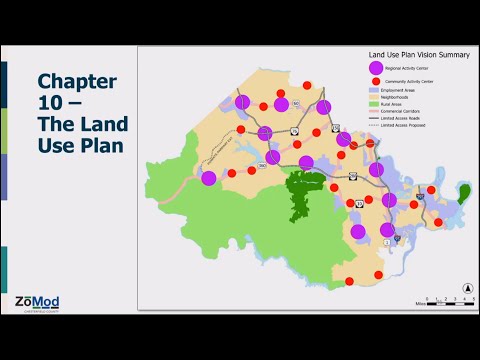
Chesterfield County planning staff asked the Board of Supervisors to set a public hearing to amend Chapter 10 of the comprehensive plan so its land‑use categories and guidance match new zoning tools in the proposed ZOMOD ordinance.
Chesterfield County planning staff asked the Board of Supervisors on a request to set a public hearing to amend Chapter 10 of the county comprehensive plan so it aligns with the zoning modernization ordinance known as ZOMOD.
The amendment would not change the plan’s vision map or the boundaries of land-use categories, staff said, but would update the plan’s language and the recommended zoning districts to match new ZOMOD tools. “We are not changing densities,” staff said, adding that the sole density change reduces the highest residential category from 12 units per acre to an 8-plus standard.
The change aims to make the comprehensive plan—described by staff as the county’s policy vision—use the same terms and district recommendations that ZOMOD introduces. Staff told the board the proposal would: rename several land-use categories (for example, previous “low-density residential” would become “residential neighborhood 1” to indicate a one-unit-per-acre cap), map older categories such as C-5 commercial into ZOMOD’s commercial-corridor or industrial categories depending on use, and add guidance on amenity space, accessory dwelling units, village overlays and large land uses such as data centers.
Staff emphasized that the draft chapter 10 amendments do not automatically rezone property. Instead, the plan would guide applicants and staff about which new ZOMOD districts are appropriate in each land-use category. For properties zoned today in legacy districts such as C-5, staff described a five‑year conversion window in ZOMOD that would allow existing uses now permitted under C-5, I‑1, I‑2 and I‑3 to continue for five years even if the ZOMOD conversion assigns a different district; those uses must be actively used and cannot be abandoned for two years or more or they revert to the comp‑plan/zoning conversion outcome.
Board members asked how the plan would handle infrastructure requests tied to walkability, citing Springline and Chester Village as examples of mixed‑use, walkable development. Staff said the plan could be used in negotiations with applicants to request off‑site improvements—such as pedestrian bridges or buried utilities—but that such items are subject to negotiations with applicants and state agencies (for example VDOT) and are not requirements imposed by the comprehensive plan itself. Staff also said the plan adds guidance recommending undergrounding utilities where feasible and general residential quality standards to guide negotiations on future residential projects.
Staff said the Chapter 10 amendment is intended as a stopgap to align plan language with ZOMOD so zoning applicants have consistent guidance; a full comprehensive‑plan overhaul is still planned and would include broader public engagement later.
Less critical details include staff’s mapping of former neighborhood office and other office‑type comp‑plan categories into ZOMOD‑compatible categories such as light business, arterial business or office‑light production, and additional guidance about analyzing impacts of data centers on infrastructure.
The board did not take a recorded vote on the Chapter 10 amendment during the discussion; staff requested the board set a public hearing for the amendment in the coming month.