
Plainfield 202 reports $15.2M in summer capital work, hires consultants to poll voters on funding options
Get AI-powered insights, summaries, and transcripts
Subscribe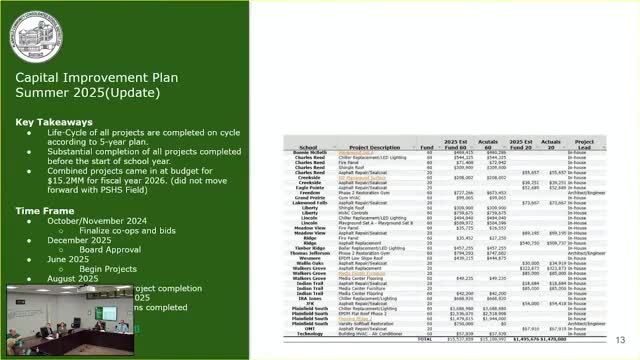
Summary
Finance committee reviewed a summer capital program that came in under budget and launched a community engagement process with Studio GC, Acuity and CityHealth to test priorities and ballot language for possible funding after 2026 bond roll‑offs.
The Plainfield CCSD 202 finance committee on Sept. 17 reviewed a summer capital program described as substantially complete and under budget and authorized a public engagement process to test voter priorities and funding approaches for future capital needs. District staff reported the district’s summer life‑cycle projects were completed this year with an overall program cost of about $15.2 million and noted a handful of remaining items, including chiller installation at two schools and a deferred softball field project.
Why this matters: several existing bond obligations will roll off in 2026, creating a window for the district to ask voters for new funding to cover a mix of priorities — from a potential new middle school to CTE expansion, an 18–22 transition center for older students with special needs, early‑childhood facilities and building repairs. District leaders said the next step is structured community testing so the Board can weigh whether to place a question on a future ballot and, if so, which funding mechanism to use.
The district contracted Studio GC to lead engagement, with quantitative polling by Acuity and demographic analysis from CityHealth Technologies; communications support will be provided by Public Communications Inc. Studio GC presented a multi‑stage plan that begins with a statistically representative survey of likely voters, followed by targeted sessions with community stakeholders to probe the reasoning behind survey responses and then broader town halls if the Board chooses to pursue a measure. Studio GC said the work will help the district choose a question the community understands and is prepared to support.
District staff summarized the capital work completed: flooring and media‑center renovations at several schools, roof replacements, LED lighting upgrades, replacement of aging boilers with high‑efficiency condensing boilers at Timber Ridge, concrete repairs and three playground installations; the presentation noted most projects were delivered in a short summer schedule to avoid classroom disruption. Two chiller replacements remain to be installed when weather cools.
On funding, the consultant and staff explained the tradeoffs between a traditional general‑obligation construction bond (a time‑limited capital borrowing) and a limiting‑rate increase (an ongoing levy increase), noting the two approaches carry different public messages and operational consequences. Studio GC recommended survey questions that test both approaches and ask respondents to prioritize specific projects because priorities and willingness to pay can change after brief educational prompts.
Next steps: staff will refine cost estimates, adapt the survey and start outreach; Studio GC will return with polling results and stakeholder feedback on a quarterly schedule. The committee will use those findings to craft a board recommendation on whether to seek voter approval and which funding mechanism to pursue.