CCRPC sets Oct. 15 public hearing for 2026–2029 Transportation Improvement Program
Summary
The Chittenden County Regional Planning Commission voted to schedule a public hearing October 15 on the draft 2026–2029 Transportation Improvement Program (TIP) and approved administrative amendments to the current TIP; commissioners and staff said larger federally funded projects and grant awards are driving big year-to-year swings in totals.
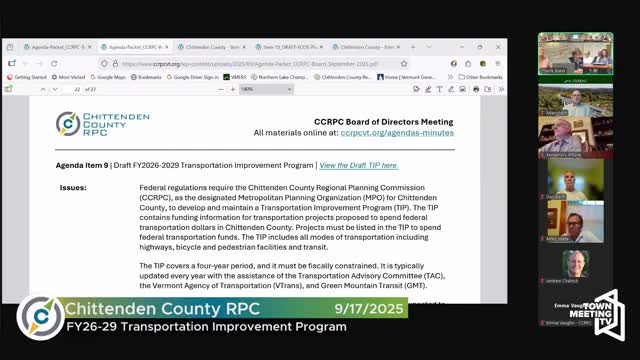
The Chittenden County Regional Planning Commission voted to schedule a public hearing Oct. 15 on the draft 2026–2029 Transportation Improvement Program, a federally constrained list of projects that authorizes the obligation of federal funds. Christine Ford, CCRPC transportation planner, presented the draft and asked the board to hear the document and take public comment before formal adoption.
Why it matters: the TIP ties federal funding to specific projects and must be fiscally constrained to match funds actually expected to come to Chittenden County. The draft TIP lists 91 projects across four federal fiscal years and includes large grant-funded projects that account for most of the variation in year-to-year totals.
Ford said the TIP is “physically constrained, which means that it’s based on the funds that we actually expect to come to Chittenden County. It’s not a wish list of projects.” She walked the board through how projects appear in the document (preliminary engineering, right-of-way, construction and a column for other or scoping), and noted that obligated funds — the federal amounts actually set aside for projects — can differ from the amounts shown in the TIP because obligation and expenditure follow different schedules.
The draft lists federal funds of about $83.7 million in federal fiscal year 2026, $91.7 million in 2027, $67.2 million in 2028 and $66.0 million in 2029, for a four-year total of roughly $308.7 million; the TIP is organized by municipality and shows each project’s federal funding by year and project phase. Ford also flagged a group of projects that remain in the document for visibility even though their funding is expected to be fully obligated by the end of the current federal fiscal year.
Board members questioned how TIP totals relate to actual obligations and expenditures. Ford noted that obligated numbers (the funds actually committed) often are lower than the TIP totals for a given year because projects sometimes are not ready to obligate. She pointed to the East–West alternative project in South Burlington where prior board action moved unobligated funds into 2025, meaning the federal share has been set aside though construction may not yet be underway.
Commissioners and staff also reviewed the grant-funded projects that inflate recent TIP totals, including RAISE and other competitive awards. Ford highlighted Burlington projects on Main Street and Cherry Street that include large federal grants; she said one Burlington project combines a $12 million congressionally directed allocation and a $22 million RAISE award.
Formal actions: a motion to schedule a public hearing for Oct. 15 on the draft 2026–2029 TIP was moved, seconded and approved by the board. Earlier in the meeting, the commission approved about 19 administrative amendments to the current TIP and confirmed that MPO business would be decided by MPO voting members present.
The board heard that after adoption by the regional board and state submission, the TIP must still be approved by federal highway and transit authorities before the new program replaces the prior TIP. Ford said the region will continue to operate under the existing TIP until the federal approval is complete.
Next steps: the commission will hold the public hearing Oct. 15, collect public comments and then return the draft to the board for final action before submitting the TIP and the Statewide Transportation Improvement Program (STIP) to federal agencies for approval.