Get Full Government Meeting Transcripts, Videos, & Alerts Forever!
Get email alerts on the Suitability Appeal topic
No spam. Unsubscribe anytime.
Board affirms hearing officer’s revocation of Tiffany Jackson’s gaming permit
Summary
The board, acting in appellate capacity, affirmed a hearing officer’s decision to revoke Tiffany Jackson’s non‑key gaming employee permit after reviewing the administrative record and testimony about pending criminal charges.
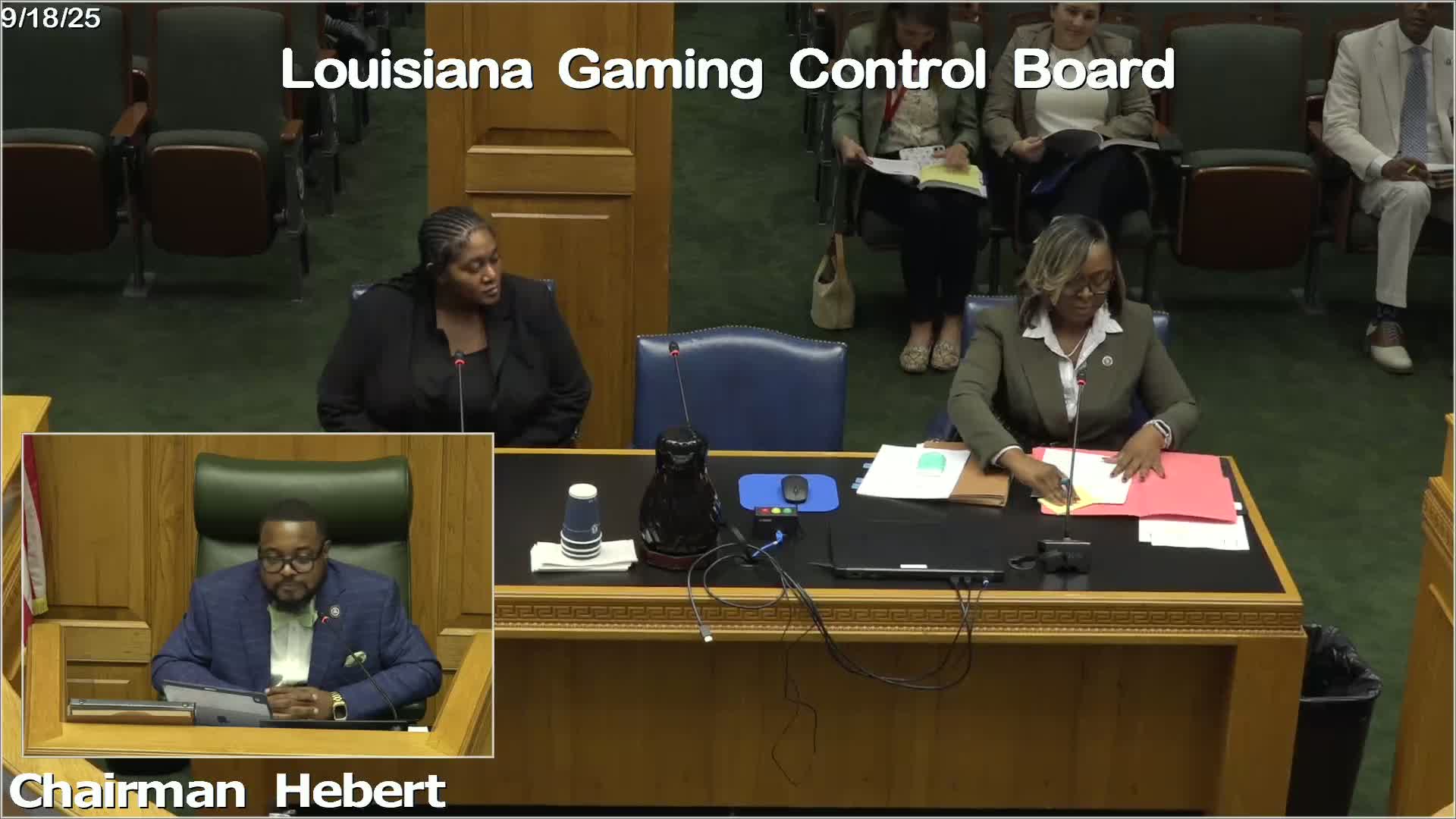
BATON ROUGE, La. — The Louisiana Gaming Control Board on Sept. 18 affirmed a hearing officer’s decision revoking the non‑key gaming employee permit of Tiffany Jackson (case P040065896), concluding the administrative record supported unsuitability findings.
Assistant Attorney General Sharon McCoy, appearing for the division, summarized the hearing record and told the board the division’s position that the hearing officer correctly revoked Jackson’s permit. McCoy said the hearing record included testimony that the Kenner Police Department arrested and charged Jackson with eight counts of cruelty to a juvenile and a separate simple battery allegation. “Cruelty to a juvenile is a felony punishable by up to 10 years in prison,” McCoy said, and she argued that the pending charges met the statutory criteria disqualifying a person from holding a gaming permit under the suitability provisions the division cited.
McCoy described testimony from Detective Ishmael Cornejo, who inspected the residence that was the subject of the investigation and described conditions the division said were “deplorable,” including the absence of adequate furnishings and hygiene issues in children's sleeping areas. McCoy said the detective testified he observed scabbed markings on a juvenile’s back and that Jackson admitted striking a juvenile with a belt. The division argued those facts supported the hearing officer’s conclusion that Jackson was unsuitable and that the permittee had not met the burden to show suitability by clear and convincing evidence.
Ms. Jackson appeared and attempted to present a letter describing her circumstances and rehabilitation efforts; the chair reminded parties that the board was operating in its appellate capacity and could not accept new evidence at the meeting. After discussion, Mr. Jackson moved and Mr. Poole seconded a motion to affirm the hearing officer’s decision. The roll call recorded unanimous affirmative votes and the board affirmed the revocation.
Ending: The board affirmed the hearing officer's revocation; no new evidence was accepted at the board hearing and the decision was based on the administrative record.