Get Full Government Meeting Transcripts, Videos, & Alerts Forever!
Get email alerts on the Rulemaking W2g topic
No spam. Unsubscribe anytime.
Gaming board institutes rulemaking to tie jackpot controls to federal W‑2G reporting threshold
Summary
The Louisiana Gaming Control Board voted to begin rulemaking to update internal control and penalty rules so jackpot reporting and internal witness requirements track the federal W‑2G filing threshold.
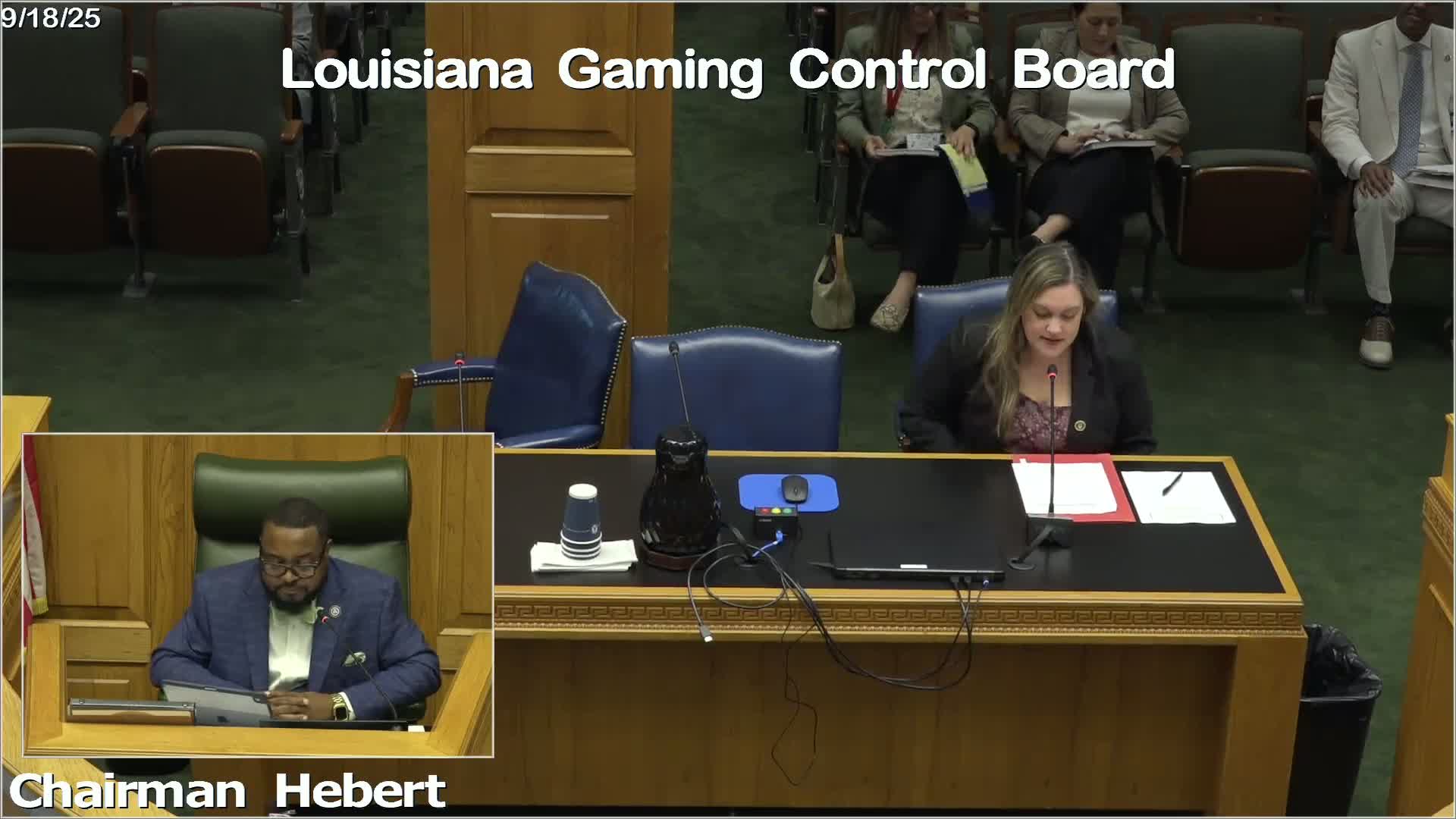
BATON ROUGE, La. — The Louisiana Gaming Control Board on Sept. 18 voted to institute rulemaking to amend two Louisiana Administrative Code provisions so jackpot payout rules automatically align with federal reporting thresholds.
Assistant Attorney General Catherine Gitts told the board the proposed amendments would change references to the fixed $1,200 threshold in the code and replace it with the amount that triggers the filing of a federal Form W‑2G. “The proposed change would amend the violation description to include jackpot payout slips greater than the amount required to file a W‑2G,” Gitts said, and she explained the base penalty and prescriptive period would remain unchanged.
Gitts also said revisions to internal controls for slots would require verification and witness procedures to apply where federal reporting is required: permanent gaming employees from an independent department must witness payouts that meet the W‑2G filing threshold, and the slot attendant must collect the information necessary to prepare a Form W‑2G when required.
Gitts said the changes are necessary to comply with a “newly enacted federal law” cited in the staff presentation and that the proposed language is structured to automatically incorporate any future federal inflation adjustments so the board would not need to act again to maintain compliance.
Judge Scholes moved to institute rulemaking procedures; Ms. Becknell seconded the motion. There was no recorded opposition and the board carried the motion to open the rulemaking process.
Ending: The vote authorized staff to begin formal rulemaking procedures; final rule adoption would require later board action after public notice and comment.