Get Full Government Meeting Transcripts, Videos, & Alerts Forever!
Get email alerts on the Public Comment Flag Lowering topic
No spam. Unsubscribe anytime.
Public speakers and county recorder rebuke board chair’s decision not to lower flag after campus shooting
Summary
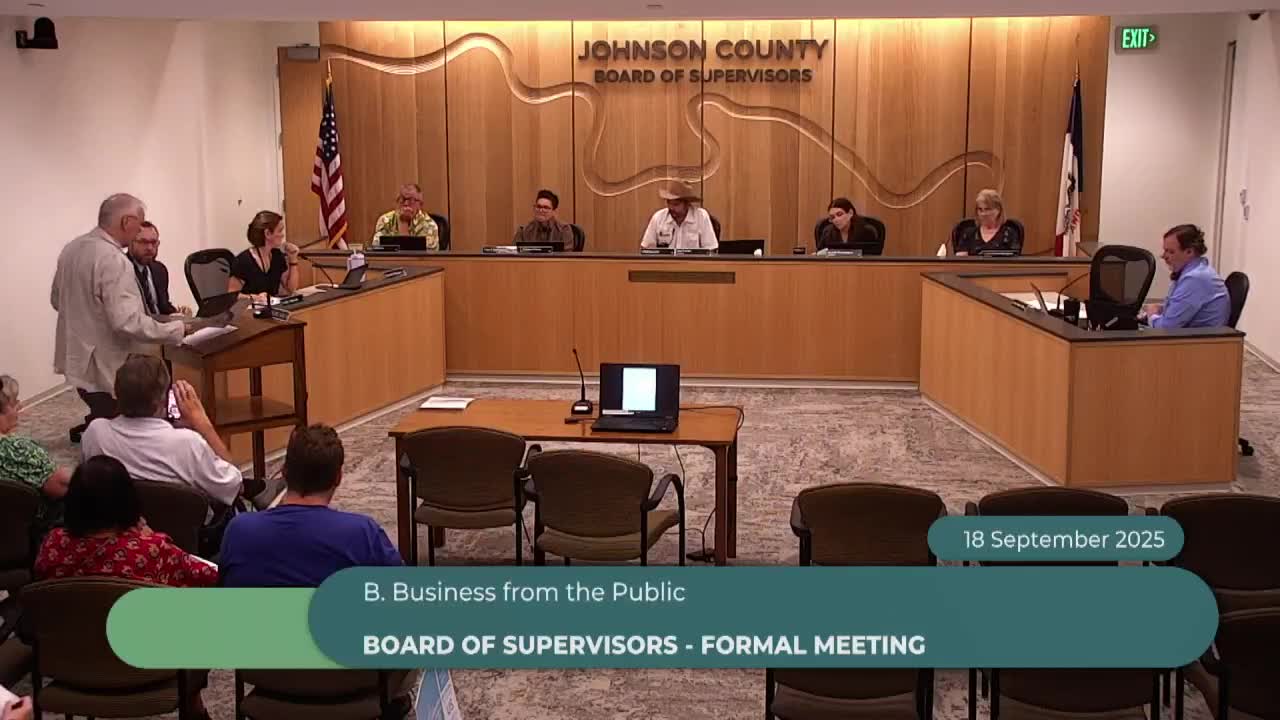
Public comment at the Sept. 18 meeting of the Johnson County Board of Supervisors drew sustained criticism of the chair’s decision not to lower the county flag after a campus shooting that killed a conservative commentator; speakers urged removal of posts and apologies and debated the balance between free speech and responses to political violence.
Public comment at the Sept. 18 meeting of the Johnson County Board of Supervisors drew sustained criticism of the chair’s decision not to lower the county flag after a campus shooting that killed a conservative commentator; speakers urged removal of posts and apologies and debated the balance between free speech and responses to political violence.
Why it matters: The episode prompted vocal public reaction and a lengthened supervisor discussion, including concerns about staff safety and the county’s public posture, though the board took no formal action on flag protocol at the meeting.
Donald Macfarlane, a resident of Iowa City, spoke during the public-comment period and said, “This board, this county actively and insultingly obstructive this move. He is dead because an individual acted on the expressed wishes of a few inflammatory people.” William Keedle, identifying himself as a past chairman of the Johnson County Republican Central Committee, told the board, “This is an attempt to introduce the morals of the Ku Klux Klan into Johnson County politics, we won't stand for it.”
Kim Thater, Johnson County recorder, said she feared constitutional protections were being eroded and warned about efforts to punish speech, saying, “The constitution is all we have.” Several speakers pressed the board to remove or take down posts and to issue apologies; others said the county should avoid becoming a site of violence or intimidation.
Board members addressed the public comments later during supervisor reports. Several supervisors said the public comment process demonstrates that people with differing views can speak at the meeting; other supervisors described personal safety concerns and explained that they had requested removal of their home addresses from the county website because of threats and heightened risks following recent events.
Discussion vs. decision: The topic appeared in public comment and supervisor reports but produced no formal motion or policy change about flag-lowering at this meeting. The board did not vote on flag protocol or discipline during the session.
Background and next steps: Speakers referenced a governor’s proclamation urging flags to be lowered; some said the chair declined to follow that guidance. The board later moved through its regular agenda items (zoning, contracts, proclamations) and scheduled a closed session for collective bargaining later in the meeting. At this meeting there was no recorded vote or directive implementing a county-wide flag protocol change.
Ending: The controversy remained a matter of public comment and supervisor rhetoric at the Sept. 18 meeting; the transcript records calls for additional scrutiny and possible legislative fixes, but no formal county action was taken during the session.