Get Full Government Meeting Transcripts, Videos, & Alerts Forever!
Get email alerts on the Infrastructure Water topic
No spam. Unsubscribe anytime.
Cross Plains plan commission reviews three options for Marshstone water service; no decision taken
Summary
Village staff presented three technical options to serve the Marshstone development — an extensive multi‑zone system, a zone‑skip approach with fewer boosters, and a lower‑cost elevated tank option — with rough cost estimates ranging from about $4 million to $13.5 million. The plan commission provided input but took no formal action.
Village staff briefed the Plan Commission on Sept. 2 about options to extend municipal water service to the Marshstone area, laying out technical tradeoffs, rough capital estimates and aesthetic and maintenance considerations. Staff emphasized there was no action to be taken at the meeting; the presentation was informational to guide future decisions by the village board.
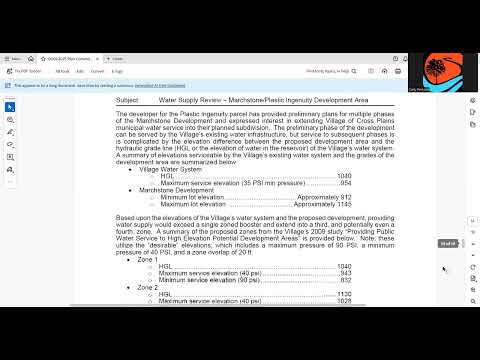
A staff presenter (identified in the record as Brian) described three broad approaches: a full multi‑zone system with several booster stations and reservoirs, a zone‑skip approach with fewer pumps and a ground reservoir near the top of the hill, and a solution that uses an elevated water tank (a sphere or "ball on a stick") at higher elevation to provide pressure with less reliance on pumps. "In a very, very rough, about 13 and a half million dollars," Brian said of the most comprehensive option. He also noted that one of the lower‑cost configurations showed a cost of about "$4,000,000" for a Marshstone booster in the presentation.
Technical clarifications given to the commission included the maximum elevation the current system can serve (presented as 954—units implied in meeting context as feet), while the higher parts of the proposed development reach elevations that staff described as close to 1,145. Staff said phase 1 of the development falls within the existing service area; later phases would reach elevations beyond the current system's reliable pressure range and therefore require new infrastructure.
Staff discussed operational tradeoffs: elevated tanks rely on gravity and provide pressure during power outages, while ground reservoirs require pumps and generators; booster stations require significant capital and ongoing operations and maintenance (O&M) costs; and elevated tanks typically require periodic painting and upkeep. Staff suggested elevated tanks are often preferable for long‑term O&M despite the visual/aesthetic impacts. Staff also said an elevated tank is typically 60 to 80 feet above ground depending on siting.
Commissioners and staff asked clarifying questions about how each option would affect northeastern areas of the village, how future wells would integrate with new storage, and how the options would change O&M responsibilities. Several commissioners raised concerns about cost, visibility from Highway 14 and other vantage points, and whether the village could recover costs through new development. One commissioner summarized the meeting's purpose as informational: "No action tonight," and staff confirmed the ultimate choice would be a board decision.
The plan commission did not vote on any water system option during the meeting. Staff said the commission's input would be shared with the village board, which will consider cost, timing and aesthetics as it determines a preferred approach for serving Marshstone and potential future development.